
After the Landing: Arrest of a Man Living in Spain for Aggravated Human Trafficking – A Reality Check
After the Landing: Arrest of a Man Living in Spain for Aggravated Human Trafficking – A Reality Check
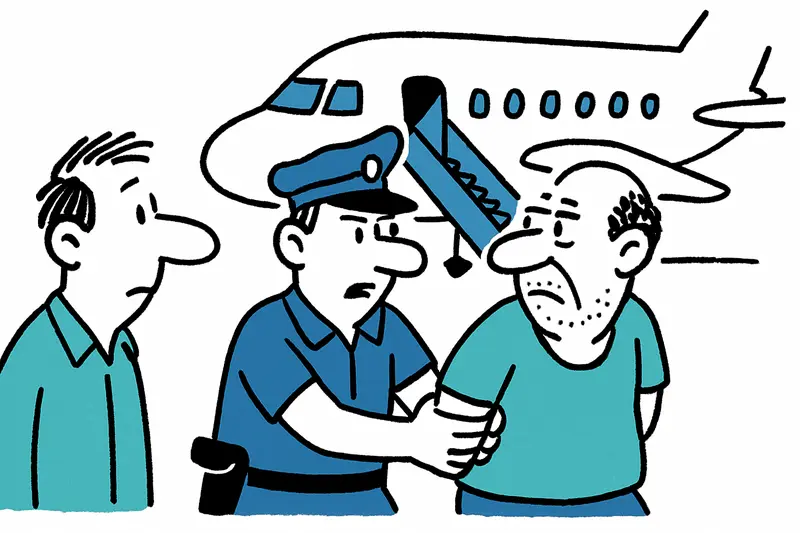
A 62-year-old man living in Barcelona was arrested at Stuttgart Airport. He is the subject of an arrest warrant for aggravated human trafficking. What does the case tell us about cross-border investigations, PNR data and the situation of victims?
After the Landing: Arrest of a Man Living in Spain for Aggravated Human Trafficking – A Reality Check
Key question: How reliable and complete is cross-border law enforcement when a person wanted for aggravated human trafficking flies from Barcelona to Germany and only comes into the authorities' focus at the destination airport?
At Stuttgart Airport the Federal Police acted when a 62-year-old man from Barcelona stepped off the plane. There was an arrest warrant issued by the Mannheim public prosecutor's office on suspicion of aggravated human trafficking; according to the statement the remaining custodial sentence amounts to 1,009 days. On the same day the man was transferred to the Stuttgart-Stammheim correctional facility, and similar cases were reported in From the Beach to Handcuffs: Mallorca Holiday Ends with Arrest at Düsseldorf Airport.
The facts can be summarized briefly: arrest after landing, residence in Barcelona, earlier deportation in 2007 to Nigeria and later naturalization in Spain. Sources also confirm that PNR data (passenger data) that airlines must report enabled the match. This is the same technique that has allowed terrorism and law-enforcement checks on international flights since 2017.
Critical analysis: At first glance, information exchange appears to work here—the hit came in time. But questions remain. Why was the man apparently free in Spain for years and able to naturalize despite a past that led to deportation? How transparent are prosecutors' review procedures when, after serious allegations, visible measures are not taken for a long time? And: how well are victims actually protected when cases run across borders?
What is missing from the public discourse: concrete information about the circumstances of the alleged crimes is still lacking. It is unclear what exact role the arrested person is alleged to have played, whether individual victims have been identified, and whether actions took place in the European context. Such details are often sensitive in criminal proceedings—but their absence makes a factual debate about prevention and victim protection difficult. It is also rarely discussed how naturalization procedures and possible identity changes interlock with search data, or where authorities may be working past one another.
An everyday scene from Mallorca: early afternoon in Palma, on the Passeig del Born, taxi drivers sit in front of the café exchanging messages. When an arrest like this makes headlines, the topic becomes conversation number one: as seen in Handcuffed Straight from Palma: Cross‑Border Manhunts, Mistakes and Mallorca's Image, 'How could he live here?' asks a woman with a shopping bag, while in the distance a bus departs for the airport. The question is not far from reality: many Mallorcans work in airport operations, experience border crossings daily and know that data systems secure a lot but do not resolve everything.
Concrete solutions: 1) Better coordination between law-enforcement authorities across Europe. A standardized procedure for passing on alerts from PNR checks to the affected public prosecutors could reduce delays, as argued in Operation 'Chanquete' in Palma: A Clampdown on Trafficking — and What's Still Missing. 2) Transparency rules: public prosecutors should, without endangering ongoing proceedings, regularly inform about case progress so that the public and media do not only speculate about gaps. 3) Strengthen victim protection: national victim hotlines and cross-border contact points must act faster and more visibly, including concrete support services for potential victims. 4) Review naturalization procedures: authorities should more systematically weigh how past deportations and criminal allegations are factored into decisions, without resorting to automatic stigmatization. 5) Advance airline compliance: carriers need clear reporting processes and contacts so that PNR hits are processed promptly and in compliance with data protection.
An important point: data systems like PNR visibly help with arrests. They are, however, not a cure-all. They generate hits that then require human decisions: prioritization, follow-up investigations, international requests. If these steps stall, a search hit remains a mere dataset.
In conclusion: the arrest at Stuttgart Airport shows that the system functions—at least up to the reporting of a hit. The greater challenge lies beyond the data: in the interplay of authorities, in protecting victims and in the question of how democratic states deal with people who were once deported and later acquired citizenship. Someone sitting in Palma at the harbor hearing the aircraft noise knows: flying connects places, but it also connects problems. Better-networked, more transparent and victim-oriented procedures would not only strengthen law-enforcement goals but also trust in public institutions—and that is no small matter on an island that depends heavily on cross-border traffic.
What matters now
Observe, ask questions, keep pressure on authorities and at the same time offer victims options for support. Only in this way will individual arrests become sustainably effective steps against organized human traffickers.
Frequently asked questions
How do airport passenger data checks lead to arrests in Mallorca-related travel cases?
Can someone living in Spain still be arrested in another country for an old warrant?
Why are cross-border arrest cases in Mallorca so often discussed in public?
What is PNR data and why does it matter for flights from Mallorca?
What happens after someone is arrested at a German airport while travelling from Spain?
How can someone be naturalized in Spain after a deportation?
Are victims protected well enough in cross-border trafficking cases involving Mallorca and Germany?
What do Mallorca residents usually take from airport arrest headlines like this one?
Similar News
Ancient Piece Brought to Light: Guardia Civil Recovers Roman Anchor Fragment off North Coast of Mallorca
Divers from the Guardia Civil recovered a massive iron piece from Roman times off Mallorca's north coast. The roughly 35...

Who Benefits from the Half‑Hourly Flight on the Edge? Aena, Investments and the Island's Interests
Almost one billion euros is flowing into Son Sant Joan. The figures show the scale of investment and expected beneficiar...
Are the Balearic Islands the Southern Border of Europe? A Reality Check on Immigration
The Balearic Islands are again calling for EU aid after a sharp rise in arrivals by sea. Conflicting priorities between ...

"Expensive chaos" and many open questions: What clients can do when a lawyer suddenly stops responding
Several clients complain that a well-known German lawyer in Mallorca has been unreachable for months. Key question: What...

TV tip: 'The Last Problem' — Mallorca as the setting of a classic crime
A classic whodunit on Mallorca: A new miniseries set in spring 1959 brings storm, an isolated hotel and a dense web of s...
More to explore
Discover more interesting content

Can Cap de Bou

Townhouse Lleo 72
