
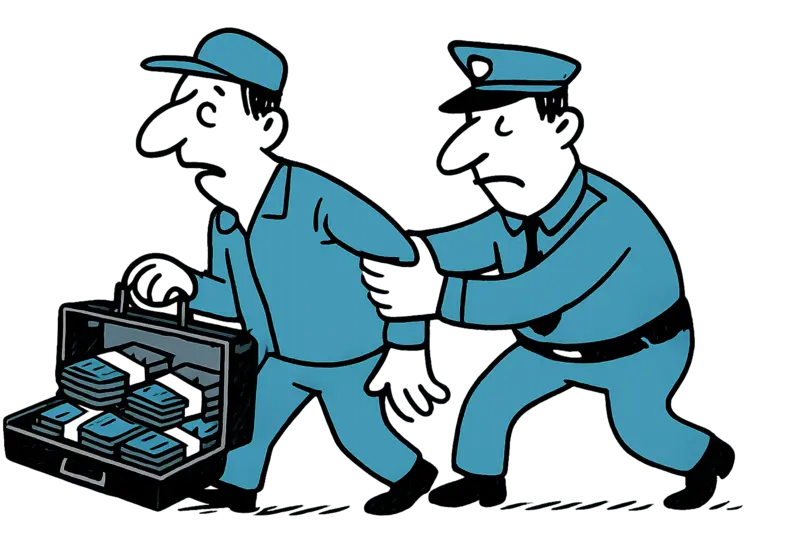
Arrest in Palma: ATM technician with nearly €150,000 in his toolbox
Arrest in Palma: ATM technician with nearly €150,000 in his toolbox
After tips from a bank, the National Police in Mallorca arrested a technician. Investigators found almost €146,000 in a toolbox. Our reality check asks: How could this happen for months — and what needs to change?
Arrest in Palma: ATM technician with nearly €150,000 in his toolbox
Key question: How could one person withdraw cash from machines for months without being noticed earlier?
In the early morning, when the streets of Palma between Passeig Mallorca and the Plaça Major are filled with the rattle of scooters and the clink of shopping bags, a report like this stands out: A technician responsible for the maintenance of ATMs was arrested by the National Police, a force that has recently carried out other detentions in Palma such as National Police Arrest Suspected Hotel Thief in Palma – A Safety Check for Travelers. The bank itself had noticed irregularities and filed a report. Investigators found almost €146,000 in his toolbox, apparently diverted over a period from May 2025 to September 2026.
The facts are sparse but solid: A bank in Palma repeatedly recorded negative cash balances at several machines. Internal investigations led to a service provider whose employee had worked on the affected ATMs on exactly those days. Security footage provided further evidence; the police then moved in.
This case is explosive because it brings together three weaknesses: cash remains central to everyday life despite digitalization, maintenance and cash logistics are often outsourced to third parties, and in practice a single employee can have extensive access rights. The result: a security risk that went undetected for months.
Critical analysis
First: the outsourcing effect. Companies that service ATMs operate on a high degree of trust — and often with little direct control from the contracting bank, as highlighted by Arrests at Palma Airport: Two employees detained after alleged thefts. Contracts regulate procedures but rarely the daily control mechanisms in detail.
Second: reconciliation intervals. If cash balances are only checked weekly or monthly, time windows arise that can be exploited. The timespan mentioned here of more than a year suggests that deviations were either not resolved with sufficient granularity or individual shortages were interpreted as user or handling errors.
Third: single-person access. Service calls where one employee alone has access to cassettes, safes or accounting documents are risky. The combination of physical access and a lack of secondary checks is a classic opportunity for abuse.
What is missing from the public debate
The debate usually focuses on perpetrators and detection. Too rarely does it address systems: contract design with service providers, insurance clauses, the quality of internal audits, and the role of supervisory authorities. Also neglected is the perspective of small branches and rural ATMs, where close monitoring is more expensive; small-scale incidents like 480 Euros Missing at the Petrol Station: How a Find Turned Into a Criminal Complaint illustrate the consequences for local businesses.
And then there is the question of transparency toward customers: How quickly and clearly are affected parties — such as shop owners or customers who made withdrawals — informed about shortages? Clear communication is often lacking here.
Everyday scene from Palma
Imagine: On Avinguda Jaume III an elderly woman waits at an ATM, takes her cash, puts it in her handbag and walks on. She notices nothing unusual; for her cash is familiarity. For the shop owner around the corner, an empty cash box on Monday morning can be nerve-wracking — and have financial consequences.
Concrete solutions
1) Faster and finer-grained checks: daily telemetry reports of ATM cash levels to a central unit instead of only spot checks. Anomaly alerts should be automated and sent to an internal security team.
2) Two-person rule: critical interventions at ATMs only allowed with two authorized persons or via remote authorization and video documentation.
3) Tamper-evident mechanisms: seals with serial numbers, digital timestamps on cassettes and clear logbooks that can be checked at any time.
4) Better selection and oversight of service providers: background checks, regular rotation of personnel assigned to sensitive ATMs and mandatory audits by independent inspectors.
5) Contractual and insurance adjustments: clear liability rules, shorter reporting deadlines for discrepancies and mandatory reinsurance for cash losses.
6) Promotion of cashless alternatives where feasible, without excluding vulnerable groups.
Conclusion
The case in Palma is not an isolated anecdote but a warning: when technology, cash and human responsibility come together in a small space, great harm can occur — silently, over months. For Mallorca this means concretely: banks and service providers must rethink their control chains, municipalities and consumers should demand more transparency, and the daily work on ATMs must be organized so that individual employees do not become the weak link. Otherwise, between hitchhikers, scooter noise and market chatter, trust in a system we all use daily will be eroded.
Frequently asked questions
What is the best time to visit Mallorca for good weather and fewer crowds?
Should I rent a car in Mallorca or rely on public transport?
What should I pack for a Mallorca trip?
Are there family-friendly beaches and activities in Mallorca?
What are the must-see sights in Palma de Mallorca?
Is the train from Palma to Sóller a good option for exploring western Mallorca?
Is Cap de Formentor worth a visit for the views?
What makes Alcúdia Beach a good choice for families?
Similar News

Iris Katzenberger: New Love on Mallorca — 28-Year Age Difference and Good Cheer
Iris, 59, appears to be in love again on Mallorca. Her new partner is said to be 31 years old. A small romantic chapter ...
When Buyers Are Missing: Why Foreign Property Purchases in the Balearic Islands Are Shrinking
Despite rising prices per square meter, more and more foreign buyers are withdrawing from Mallorca and the neighboring i...

Kruemel keeps going: From closing to winter opening in Peguera
Peguera's scene experiences a double event: Krümel's traditional closing coincides with the hostess's birthday, and a fe...
Malaysia Instead of Mallorca: How a Package Traveled the World and Still Ended Up in Palma
A small package from Lower Saxony was mistakenly sent to Malaysia — and surfaced weeks later on the desk of the newsroom...

When Pensions and Rent No Longer Fit: Why More Seniors in Mallorca Are Moving into Shared Housing
The gap between average pensions and housing costs in the Balearic Islands is pushing older people into communal living ...
More to explore
Discover more interesting content

Can Cap de Bou

Townhouse Lleo 72
