
Back to School in the Balearic Islands: Around €850 per Primary School Child — What Families Can Do Now
Parents in the Balearic Islands face a hefty bill: around €850 per primary school child. Where the money goes, which gaps are barely noticed, and which local solutions can help.
Back to school is getting more expensive: Families in the Balearic Islands feel the extra costs
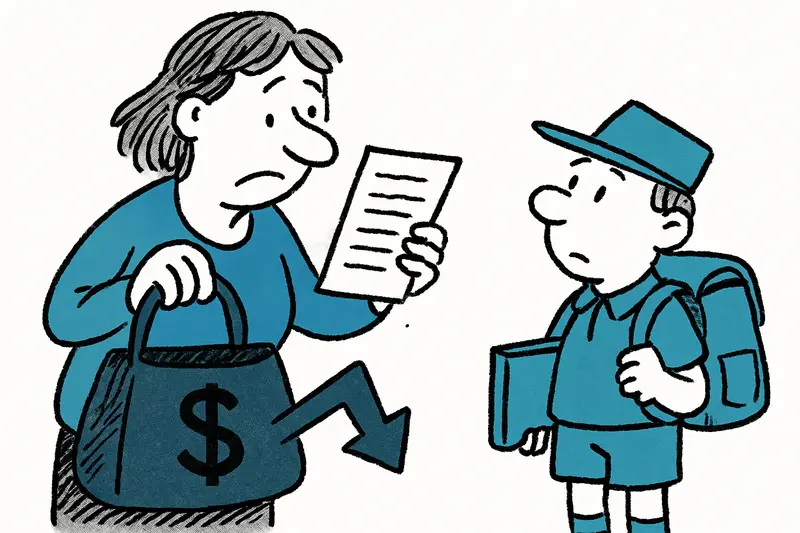
In the early morning the mopeds rattle along Avinguda Jaime III, from the stationery shops comes the rustle of paper and the quiet tapping on phones: WhatsApp lists, the favourite brand, the right line of exercise books. A consumer organisation has calculated: those sending a primary school child to Mallorca should expect to pay around €850 this year, according to Back to School in the Balearic Islands: Families Suddenly Face a €850 Bill. An amount that hurts not only on paper but visibly disrupts many household budgets.
The figure does not stand alone: compared to last year expenses have risen by about five percent, and on the Balearic Islands the costs for the start of school are roughly ten to fifteen percent above the Spanish average, as reported in Inicio de curso en las Baleares: familias afrontan de repente una factura de 850 euros. You can see it in the queues in front of the Mercat de l’Olivar when parents rummage between used exercise books and half‑intact pencil cases, and in the swapping of trainers in neighbourhood chats.
Where the money disappears to
Books and workbooks are the largest item. Closely followed by notebooks, pens and special materials for art or workshop classes. Many schools add extra costs: shared materials, excursions, and also school uniforms — at semi-private or private institutions quickly €50 to €100 per item. Digital costs are often underestimated: apps, platform fees or the recommendation to buy a tablet further add to the bill, especially when several children are affected.
Behind these numbers lie everyday worries: parents who compare the shopping list with their bank balance in the morning; teachers who rely on sandwiches from parents because excursions can no longer be paid for; children who arrive at school with borrowed gym bags. The sounds at the school gates — rattling satchels, a few indignant voices, the ringing of the school bell — tell of the compromises many families make.
Aspects that are rarely discussed
The fact that the average number is rising is only part of the problem. Less visible are the consequences: digital divide when households cannot buy a tablet; social exclusion when only some children wear new uniforms; or time burdens because parents spend hours searching second‑hand or taking part in swap markets. Schools with a higher share of children from low‑income households often have more organisational effort because teachers and parent associations need to coordinate aid.
Another problem is the distribution of costs. Some items fall due at the beginning of the school year (books, uniforms), others are spread across the year (excursions, materials). For households with tight budgets this means they need liquidity immediately — a burden that simple year‑to‑year comparisons do not capture.
Concrete opportunities and local solutions
The island community is reacting creatively. In Palma there are already established swap circles in front of the Mercat de l’Olivar, schools organise bulk orders instead of individual purchases, and parent associations coordinate second‑hand flea markets, as detailed in Inicio del curso en las Baleares: los padres calculan alrededor de 850 € por niño. Such measures help, but they do not reach everywhere.
Concrete approaches that would have more impact:
1. Municipal collective budgets: Municipalities could act in advance and centrally organise bulk orders for books and digital licences — cheaper through volume discounts and without long waiting times.
2. Early payment plans: Flexible payment options for larger items (uniforms, tablets) would relieve families rather than requiring everything at the start.
3. Expanded second‑hand support: School authorities could promote official exchanges, with storage rooms or voucher systems for those in need, to professionalise the informal swap market.
4. Transparency on digital requirements: Clear guidelines on which digital devices are truly necessary, instead of mediation through “recommended” models — this could stop the buying spiral.
5. Tax and subsidy solutions: Short‑term subsidies or tax relief for families with multiple school‑age children would reduce the burden.
What parents can do in practice
Some simple steps help immediately: plan early, compare prices, encourage bulk orders at school and keep an eye out for organised swap markets. A look into the neighbourhood chats is worth it — packages with already prepared exercise books are often offered more cheaply. And if possible: invest in sturdy shoes right away instead of buying several cheap pairs in a row.
The return to the school routine is for many families a mix of anticipation and arithmetic. The challenge is not only higher prices, but the way costs are distributed and hidden. What Mallorca needs now are fewer one‑off actions and more reliable, structured support — from schools, municipalities and island society. Otherwise the start of school will remain a backpack that is too heavy for some families.
Frequently asked questions
How much does it cost to send a primary school child back to school in Mallorca?
Why is back-to-school shopping more expensive in Mallorca this year?
What school expenses do Mallorcan parents often forget to budget for?
What can families in Mallorca do to save money on school supplies?
Are there second-hand school book swaps in Palma?
Where do parents in Mallorca look for cheaper school books and uniforms?
How can Mallorca schools help families with back-to-school costs?
Do school costs in Mallorca affect families with several children more strongly?
Similar News

Release after bloody attack in Palma: Why the court's decision raises questions
An 18-year-old who allegedly inflicted a serious neck injury on a man at Plaza Gomila using a wristwatch wrapped around ...
Kidnappings in Inca: Three young men forced into car trunks and abused in the forest – a reality check
In Inca, three 18-year-old men were forced into car trunks by masked assailants at the Plaça des Bestiar, taken to a for...
Spreading Massification: The Brake That Still Has Much Work to Do
Marga Prohens announces limits on volume tourism. The measures sound harsh — but are they enough to save everyday life, ...
Through the Keyhole onto the Party Yacht: How Daniela Katzenberger Is Planning Her 40th on Mallorca
Daniela Katzenberger turns 40 and wants to celebrate it on the island — likely with a boat, cake and her mother. A relax...
By Boat Instead of the Road: Palma's Water Bus — a Reality Check
The 'Bus Nàutic' launches in two stages — but questions remain over interim operations, fares and environmental requirem...
More to explore
Discover more interesting content

Can Cap de Bou

Townhouse Lleo 72
