
Invisible Barriers at Palma Airport: Making Flying Less Stressful for Autistic People, Those with ADHD and Passengers with Anxiety
Invisible Barriers at Palma Airport: Making Flying Less Stressful for Autistic People, Those with ADHD and Passengers with Anxiety
Son Sant Joan does not yet offer dedicated sensory rooms. Psychological tips help, but what is missing are clear procedures, better signage and infrastructural changes.
Invisible Barriers at Palma Airport: Making Flying Less Stressful for Autistic People, Those with ADHD and Passengers with Anxiety
Guiding question: What needs to change at Son Sant Joan so that people with invisible disabilities can fly calmly?
Early in the morning, when buses from Palma arrive at the airport and the smell of coffee drifts from the terminals, you encounter the full range of travelers: parents with strollers, older people with rolling suitcases, and also people who fidget silently with their fingers and clearly feel uncomfortable. For many, the check-in process is routine; for others, the sequence of announcements, jet bridges and queues can be overwhelming.
Fact: Son Sant Joan currently has no specially equipped sensory rooms for autistic passengers — unlike some other airports in Spain. At the same time, internationally recognized aids exist, such as the sunflower symbol that allows affected people to discreetly indicate a need for extra support. In Spain, it is recommended to register assistance with AENA at least 48 hours before the flight. And: EU Regulation CE1107/2006 stipulates that people with disabilities are entitled to free assistance with ground handling.
Critical analysis: Many protections exist on paper but are too rarely effective in practice. Problems range from the lack of visibility of services and communication and coordination failures to staff who do not always recognize when nonverbal signals mean help is needed. Good examples — such as quieter announcements at some gates — show that change is possible. But these approaches remain sporadic and do not reach all areas of the terminal.
What is missing from the public discourse: There is much talk about boarding and wheelchair assistance, but hardly any about invisible impairments. The debate focuses on wheelchairs and ramps, seldom on acoustic relief, sensory retreat spaces, or information provided in plain language and with images. Also little considered: the role of airlines in seat allocation for families with autistic relatives, or how to teach gate and security staff practical behaviour on the job.
Everyday scene from Mallorca
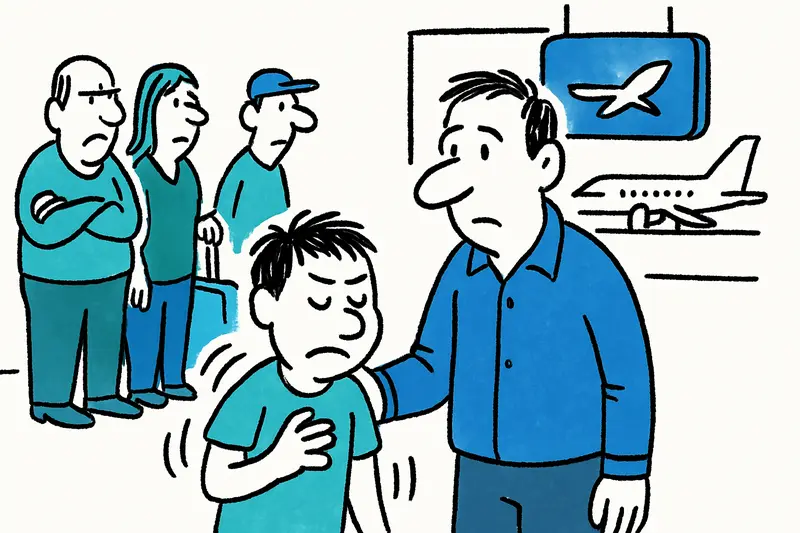
Imagine: a father and his son are at Gate 12. The boy begins to rock, the loudspeakers make a safety announcement, a queue in front of security grows — people around him become impatient. No one notices the sunflower symbol on his jacket because there are no information boards and no staff responding to it. A small measure — a quiet corner at the gate with clear signage — could have eased the situation.
Concrete solutions
- Create sensory rooms: A small, quiet room near the terminal with reduced lighting and sound insulation as a retreat for people with sensory overload.
- Increase visibility: Information signs about support services, notices about the sunflower symbol at entrances, digital prompts during booking and check-in processes.
- Simplify registration: AENA assistance registration must be clearly communicated and linked from airline websites; highlight the 48-hour deadline.
- Train staff: Short, practical trainings for check-in, security and boarding staff so they can recognize nonverbal signals and respond de-escalatingly.
- Gate management: Reserved, quieter areas at gates and the ability to move travelers at short notice; priority processing when needed.
- Seat recommendations: Automatic prompts in booking systems (e.g., “quiet seats near the aircraft centre by the wings”) and assurances that families will be seated together when requested in time.
- Preparation materials: Visual step-by-step guides, short videos or photo stories showing the route through Son Sant Joan and available online; local advisory centres and travel agencies should distribute these materials.
- Acoustic relief: Reduce loud, routine announcements in certain areas; use displays and targeted announcements only when necessary.
Many of these measures cost little but require a clear mandate from the airport operator, airlines and authorities. Technically complex renovations are less urgent than better processes and visible information.
Conclusion
The guiding question remains relevant: Who will ensure that Son Sant Joan is not only ramp- and wheelchair-accessible, but also works for people with invisible disabilities? Small infrastructural adjustments, better information and consistent training would already make a big difference. Mallorca is an island of hospitality — you can see it at the café tables along Passeig Mallorca. So why not create a friendly, quiet reception room at the airport that anyone can use? The decision lies with AENA, the airport management and the airlines — and with those who work here every day and know what travelers really need.
Read, researched, and newly interpreted for you: Source
Similar News
When the Tank Runs Low: What Mallorca Should Do About Fuel Risks for Air Traffic
Ryanair warns of possible fuel shortages if the conflict in the Persian Gulf continues. What does that mean for Mallorca...
Church as Sound Space: Choir, Lights and Benefit Evening in Palma
On April 15 the choir Mallorca a l'Octava will fill the small Sagrat Cor church in Palma's old town with choral music — ...
When DJ Meets Live Music: "DJ Plus" Bridges the Gap on Mallorca
A new musical offering combines DJ craft with live instruments — ideal for fincas, yachts and intimate dinners on the is...
Easter in Mallorca: Where you can still shop on public holidays
Not all stores close on Good Friday and other holidays. Here's a handy overview: which shopping centres, supermarkets an...

Strong Wind, Little Protection: The Kitesurf Accident in Port de Pollença and the Unanswered Questions
A 29-year-old German woman in Port de Pollença was lifted from the water by a gust of wind and thrown against a car. Why...
More to explore
Discover more interesting content

Experience Mallorca's Best Beaches and Coves with SUP and Snorkeling

Spanish Cooking Workshop in Mallorca
