
Batteries in the Countryside: Mallorca’s Energy Transition Needs Clear Limits
Battery storage can make solar power available long after the sun has set. But farmland is scarce in Mallorca. The debate should go beyond a simple yes or no.
Battery storage is no blank cheque to build on any plot
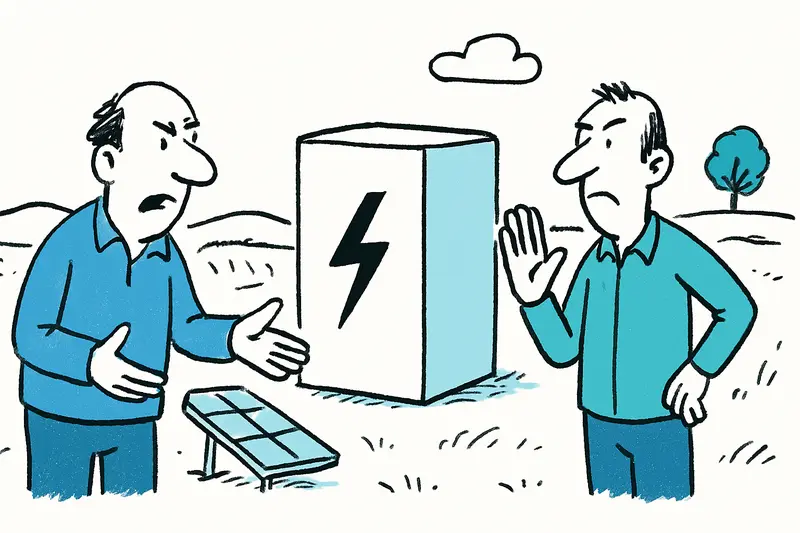
A battery park in a field may sound like a clean solution at first: solar power is stored during the day and released later. But a battery does not produce energy. It shifts electricity from one hour to another—and requires land, equipment, a grid connection and raw materials. So the key question for Mallorca is not simply whether such facilities can be built, but where, under what conditions and at whose expense.
The island needs to transform its energy supply. Solar power can play an important role, and storage can help make it available when the sun is not shining. That is a reasonable part of the equation. But a single battery park solves neither the need for power lines nor disputes over land. Anyone presenting it as an all-purpose answer is simply leaving the difficult parts of the energy transition in the shadows.
A field is more than an empty space on a map
Agricultural land in Mallorca is not interchangeable at will. It is used to grow crops, shapes villages and landscapes, and can provide an economic foundation for farming businesses. Permanently covering a plot with equipment is more than changing its use on a site plan. The quality of the soil, water availability and whether the land can be farmed effectively at all must be assessed locally—not once the bulldozers are already on their way.
At the same time, it would be too simplistic to reject every facility on farmland outright. There may be sites where agriculture and energy production can coexist to some extent. But “to some extent” is the crucial phrase. A plan that leaves enough room for crops, provides safe access and allows for realistic cultivation is very different from a fenced-off facility where agriculture exists only on paper. That needs to be verifiable.
The technical aspects also need to be considered. Batteries lose energy when charging and discharging. They require maintenance and a grid connection, and they must be handled properly at the end of their life cycle. Residents are also concerned about fire safety, access roads, noise from technical equipment and who is responsible if something goes wrong. These are not arguments against every battery. They are reasons to set clear conditions before a permit is granted.
What often gets overlooked in the debate
Public discussion quickly settles on two sweeping claims: either every available field must be used for the energy transition, or any project on agricultural land is fundamentally wrong. Both positions are convenient. What is missing is a clear-eyed assessment: Which rooftops, car parks, commercial sites or already degraded plots should be considered first? Which parts of the grid can accommodate additional electricity? How much storage is actually needed at a particular location? And who benefits if a project is built?
People also rarely ask whether reducing consumption could ease pressure on land. More efficient buildings, better management of electricity demand and more careful energy use may be less eye-catching than a new technical site. But they also need a place in the plan. Otherwise, the debate focuses on new facilities without addressing the scale of the problem they are meant to mitigate.
On the ground, the order of priorities matters
On a calm afternoon, anyone driving along a country road in the Pla sees fields, stone walls and scattered farmhouses. A battery storage facility there would not be an abstract figure in the energy mix. It would be a fenced site, perhaps with equipment containers and a new access road. For the people who work or live nearby, acceptance depends on practical questions: Does the facility fit into the landscape? Can the land still be farmed? Is clear information available before construction begins?
A sensible approach therefore starts with a clear order of priorities. First, suitable rooftops, car parks, commercial areas and already sealed or contaminated sites should be assessed. If agricultural land is considered at all, it needs an independent assessment of soil, water, nature and grid access. Permits should include measurable requirements—for example, regarding actual agricultural use, fire safety and drainage, as well as decommissioning obligations and financial guarantees for the end of the facility’s life.
Municipalities should be involved early—not just at a presentation after the key decisions have already been made. Maps, assessments and impacts should be published in an accessible format. A clear, tangible local benefit can also help, such as opportunities for community participation or a defined contribution to local infrastructure. This does not replace good site selection, but it makes clear who bears the consequences and who benefits.
Solar power and battery storage can make Mallorca less dependent on fossil fuels. But the energy transition will not be fair if a public goal is pitted against the interests of agriculture. The best compromise is not automatically the one that can be built fastest. First, select sites carefully; then allow storage where its benefits genuinely justify the impact—and reduce consumption at the same time. On the island, land is not an empty field. Planning should reflect that.
Frequently asked questions
What does a battery storage park do in Mallorca?
Can battery storage make Mallorca's solar power available after sunset?
Can farmland in Mallorca still be farmed if a battery park is built there?
What should be checked before a battery park is built in Mallorca?
Are fire safety and noise important issues for battery parks in Mallorca?
Where should Mallorca look before using agricultural land for battery storage?
How can Mallorca reduce the need for new energy sites?
How should local residents be involved in battery park planning in Mallorca?
Similar News
Serious Crash Between Santa Maria and Muro: What Matters on Mallorca’s Country Roads
Three 19-year-olds were injured when a car hit a wall, two of them seriously. The crash raises a bigger question: How sa...
Ses Païsses: What the Beetle Infestation Reveals About Oak Care in Mallorca
Holm oaks around the Talayotic site of Ses Païsses are infested with the Banyarriquer beetle. Tree felling and traps are...

Fitness with a DJ in Son Castelló: Does Music Really Improve Your Workout?
A fitness class with a DJ brings a club atmosphere to your workout. But in Palma, the beat isn’t everything: accessibili...

Gospel Evening in El Arenal Combines Music with Support for Older People
The Palma Gospel Singers will give a benefit concert at the Porciúncula Church on November 28. Proceeds will go to herzt...

Magaluf’s Quiet Wetland: Nature Needs More Than a Pretty Picture
A wetland beside a well-known holiday resort is an asset—but not proof of effective conservation. What matters is ongoin...
More to explore
Discover more interesting content

Can Cap de Bou

Townhouse Lleo 72
