
Between Runway and Keel: How Boatbuilding Lives in Son Bonet, Mallorca
Between Runway and Keel: How Boatbuilding Lives in Son Bonet, Mallorca
In the small Son Bonet airport, craftsmen preserve the island's boatbuilding tradition: restoration work, woodworking guided by the lunar calendar, and a 115-year-old fishing boat used as a teaching piece.
Between Runway and Keel: How Boatbuilding Lives in Son Bonet, Mallorca
In a hall beside propellers and helicopters beats the heart of a centuries-old craft tradition
Four kilometres northeast of Palma, where small aircraft still occasionally pierce the sky, stands a hangar called Mestres d'aixa. At first glance the workshop doesn't quite fit its surroundings: airplanes, concrete, a runway, and between them wood shavings, white paint and the smell of turpentine. It is precisely here that something is nurtured that is scarcely replaceable on Mallorca – the art of building and preserving boats.
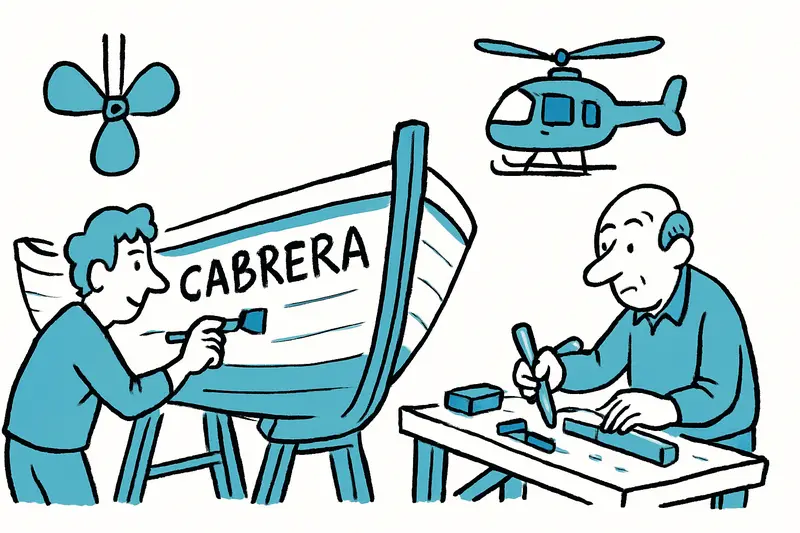
You can see young hands using a fine brush to paint the sheer of an approximately four-metre-long boat called 'Cabrera'. Álvaro García-Delgado, who is working on the boat, says he often spends weeks working only a few concentrated hours each day. Beside him are benches where caulking hammers are being made after old models – tools specifically adapted to the needs of the boatbuilders. Such details are not frills; they are part of passing on skill.
The island council is responsible for the project: the workshop was established in 2000 because the airport site offered space and affordable halls. Pep Florit, who runs the workshop, has been working there for more than two decades. He draws plans with a ruler, compass and pencil; you will look in vain for digital designs in his room. Small models display llauts, bots, gussis and xabeqs – hull shapes that have evolved over centuries and respond to wind and waves.
At the centre of the hangar stands a special piece: a 14-metre-long trawl-net fishing boat, about 115 years old. It has been classified as a cultural asset, and the island council has allocated around 80,000 euros for its restoration. The aim is not to send the boat back into commercial fishing, but to use it as a public teaching and exhibition piece: so that people, especially the young, can get to know the sea and the coast not only through images but by touching and seeing a real boat.
Wood plays a central role. In Son Bonet the craftsmen work according to experience, feeling and, yes, sometimes also according to the lunar calendar: depending on the phase, trees are felled because their behaviour during drying and working differs. Pine and holm oak are common choices; red pine is imported for special parts. Such decisions may seem small, but they are crucial for the lifespan of a hull.
Besides restoration, the workshop also builds new boats: a small, gondola-like boat called the 'Virot' is currently under construction and is intended for use in the S'Albufera nature reserve. This shows how closely traditional craft and modern conservation ideas can fit together, as in A man from Bremen, his boat and the new heartbeat: how a sailboat in Mallorca quietly went electric, where contemporary adaptations meet island practice.
What makes this workshop so valuable is not only the result, but the way the work is done. Tools are manufactured in-house. Knowledge is passed on through conversation. Young people drop by, hear the whir of the sanding machine, the distant rising whine of an incoming light aircraft and the cries of seagulls – and learn that with wood, patience and skill they can build bridges to the island's history.
Why is this good for Mallorca? Because a piece of identity is preserved here; this resonates with broader conversations such as Barcolana in Trieste: What Mallorca's Coasts Should Learn Now about coastline and harbour life. The workshop in Son Bonet keeps these archives open, makes craft visible and provides space for education: school classes, volunteers and the curious can see and touch old knowledge, and encounter boats at local gatherings such as Dijous Bo in Inca: Market, Music and the Return of the Boats.
A brief outlook seems appropriate: more cooperation with schools, hands-on days during restoration phases and small weekend tours would connect the workshop even more to the island's daily life. When the 'Cabrera' and the old trawler are eventually on public display, children may not only watch but also get hands-on – and carry the tradition forward.
In the end, it is a comforting thought: while planes take off and land over the island, a group of people in a hall near the runway are working to ensure that Mallorca's boatbuilding remains not just a relic but alive. It may sound almost poetic, but it is down-to-earth: wood, nails, paint — and a lot of effort.
Frequently asked questions
What makes the Son Bonet boatbuilding workshop in Mallorca special?
Can visitors learn about traditional Mallorcan boatbuilding at this workshop?
What is the significance of the 14‑metre trawl‑net fishing boat in the workshop?
What materials and techniques define Mallorca's traditional boatbuilding at Son Bonet?
Where is Mestres d'aixa located and what surrounds it?
How does the workshop connect traditional craft with conservation?
What role does knowledge transfer play in the Son Bonet workshop?
What can visitors do to experience Mallorca's boatbuilding scene in Son Bonet?
Similar News
Advertising poster relocates Palma to the mainland - what the mistake says about us
An advertising poster for flights from Andorra shows Palma on the Spanish mainland. Why such an error occurs, what is mi...
Who Protects Valldemossa's Charterhouse? A Construction Site That Leaves More Questions Than It Opens
Two new entrances in the Claustre de les Murteres have pitted the administration against the opposition. Who authorized ...
Debris by the Pool, Fear in the Streets: What to Do About the Squatted Hotel in s'Arenal?
For weeks people have been living in a vacant hotel on Rua Girona in s'Arenal. Trash, noise and insecurity plague reside...

Disguised Thieves on Palma's Shopping Street: Who Protects Shops and Shoppers?
For about eight months traders around Sant-Miquel have reported daily thefts, disguises and threats. Why do existing mea...

Long Weekend in Mallorca: Sun Returns, Sunday Nearly Summery
After several rainy days, Aemet brings relief: isolated showers on Friday, then milder, sunnier weather — Sunday up to n...
More to explore
Discover more interesting content

Can Cap de Bou

Townhouse Lleo 72
