
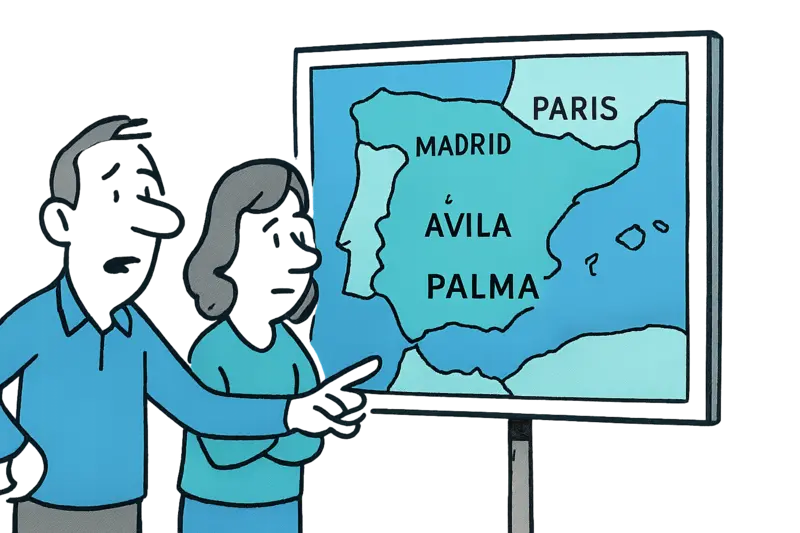
Advertising poster relocates Palma to the mainland - what the mistake says about us
Advertising poster relocates Palma to the mainland - what the mistake says about us
An advertising poster for flights from Andorra shows Palma on the Spanish mainland. Why such an error occurs, what is missing from the public debate, and how to avoid such gaffes.
Advertising poster relocates Palma to the mainland - what the mistake says about us
Key question: How can an advertising campaign miss geographical reality so badly - and who is responsible for correcting it?
The mistake, in brief
On a large-format poster promoting connections from the small Pyrenean airport Andorra–La Seu d'Urgell, the island capital Palma has been moved to a new address: right on the Spanish mainland near Ávila. The Balearic Islands are missing entirely. At the same time, French cities are placed correctly on the design. This is not a typo but a map error that, in its absurdity, draws attention - and raises questions.
Critical assessment
Maps are more than background images. They are visual promises to tourists: where am I, how do I get there, what is reachable? When a map simply omits Palma and the Balearics, it's no longer just an embarrassing designer slip-up, but an issue of care, quality control, and respect for the destination. An advertisement that claims "Andorra is getting closer to France and Europe" should at least signal geographically what "closer" means.
What is missing from the public debate
Usually these gaffes are laughed off or the campaign is dismissed as quirky, as seen in Posters, Provocation, Polarization: How Mallorca's Streets Become a Campaign Ground. But three questions remain unanswered: who approved the layout? Poster Dispute in the Balearic Islands: How Much Provocation Can Public Space Tolerate? Were external map resources used or a clip-art set applied without checking? And finally: what are the consequences for trust in tourist sources and destinations? Instead of pure amusement, we need a discussion about standards in cross-border advertising, agency review processes, and the inclusion of local experts.
A typical Mallorca street scene
Those who walk to work along Passeig Mallorca in the morning see bus shelters plastered with ads. Last Tuesday a café owner stopped, nodded and said dryly: "If it's going to be wrong, it might as well be funny." Children coming from school pointed at the poster and asked their parents whether Mallorca is now "on the mainland." Small observations like these show: for locals it's everyday life, for visitors it can cause confusion.
Concrete solutions
1. Before approval: a mandatory checklist for maps in advertising materials - scale, islands, names, national borders. 2. Local fact-checking: agencies should involve a local contact person to verify map content. 3. Use reliable sources: OpenStreetMap, national mapping agencies or professional map services instead of arbitrary stock graphics. 4. Transparent communication: when a campaign makes a mistake, a quick, visible note or correction on the same channel helps. 5. Training and process: creative teams need training on basic rules of geoinformation; approval processes must formally cover these points.
Why this matters to Mallorca more than a joke
Tourism is an economic factor for the island that rests on trust. A misplaced place name is not an economic disaster, but a symptom: if details don't matter, what other messages will be delivered sloppily? From accurate flight schedules to sustainable offers - reliability pays off; for example, New Signage at Palma Airport: Luggage Drop-Off Made Easier. For local businesses and authorities, it is also important how the island is visually represented; images shape expectations, as discussed in Palma or Palma de Mallorca? The Name Dispute and What It Really Means.
Conclusion
Such map blunders are avoidable and say more about processes in marketing projects than about the humor of some designers. A loud laugh on social media does not replace a proper review process. If advertising claims responsibility, the duty starts with small truths: accuracy on the map before making travel promises.
Frequently asked questions
Why did a Mallorca advertising poster relocate Palma to the mainland?
What does omitting the Balearic Islands on an ad map mean for tourist trust in Mallorca?
How can Mallorca advertisers prevent map errors in campaigns?
What are the implications for Palma businesses when a travel ad misplaces the city?
Is a map blunder in Mallorca ads just a joke or something more serious?
What steps should Mallorca agencies take after a map error becomes public?
How do locals along Passeig Mallorca react to seeing Palma placed on the mainland in ads?
What lessons should Mallorca draw from advertising map mistakes?
Similar News
Who Protects Valldemossa's Charterhouse? A Construction Site That Leaves More Questions Than It Opens
Two new entrances in the Claustre de les Murteres have pitted the administration against the opposition. Who authorized ...
Between Runway and Keel: How Boatbuilding Lives in Son Bonet, Mallorca
In the small Son Bonet airport, craftsmen preserve the island's boatbuilding tradition: restoration work, woodworking gu...
Debris by the Pool, Fear in the Streets: What to Do About the Squatted Hotel in s'Arenal?
For weeks people have been living in a vacant hotel on Rua Girona in s'Arenal. Trash, noise and insecurity plague reside...

Disguised Thieves on Palma's Shopping Street: Who Protects Shops and Shoppers?
For about eight months traders around Sant-Miquel have reported daily thefts, disguises and threats. Why do existing mea...

Long Weekend in Mallorca: Sun Returns, Sunday Nearly Summery
After several rainy days, Aemet brings relief: isolated showers on Friday, then milder, sunnier weather — Sunday up to n...
More to explore
Discover more interesting content

Can Cap de Bou

Townhouse Lleo 72
