
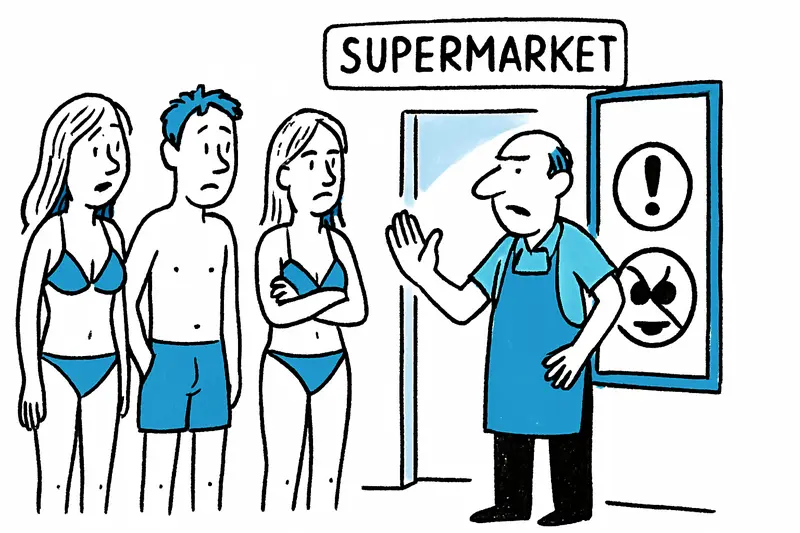
Bikinis at Mercadona: Who decides what is allowed in the supermarket?
Bikinis at Mercadona: Who decides what is allowed in the supermarket?
An incident in Cala Millor has reignited discussions about dress rules: a group of beachgoers were asked to leave a Mercadona. What do the rules say — and what is missing from the public debate?
Bikinis at Mercadona: Who decides what is allowed in the supermarket?
Key question: Can a shop refuse entry to customers because of swimwear — and how transparent is that for visitors?
In Cala Millor, where in the morning the garbage collection still competes with the clattering on hotel facades and in the afternoon beach towels are beaten dry on car roofs, a scene recently unfolded that no one on the beach expected: a group of young people in bikinis and swim trunks were asked to leave at the door of a supermarket. The heat still hung in the air, seagulls circled above the parking lot, and on the town centre's cobblestones the steps of tourists and locals mixed together. This everyday choreography sometimes echoes broader disputes such as Towel wars at hotel pools: When sunbeds become currency — what Mallorca can learn.
What many do not know: some store chains have clear rules of conduct for entering their branches. At some entrances there are signs prohibiting bare upper bodies or shopping solely in swimwear. Such rules are not an island phenomenon: since 2023 the city of Palma, for example, bans walking around without upper clothing away from the beach. Fines can — depending on the municipality — reach up to 750 euros. The decisive point, however, remains: there is no uniform island regulation; each municipality decides for itself how it handles standards of decency, as discussed in Sóller wants to regulate the beaches: rules, controversy and what's missing in the debate.
Critical point: the legal basis for private house rules and municipal public-order regulations diverges. A shop owner can set store rules to protect customer comfort or hygiene. Municipalities, in turn, issue ordinances for public order. The problem is that this must be comprehensible for people who come to Mallorca. High-profile incidents show how exposure cases can become legal matters, for example Sex at a Hotel Pool in Port d'Andratx: When Vacation Freedom Meets Public Exposure. In practice, clear, well-visible information — especially in several languages — is often missing before someone, after a day at the beach, is publicly confronted at the checkout.
What rarely appears in the public debate is the perspective of employees. Sales staff are caught between store policy, heated customers and the pressure to preserve a calm atmosphere. A short, friendly notice at the entrance is one thing; a public confrontation in front of other customers is another. In many places there are no binding behavioural guidelines for staff: when is a reminder sufficient? When should someone be asked to leave? And how can escalation be avoided?
Tourists are also rarely informed. Tour groups and families who go straight from the beach do not expect shopping bans in swimwear. Hotels generally do not provide notes about local rules at supermarkets or on the pedestrian zone, an issue also highlighted around holiday openings and closures such as Immaculate Conception on Mallorca: Shops closed, questions remain. The result is embarrassing situations, a sense of injustice and in some cases hot tempers despite the already heated air.
Concrete solutions are conceivable and practically implementable: first, shops should place visible, multilingual notices at the entrance — not as a threat but as a service. Second, standardised de-escalation training for staff would be helpful; simple phrases, short procedures and a contact person for conflicts prevent loud scenes. Third, municipalities could agree on common minimum standards so island visitors are not surprised by different rules from place to place. Fourth: hotels and tourist information centres could provide small leaflets that, alongside siesta and waste information, briefly explain dress codes in public spaces.
Practical examples: a pictogram at the supermarket immediately shows: no entering shirtless, no shopping in wet clothing. A clear sign in Spanish, English and German prevents misunderstandings. For a first offence a polite reminder; for repeated appearances a suggestion of alternative solutions — for example asking someone to put on a T-shirt briefly or to change in the car — is less conflict-prone than an abrupt ejection.
What is still missing from the discussion? A sober weighing up between guest freedom and respect for local places. Some locals perceive overly free behaviour far from the beach as a disturbance of their everyday life. Other visitors see such rules as an unnecessary restriction after a day at the beach. Both perspectives carry weight. The art would be to communicate rules so they do not feel like a surprise trick.
Conclusion: visitors to Mallorca should not be taken by surprise — a quick look at the sign by the entrance won't hurt. At the same time, it should be easy for hosts to communicate rules transparently and kindly. An island where people treat each other respectfully in the midday heat gains nothing from publicly shaming someone in front of a supermarket. A bit of common sense, clear signs and a friendly word at the door could spare many heated moments.
Frequently asked questions
What should I pack for a Mallorca trip in spring or summer?
What is the best time of year to visit Mallorca for outdoor activities?
Are Mallorca beaches safe for swimming?
How can I get around Mallorca without a car?
What are good day-trip options from Mallorca for nature lovers?
What should I know about Mallorca’s weather patterns for packing and safety?
Are there family-friendly activities in Mallorca for kids?
Do Mallorca beaches have facilities like showers and restrooms?
Similar News

Are the Balearic Islands the Southern Border of Europe? A Reality Check on Immigration
The Balearic Islands are again calling for EU aid after a sharp rise in arrivals by sea. Conflicting priorities between ...

"Expensive chaos" and many open questions: What clients can do when a lawyer suddenly stops responding
Several clients complain that a well-known German lawyer in Mallorca has been unreachable for months. Key question: What...

TV tip: 'The Last Problem' — Mallorca as the setting of a classic crime
A classic whodunit on Mallorca: A new miniseries set in spring 1959 brings storm, an isolated hotel and a dense web of s...
Nipping Sea Creatures: Why Bathers in Cala Major and Elsewhere Should Be Cautious
In Cala Major, bathers have reported being nipped by small fish. What is behind it, how can problems be avoided — and wh...

Forced eviction in Santa Catalina: When a 65-year-old slept in her car and showered on the beach — a question of responsibility
The story of Pilar López from Santa Catalina represents a problem affecting many Mallorcans: How can an island with a bo...
More to explore
Discover more interesting content

Can Cap de Bou

Townhouse Lleo 72
