
Nighttime Fire at Magaluf Hotel – a Reality Check on the Evacuation
Nighttime Fire at Magaluf Hotel – a Reality Check on the Evacuation
On Sunday evening a fire broke out in a Magaluf hotel. Guests from the upper floors were evacuated; no one was injured. Why the evacuation was so extensive and what is still missing.
Nighttime Fire at Magaluf Hotel – a Reality Check on the Evacuation
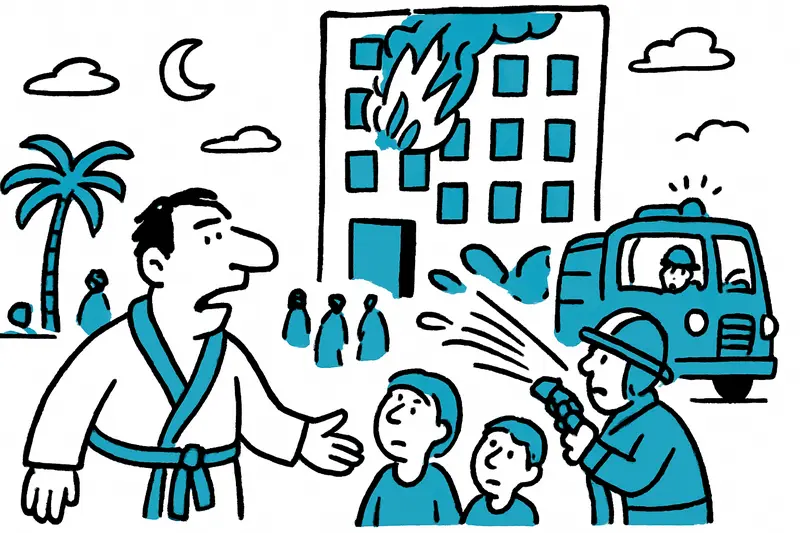
In the heat of the evening, when the bars on Calle Punta Ballena are full and sirens are rarely heard, the fire brigade responded on Sunday at around 21:55: a fire had broken out on the sixth floor of a hotel in Magaluf. Because the building's main entrance is on the eighth floor, the affected sixth floor is officially classified as below ground level – a circumstance that complicated the operation. Guests from floors six to twelve were brought outside as a precaution; the lower floors initially remained in their rooms. No one was injured, and according to the emergency services the hotel rooms were not damaged.
Key question
Why did a fire on a floor classified as a "basement" lead to such a widespread evacuation, and how well are hotels in Magaluf prepared for such unusual building layouts?
Critical analysis
At first glance the sequence sounds routine: alarm, dispatch, evacuate, extinguish. But the details reveal weaknesses. Buildings with entrances on higher levels change escape routes and smoke behaviour; fire compartments, pressure ventilation and stair layouts function differently than in a conventional high-rise, as highlighted by Fire at Alcúdia Hotel: Evacuation Succeeds — What Lessons Will the Island Learn? If the sixth floor is formally a "souterrain," questions arise about its labelling, access for emergency services and the clarity of evacuation instructions for guests who are in nightwear and flip‑flops and who often speak multiple languages.
What's missing from the public debate
The causes will usually be clarified later, but two topics are already lacking: first, a transparent presentation of how fire safety requirements for hotels with unusual topography are checked; second, reliable information about staff emergency training and multilingual evacuation plans. Tourist hotspots like Magaluf have many short‑term guests who do not know the escape routes. That causes delays in an emergency, even though this time everything turned out well, as seen in Fire in hotel at Playa de Palmanova: Evacuation, no injuries — and unanswered questions.
Everyday island scene
Imagine the scene: the night air over the bay is still warm, glasses clink at a bar on the coast, then the sirens cut through the sound of the sea. Travelers in bathrobes stand in the car park, some smoking nervously, others trying to calm their children. Firefighters from Inca and Sóller, supported by units from Palma, work under the yellow lights of the emergency vehicles, similar to the operations described in Fire in Port d'Alcúdia: Why the big scare is also a wake-up call for fire safety. On Twitter the official account of the Bombers de Mallorca later reported that the fire had been extinguished – a brief, reassuring message, but not an explanation.
Concrete solutions
- Multilingual, clearly visible escape plans in every corridor; simple pictograms for orientation at night.
- Regular evacuation drills with varying scenarios, including at night and during the high season.
- Mandatory documentation and publication of fire safety inspections for accommodation providers, accessible to guests and authorities.
- Technical upgrades: smoke detectors with direct connection to the fire brigade, functioning sprinklers in critical areas, smoke extraction systems for floors declared as "basement."
- Improved maps for emergency services: hotels with multiple horizontal entrances must be clearly marked as special cases.
Incidents such as Fire at Hotel near Cala San Vicente: A Wake-up Call for Fire Safety in the Off-Season underline the practical need for these measures.
Brief conclusion
That no one was injured and rooms remained undamaged is due to luck and professional work by the emergency services. However, the incident exposes that different building entrances and tourist turnover demand targeted preparation rather than blind routine. The island needs more transparent inspections, better multilingual communication and emergency plans that take unusual building structures into account. Otherwise the next nighttime operation by the bay will be riskier than it needs to be.
Frequently asked questions
Why did a fire on a basement-classified floor lead to a wider evacuation in a Magaluf hotel?
How are hotels in Mallorca adapting to buildings with non-standard layouts for emergencies?
What happens during a nighttime hotel fire evacuation in Mallorca?
Are evacuations in Magaluf hotels always straightforward?
What improvements are proposed to prevent delays during hotel evacuations in Mallorca?
What happened during the Magaluf hotel fire, and what was the outcome?
How does unusual topography affect emergency responses in Mallorca hotels?
What should visitors know about safety planning when staying at Mallorca hotels during peak season?
Similar News
Are the Balearic Islands the Southern Border of Europe? A Reality Check on Immigration
The Balearic Islands are again calling for EU aid after a sharp rise in arrivals by sea. Conflicting priorities between ...

"Expensive chaos" and many open questions: What clients can do when a lawyer suddenly stops responding
Several clients complain that a well-known German lawyer in Mallorca has been unreachable for months. Key question: What...
TV tip: 'The Last Problem' — Mallorca as the setting of a classic crime
A classic whodunit on Mallorca: A new miniseries set in spring 1959 brings storm, an isolated hotel and a dense web of s...
Nipping Sea Creatures: Why Bathers in Cala Major and Elsewhere Should Be Cautious
In Cala Major, bathers have reported being nipped by small fish. What is behind it, how can problems be avoided — and wh...
Forced eviction in Santa Catalina: When a 65-year-old slept in her car and showered on the beach — a question of responsibility
The story of Pilar López from Santa Catalina represents a problem affecting many Mallorcans: How can an island with a bo...
More to explore
Discover more interesting content

Can Cap de Bou

Townhouse Lleo 72
