
Private Security Services at Playa de Palma: Welcome or a Threat to the Public Mandate?
Private Security Services at Playa de Palma: Welcome or a Threat to the Public Mandate?
The city of Palma is bringing in private security firms to Playa de Palma. What this means for residents, businesses and the police — a critical look with concrete proposals.
Private Security Services at Playa de Palma: Welcome or a Threat to the Public Mandate?
The city administration has concluded an agreement with industry associations. Many questions remain open.
Late afternoon at Playa de Palma: the beach bars pump out house beats, delivery scooters struggle along the Passeig de Mallorca, a city bus releases a cluster of tourists – and somewhere between sunbed rentals and half-empty sangría glasses, people with company logos will soon be patrolling, not just uniformed police officers (see Palma gears up: 170 new police officers for Playa de Palma – solution or placebo?).
The facts: Mayor Jaime Martínez signed an agreement with representatives of the Balearic private security industry association (ASSP) and the professional association APROSER; those named included Inés Ybarra, Pilar Albacete Redondo and Carlos Botán, and councilor Llorenç Bauzá was also present. The document foresees communication channels, reporting protocols, a multilingual code of conduct for businesses and the establishment of a specialized team (SETUR) as a bridge between the public sector and private services.
Key question: Who oversees things when private forces take on public tasks? That is the crux. It is not enough to rely on the goodwill of the companies. If security technology, intervention powers or surveillance practices are expanded, citizens need clear guarantees — not just lip service.
Critical analysis: Private guards can provide rapid assistance and defuse conflicts. But there are legal and practical grey areas. What powers do these employees actually have? Are they allowed to search bags, issue bans from premises, or only inform the local police? Who verifies their training standards, language skills and the handling of intoxicated guests? The question of liability in incidents is also not trivial: who bears responsibility if an operation gets out of hand? These concerns echo wider debates about controls and enforcement (see Palma Tightens Controls: More Security — or a New Punitive Culture?).
Several aspects are currently missing from the public debate: first, transparency about concrete criteria for deployment (time, place, tasks). Second, published contracts or at least a summary regarding costs and financing. Third, an independent complaints office for affected persons and witnesses — the municipal police must not be the only instance when accusations concern private personnel. Fourth: data protection and video surveillance. If private personnel view camera footage or pass on personal data, clear rules and controls in accordance with applicable law are needed.
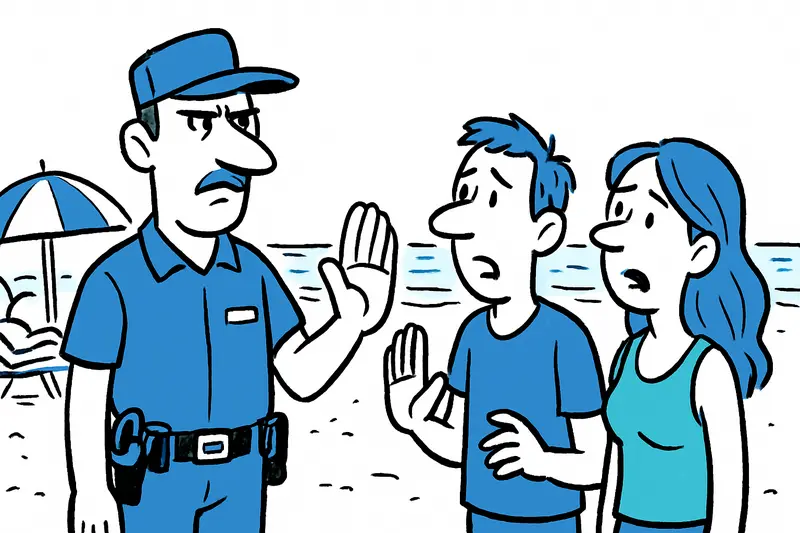
An everyday scene illustrates the urgency: a German couple complains about noise in a beach bar. A security employee intervenes, the situation escalates, a guest is expelled. Later it turns out the expulsion was arbitrary. Who records the complaints? Who keeps the files? Such cases can quickly damage trust in public order institutions, as recent incidents at Playa de Palma have shown (see Tumults at Playa de Palma: When Controls Threaten the Beach Scene).
Concrete solutions: First: full publication of the agreement in an easily accessible form — including tasks, rights, limits and oversight mechanisms. Second: a public certification for recruitment and training of all deployed personnel, defining minimum standards for de-escalation, first aid, language skills and data protection. Third: an independent complaints office with published case statistics and sanctions. Fourth: a time-limited pilot project with clear success criteria (e.g. number of deployments, complaints, response times), evaluated after six months. Fifth: inclusion of residents' representatives and business owners in the SETUR commission so that local experience is reflected in decisions.
This is not about rejecting private security personnel outright. They can usefully complement local law enforcement. But the city must set rules instead of relying on informal practices. Otherwise there is a risk of the gradual privatization of tasks that rightfully belong to democratically legitimized institutions (see Night raid at Playa de Palma: assessment, questions and what's missing).
Conclusion: Palma intends to respond more quickly to disturbances at Playa de Palma. That is understandable during a summer season of loud nights and crowded beaches. To ensure the measure does not become a burden for rights and neighborhoods, transparency, oversight and a clear time limitation are now required. Only then can it be prevented that private order personnel gain more power than society is willing to grant them.
Frequently asked questions
What changes are planned for Playa de Palma with the introduction of private security firms?
What powers might private security guards have on Mallorca beaches, and what is not clear yet?
How will complaints be handled if private security actions cause problems on Mallorca?
What is SETUR, the bridge between public and private security on Mallorca?
When would a private security pilot on Mallorca take place, and how would success be judged?
How does the plan address privacy and data protection when private guards use cameras or handle personal data?
What should visitors know about private security on Mallorca's beaches like Playa de Palma?
Who funds and is accountable for private security deployments on Mallorca's Playa de Palma?
Similar News

More water than last year: Mallorca's reservoirs breathe easier
September rain refilled the Tramuntana's reserves: overall fill around 35 percent, Cúber at 40.42 percent, Gorg Blau at ...

Three Luxury Hotels in Banyalbufar: Lots of Money, Many Questions
A Danish investor plans three exclusive accommodations in Banyalbufar — including the historic Son Valentí. The announce...
2.1 tonnes of cocaine on sailing yacht off Spain's coast – a reality check for the coastguard
A 14-metre yacht was seized with 2.1 tonnes of cocaine. Who monitors the ports, how does the international hunt succeed ...

Heat Bonus in Mallorca: 100 Euros Extra for Outdoor Staff at MarSenses
MarSenses pays employees who worked outdoors in August an extra €100 as recognition. Lighter uniforms, reduced hours for...

Renovating in Mallorca: What You Really Can Do Without Neighbour Consent
Many think they can do whatever they want in their apartment. That's partly true — but only as long as structural elemen...
More to explore
Discover more interesting content

Can Cap de Bou

Townhouse Lleo 72
