
Bloodstains on the Engine: What the Vulture Crash Reveals About Our Aviation Safety
Bloodstains on the Engine: What the Vulture Crash Reveals About Our Aviation Safety
A Ryanair flight from Madrid to Milan turned back after a Boeing 737-800 struck a vulture during climb. Key question: Are airports prepared for large birds?
Bloodstains on the Engine: What the Vulture Crash Reveals About Our Aviation Safety
Key question: Are airports and airlines prepared for collisions with such large birds?
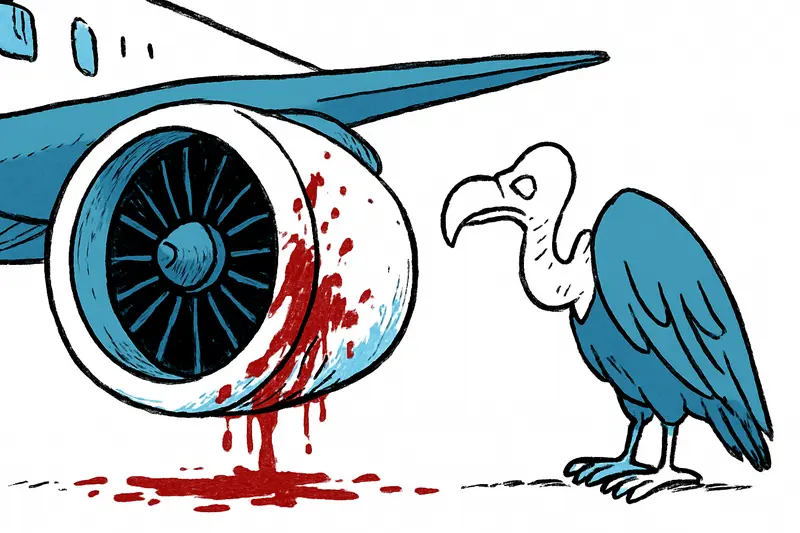
On Monday at midday a Ryanair flight from Madrid to Milan aborted its climb because a large bird entered the left engine. The aircraft, a Boeing 737-800 operating flight FR2753, turned back at around 4,000 meters and returned to the departure airport. According to fellow passengers, visible traces could be seen on the outer skin and in the air intake. A replacement aircraft later brought the passengers to their destination with about 2 hours and 40 minutes delay.
In short: a striking image — blood and feathers on an engine — and many questions. Such collisions are rare, but when a vulture or another large bird strikes an aircraft, the consequences are by no means merely cosmetic. Large birds bring mass and force; if they hit components like the air intake or the fan blades, parts can be damaged or entire engine functions impaired.
The first question is prevention. Airports usually work with specialized wildlife management teams, nets, acoustic deterrents or lighting concepts. They must also guard against other ground-based threats — see Laser on the approach: Ryanair aircraft at Son Sant Joan dazzled – time to act — but dealing with scavengers and large raptors is a particular challenge: these animals are mobile, behave differently than pigeons, and often come from nearby mountain or landfill structures that are difficult to change at short notice.
What has been largely missing from public discourse so far: reporting has focused almost exclusively on the spectacular moment — feathers on the engine, return to the departure airport, waiting time for passengers. There is little discussion of the conceptual link between land use, waste management and bird populations. We know this from Mallorca: when landfills or open food waste at urban edges are not adequately secured, scavengers find abundant food and increasingly approach settlement edges and flight paths.
Another blind spot: transparency after such incidents. Passengers saw photos, airport services and airline crews acted — but how easily accessible are the technical investigation findings, the longer-term action plans and the assessments of the safety authorities? Similar reporting has discussed aircraft defects and passenger impact, for example Crack in the window — what an aircraft defect means for Mallorca travelers, but without clear, publicly comprehensible reports, uncertainty and distrust remain.
An everyday scenario in Mallorca helps to make this tangible: on a hot morning you sit on the Passeig Mallorca in Palma, the smell of brewed coffee mixes with the noise of engines. A tourist boat follows its route, a scheduled jet climbs over the city. An older man shows a boy photos of feathers he recently found on the coast and tells how buzzards often circle in his bay. These small observations are part of a larger mosaic that airports and communities must connect.
Concrete solutions that could work faster and with local effort: first, systematic mapping of bird migration routes and food sources near airports — not only pointwise, but seasonally. Second, coordinated waste policies around airports: closed landfills, regular checks of restaurant waste, strict rules for securing containers. Third, expansion of detection and deterrence technology — from bird radar to drone patrols to targeted habitat measures within a radius of several kilometers.
Airports should also be required to document incidents publicly and clearly: what damage occurred, which systems failed or held up, which immediate measures were taken? And for passengers it is important to know: there are rules and claims in the event of flight interruptions — travelers should actively assert their rights and contact the airline to clarify options.
For policymakers this means: more budget for wildlife management. For communities: more controls on waste and food leftovers. For airlines: clearer communication standards with passengers in real time. And for tourism operators in Mallorca: sensitive information for guests about behavior in nature — do not leave food scraps exposed, dispose of waste correctly.
Bottom line: the incident was a serious warning, not a ticket to panic. It shows that aviation is robust in technical and operational areas — incidents such as Frightening Seconds over Palma: Two Flight Attendants Injured underline the range of challenges crews and systems face — but the interfaces with landscape and waste management are weaker. We must close these gaps — with local engagement, transparent reports and pragmatic measures so that photos of blood-streaked air intakes become rarer in the future.
Frequently asked questions
What steps do airports in Mallorca take to prevent collisions with large birds like vultures?
Why are large birds such as vultures a bigger concern for aircraft engines on Mallorca routes?
How does waste management near Mallorca airports influence bird activity and collision risk?
Should incident reports from bird strikes be made public, and what should they include?
What practical steps could Mallorca implement to reduce bird-related aviation risks?
What should passengers know about rights if a flight is interrupted due to a bird strike?
What role do local communities and Mallorca's tourism operators play in reducing bird-related aviation risks?
What does the incident suggest about transparency and public understanding of aviation safety investigations?
Similar News

More water than last year: Mallorca's reservoirs breathe easier
September rain refilled the Tramuntana's reserves: overall fill around 35 percent, Cúber at 40.42 percent, Gorg Blau at ...

Three Luxury Hotels in Banyalbufar: Lots of Money, Many Questions
A Danish investor plans three exclusive accommodations in Banyalbufar — including the historic Son Valentí. The announce...
2.1 tonnes of cocaine on sailing yacht off Spain's coast – a reality check for the coastguard
A 14-metre yacht was seized with 2.1 tonnes of cocaine. Who monitors the ports, how does the international hunt succeed ...

Heat Bonus in Mallorca: 100 Euros Extra for Outdoor Staff at MarSenses
MarSenses pays employees who worked outdoors in August an extra €100 as recognition. Lighter uniforms, reduced hours for...

Renovating in Mallorca: What You Really Can Do Without Neighbour Consent
Many think they can do whatever they want in their apartment. That's partly true — but only as long as structural elemen...
More to explore
Discover more interesting content

Can Cap de Bou

Townhouse Lleo 72
