
Bone discovery in Alcúdia: Who controls the layers of our buried history?
Bone discovery in Alcúdia: Who controls the layers of our buried history?
During utility works on Pol·lèntia street, femur fragments and ribs were uncovered. Criminal police and archaeologists secured the find — but many questions remain unanswered.
Bone discovery in Alcúdia: Who controls the layers of our buried history?
Construction work on Pol·lèntia street brings human remains to light – police and archaeologists expand the excavation
Key question: How well prepared is Alcúdia when construction work in an archaeologically sensitive area encounters human remains?
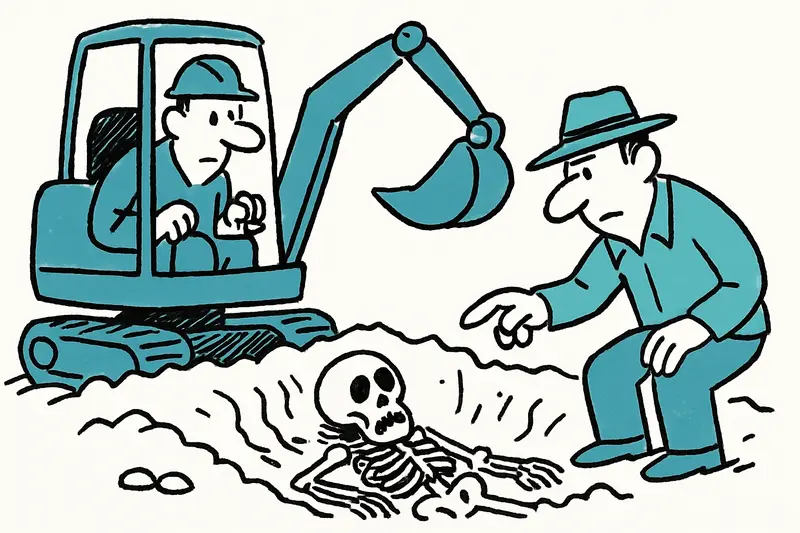
On Monday, while workers were digging a trench for a gas pipeline on Pol·lèntia street, they came across bones. Parts of a femur and ribs were discovered. Local police and the relevant criminal units secured the site, archaeologists from the island council examined the area, and the excavation was locally extended to determine whether this was an isolated find or part of a larger burial area.
Critical analysis: The authorities treated the discovery briefly and factually, but the event raises structural questions. Alcúdia lies in a landscape that contains several millennia of overlapping use: pre-Talayotic settlements, Talayotic monuments, the Roman city of Pol·lèntia and medieval structures sit on top of each other. In such a context it is unsurprising that historical remains surface during deep excavation works; similar surprises have been reported elsewhere, as in Deeper Cistern, a Thousand Shards: What the New Finds at Alaró Castle Mean. The problem is rather how such finds are anticipated, discovered and then promptly and scientifically classified.
What is missing from the public discourse: information on routine procedures is sparse. Citizens rarely know what obligations construction companies have towards archaeological heritage, how quickly samples can be dated and which responsibilities the court, police, island council and municipality specifically assume. There is a lack of transparent communication about timelines: How long may a construction project be stalled before a thorough archaeological investigation is available? Who bears the costs of emergency excavations? And how is the protection of the find from curious onlookers and damage ensured? Recent local cases, like Body found in disco ruin in Alcúdia: Who is responsible for abandoned sites?, illustrate the confusion.
An everyday scene from Alcúdia: On the day of the discovery a small excavator rumbled along Pol·lèntia street, its diesel noise mixing with the voices of tourists who stopped, wearing sun hats and holding cameras. A waiter from a nearby café put down his tray to watch. Children leaving school kept their distance; some pointed at the black plastic sheet the criminal police had stretched over part of the excavation. Such scenes show how closely present-day life and history lie together here — and how unprepared daily life often is when the past suddenly becomes visible.
Concrete solutions: First, a mandatory mapping system for archaeological sensitivity that makes it clear to contractors and authorities before any work begins whether an area requires special monitoring. Second, archaeological on-site supervision as a standard for works in designated zones — that is, an archaeologist present as soon as excavation starts. Third, an accelerated sampling and dating procedure with clear deadlines, funded through a fund to which construction projects in sensitive areas contribute proportionally. Fourth, mandatory training for construction firms and municipal employees on reporting obligations and handling sensitive finds. Fifth, transparent information duties towards residents and the public — a short, comprehensible update within 48 hours after a find.
An additional practical point: for finds in inhabited areas temporary protective measures should be provided — tarps, fencing, at least basic documentation by photographs and GPS before assessors arrive. This reduces the risk of damage by curious onlookers or heavy machinery.
Why this matters: Alcúdia is not a monument in a park but a living town where everyday work meets layered history. If these encounters are uncoordinated, research suffers, the dignity of the deceased is compromised, and legal as well as financial uncertainties arise for residents and investors.
Punchy conclusion: The bone discovery on Pol·lèntia street reminds us that the past lies beneath our feet — sometimes quite literally. Instead of reacting with surprise each time, the municipality, island council and developers should install a pragmatic system: clear maps, mandatory supervision, rapid dating and transparent communication. That way dignity, science and construction interests can be better balanced — and the next find will not just be a stir at the sidewalk café, but an orderly step toward treating our history responsibly, rather than another episode like Corpse found in Alcúdia disco ruin: Who is responsible for decaying places?.
Frequently asked questions
Why do human remains sometimes turn up during construction work in Alcúdia?
What happens when bones are found during a dig in Mallorca?
How long can construction be delayed in Mallorca if archaeological remains are found?
Who is responsible for archaeological finds during building work in Alcúdia?
Can you still visit Pol·lèntia street in Alcúdia after a discovery site is secured?
Why is Alcúdia so rich in archaeological remains?
What should construction companies in Mallorca do if they find bones on site?
What is the best way to protect an archaeological find in a town like Alcúdia?
Similar News

Fewer Airlines, Fewer Destinations: What Palma's Winter Flight Schedule Means for Mallorca
Analysis shows: Winter at Son Sant Joan Airport will be quieter, with significantly fewer airlines and destinations. Who...
German tourist dies in Sa Calobra – a reality check for emergencies on Mallorca's beaches
A 40-year-old tourist died at the Torrent de Pareis. The emergency call, a doctor who happened to be present, a defibril...
Deadly Tractor Accident in Bunyola: What Needs to Be Done Now
In a work accident on an estate near Bunyola, a roughly 40-year-old man lost his life. His wife and a small child were o...
Head-first dive into the shallow part of Cala Fonoll: An accident and the unresolved question of responsibility
A young tourist dove into Cala Fonoll and was seriously injured. Key question: Why are clear warning signs missing at da...
Mistaken identity with fatal consequences: Brutal assault in S'Aranjassa — what's missing in the follow-up?
At S'Aranjassa a visitor to a finca was tied up, beaten and thrown out of a van. Three men have been arrested, including...
More to explore
Discover more interesting content

Can Cap de Bou

Townhouse Lleo 72
