
Starting a Glider with Pedal Power: What the Bora Stunt at Son Bonet Really Means
Starting a Glider with Pedal Power: What the Bora Stunt at Son Bonet Really Means
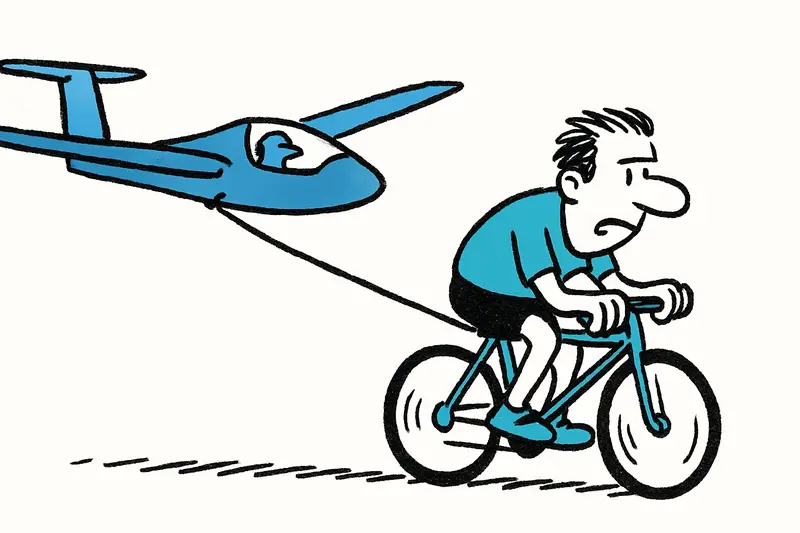
Nine professionals from Team Red Bull–Bora–Hansgrohe used bicycles to pull a glider into the air at Son Bonet. Impressive — but the incident raises questions about safety, approvals and PR logic.
Starting a Glider with Pedal Power: What the Bora Stunt at Son Bonet Really Means
On Tuesday morning there was unusual activity at the entrance to Son Bonet airfield: instead of the usual light planes and people waiting with coffee cups, there were bike transporters, technicians with radios and a rope stretching 150 meters across the tarmac. Nine riders from Team Red Bull–Bora–Hansgrohe then strapped into a harness — and within seconds got a glider into the air, as reported in Cuando la fuerza de las piernas hace despegar un planeador: lo que realmente dice el espectáculo de Bora en Son Bonet. Impressive. But is this just a PR stunt or is there more to it?
Key question
Can such a record attempt be meaningfully assessed when athletic performance, technical risks and commercial staging are so closely intertwined?
Critical analysis
Facts that remain: nine riders, including Florian Lipowitz, accelerated together on a 150-meter-long rope; the team stated they reached the roughly 54 km/h required, and pilot reports speak of a climb to about 100 meters; technical direction was, according to the project statement, in the hands of Dan Bigham, and the pilot was Andy Hediger. These facts are impressive. At the same time, the attempt is no longer a pure sporting achievement on the road, but a maneuver with aviation relevance. That means responsibility is shared between the athletes, the pilots, the airfield operator and the sponsor. Who authorized the action? Which safety analyses were performed? How was the risk of material failure (rope, harness, attachment) assessed? These questions remain largely unanswered for the public.
What's missing from the discourse
The debate quickly focuses on superlatives – world record, new, never done before. Three points barely come into view: first, the regulatory side. Mallorca has clear rules for flight operations and for events on airfields; which authorities were involved has not been communicated transparently, as discussed in Fuerza de pedales sobre la pista: un récord en Mallorca que plantea preguntas. Second, the liability question: who takes responsibility if something goes wrong in such an experiment — medically, legally, financially? Third, the long-term effect: such actions set standards for future stunts. If safety checks and documentation are not made public, there is a risk that others will imitate them without the same resources, or that PR interests will downplay risks.
Everyday scene
Late that morning the road to Marratxí was quiet; the women from the nearby weekly market had just had a break. An old man fed pigeons, two teenagers looked at their phones and filmed the rope hanging like an unusual wire over the airfield. A local resident with potatoes on the back seat casually remarked, “Nice spectacle, but the main thing is that nobody gets hurt.” This mix of curiosity and pragmatism describes how the island receives such events: admiration paired with the expectation that rules will be followed.
Concrete solutions
1) Transparent approval records: organizers should make permits, risk assessments and insurance certificates publicly accessible or at least available to the relevant authorities. 2) External safety review: an independent technical assessment by aviation experts and sports engineers should be mandatory before people are exposed to unusual physical hazards. 3) Standardized protocols for PR stunts: similar actions need guidelines for communication with neighbors, air traffic control and on-site medical preparedness. 4) Clear labeling: if an event primarily serves PR purposes, that should be stated openly; the mix of record attempt and brand staging must be clear so that the public and authorities can respond appropriately.
On the relationship between sport and spectacle
Mallorca is a training ground for professionals, and Son Bonet is part of that infrastructure. That makes the island attractive for unusual experiments. However: athletic skill does not automatically justify treating aviation-related risks as an afterthought. If a pilot loses visual contact with the peloton and must rely solely on instruments and trust, then it is no longer a harmless gag but a scenario with calculable risk that must be documented.
Conclusion: The peloton start at Son Bonet shows the raw power and precision professional cyclists are capable of. At the same time it reveals how thin the line can be between a sporting demonstration and a corporate-controlled spectacle. Mallorca benefits from the attention — as long as authorities, organizers and sponsors are willing to prioritize transparency and safety standards over show effect.
Frequently asked questions
What happened at Son Bonet airfield in Mallorca?
How does a pedal-powered glider launch work?
Was the Son Bonet glider stunt in Mallorca a record attempt or a PR event?
What safety concerns were raised about the Mallorca glider launch?
Who was involved in the Son Bonet glider launch in Mallorca?
Why is Son Bonet airfield used for unusual events in Mallorca?
What should organisers in Mallorca do before staging a stunt on an airfield?
How did people in Mallorca react to the Son Bonet glider stunt?
Similar News
Rats in Llucmajor: How Uncollected Garbage Became a Health Problem
In Llucmajor, uncollected trash bags, overflowing containers and rain are leading to increased rat sightings. An assessm...
Sly Distraction Scam at Ballermann: How Tourists Became Targets — and What Must Be Done Now
Five suspected pickpockets were arrested. Their method: distract, secure the loot, return the wallet — without the cash....
Eviction in El Arenal: Who protects neighbors — and who protects the homeless?
A vacant hotel on Carrer Girona was cleared and secured. The neighborhood breathes a sigh of relief. But the action trea...
'La Tapita' loses its home: Who will protect Palma's last affordable meeting places?
The bar 'La Tapita' on Simó-Ballester Street will close at the end of December. For neighbors, police officers and small...
Million Heist at Bulgari: Who Is Responsible for Palma's Security Gaps?
Three men stole jewelry worth around one million euros – the crime series began at the end of September and was likely c...
More to explore
Discover more interesting content

Can Cap de Bou

Townhouse Lleo 72
