
Bronze Age at Ballermann: New Traces in Es Velar and Son Sunyer
Bronze Age at Ballermann: New Traces in Es Velar and Son Sunyer
Archaeological work in Es Velar (Santanyí) and Son Sunyer (Es Pil·larí) has produced evidence of metalworking and burial places from the Bronze Age. A piece of prehistory very close to today's Playa.
Bronze Age at Ballermann: New Traces in Es Velar and Son Sunyer
A research team is excavating at two sites near the beach and is uncovering traces around 3,500–4,000 years old
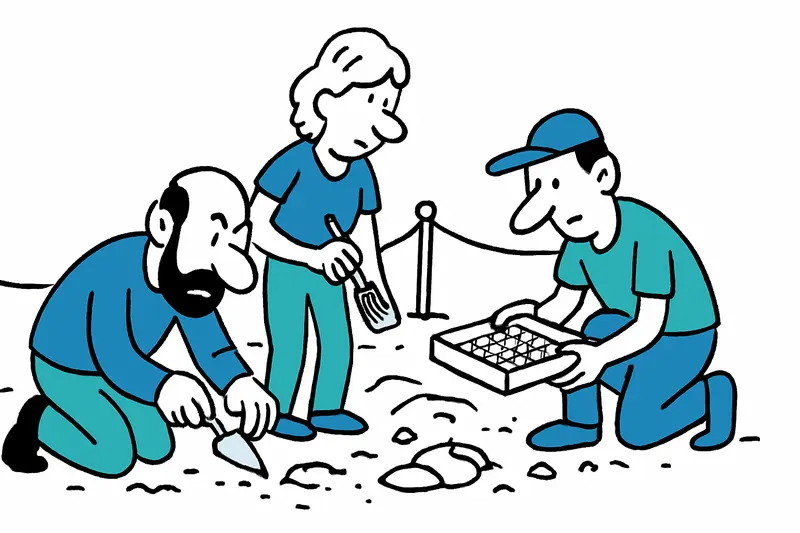
In the early morning, when the seagulls are still searching for rolls over the Passeig and the first delivery vans on the Playa de Palma open their tailgates, a small team is working behind barriers with brushes and sieves. In October, a campaign by the Institute for Cultural Heritage Sciences (INCIPIT-CSIC) led by researcher Pau Sureda resumed what began last year: excavations at the sites Es Velar near Santanyí and Son Sunyer in the Es Pil·larí district, only a stone's throw from the Ballermann area and the stretch of coast near the Roman wreck off Can Pastilla.
The researchers are specifically looking for traces of early metalworking that could indicate activity around 4,000 years ago, and for evidence of burial rituals from about 3,500 years ago. Such findings help to form a clearer picture of how people lived, worked and buried their dead on Mallorca during the Bronze Age.
Last year the teams had already uncovered well-preserved layers from the late third millennium BCE. These well-stratified deposits continue the investigations this year and allow the teams to target specific spots for furnace remains, slag, grave goods or skeletal fragments, comparable in intensity to other recent recoveries such as Deeper Cistern, a Thousand Shards.
The sites are not in the middle of the party zone, but on the edges, where the road noise from the Ma-10 is still audible and the beach bars play their music in the evenings — a strange contrast between present-day life and prehistory.
For residents like Mrs. Marina, who runs the greengrocer on the edge of Es Pil·larí, this means more than just science: "It's fascinating that so much history lies right outside our front door," she says as a moped roars past on the road. Moments like this also create a new everyday awareness that the island holds layers of stories far beyond postcard motifs.
Why is this good for Mallorca? First, because it broadens the image of the island. Mallorca is not just beaches and seasonal tourism, but has a deeply rooted prehistory that supports locally anchored identity and offers visitors different perspectives. Finds and insights also provide material for exhibitions, museum education and school programs in Santanyí and Palma. A lasting visible gain would be a small exhibition or an information panel at the site that would make passers-by pause for a moment.
Practical consequences are also conceivable: conservation work, proper storage of the finds, more contracts for local craftsmen and technicians, as well as the involvement of volunteers in securing measures. If consular or museum staff from the capital show interest, collaborations could arise that strengthen small museums in the communities — creating long-term jobs without large tourist crowds, as seen in initiatives like Sencelles buys prehistoric cave Cova del Camp del Bisbe.
From a research perspective, the prospect of clearer maps of prehistoric metallurgy is attractive. Metalworking is a key to networking with the Mediterranean; slag, furnace remains or metal fragments reveal trade routes, technical know-how and the economic conditions of the community at the time.
Practical idea: guided tours where locals and visitors join an archaeologist on a short field walk on certain afternoons, combined with a visit to the village café — this connects science with the clinking of coffee cups and the smell of freshly baked ensaimadas. Such formats bring knowledge into the neighborhood and promote respect for surface finds.
The campaign starts where the island itself becomes most tangible: in the soil beneath our feet. And while the beach bars keep their lights flickering at night, the new layers remind us that Mallorca tells several stories at once. A few pottery sherds, some slag, perhaps a grave good — and a piece of island history that suddenly becomes audible again.
Outlook: Once the scientific work is complete and the finds have been analyzed, one goal would be to present the results in an easily accessible format: a traveling exhibition, school materials, information trails. This way the Bronze Age would not remain the preserve of specialists, but would, for a moment, also belong to the people who open the bakery on the Plaça every morning.
Frequently asked questions
What are archaeologists discovering at Es Velar and Son Sunyer near Ballermann in Mallorca?
Why does this archaeology matter for Mallorca’s heritage?
Where exactly are the excavation sites and can visitors see them?
What kinds of finds are researchers looking for?
Are there ways for locals and visitors to learn about Mallorca’s Bronze Age during or after the dig?
When does the excavation season take place and what does it reveal?
What practical benefits could come from this research for local Mallorca communities?
How could the Bronze Age discoveries influence future museum displays or education in Mallorca?
Similar News

'We must be very careful'? A reality check on Mallorca's tourism debate
Hoteliers and politicians draw a mixed assessment of the season: economically satisfied, socially strained. Key question...

Prominence Alone Is Not Enough: The Case of Germania Mallorca and the Reality Behind the Dream
After six games the coach is gone. What does that say about ambitions, leadership and everyday life at FC Germania Mallo...

Blackboard on Mondays, Microphone on Weekends: How a Teacher Conquered the Ballermann Stage
She carries teaching materials and playback kits with her: once an elementary school teacher in Germany, today a fixture...
No More Coal Dust: Es Murterar Becomes an Energy Runway for the Future
End of an era: The last coal units at the Es Murterar power plant are being shut down. For Mallorca this means cleaner a...

Winter over the island: Who keeps flying, who pauses — and what does that mean for Mallorca?
Palma airport reports almost eight million seats for the coming winter season. Between expansion by some carriers and co...
More to explore
Discover more interesting content

Can Cap de Bou

Townhouse Lleo 72
