
Burglary Spree in Puig de Ros: Fear in the Villas — What Needs to Be Done Now
After several nighttime burglaries in Puig de Ros, uncertainty prevails in the villa districts. Why is this happening here — and which measures can bring quick and long-term protection?
Burglary Spree in Puig de Ros: Fear in the Villas — What Needs to Be Done Now
The usual silence in Puig de Ros was abruptly broken that Saturday shortly after half past two: a barking dog, flashlight beams between olive trees, the soft click of an alarm — and in the morning a ransacked villa, as described in Mallorca-Magic report on the Puig de Ros burglary spree. Jewelry worth around €100,000 had disappeared. For many neighbors it quickly became clear: this was no coincidence, but a planned attack.
How the perpetrators seem to operate
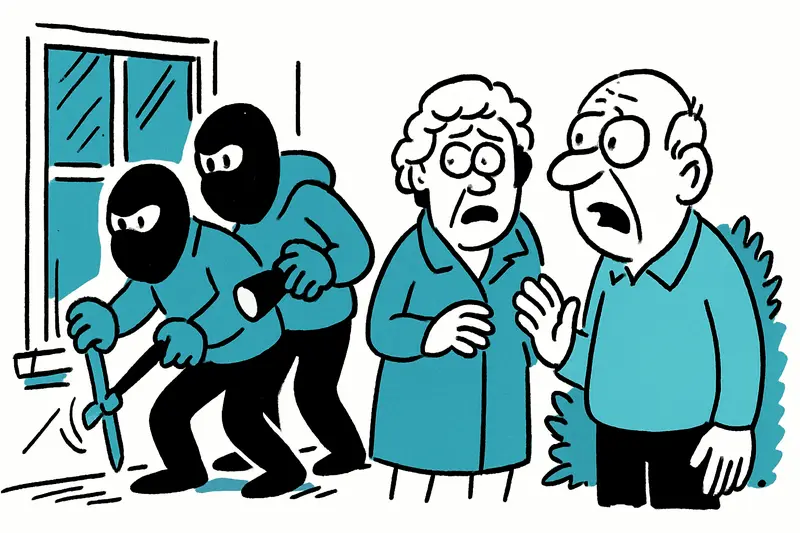
Witnesses report a quiet drill near a window, systematic attempts on lock areas and a four-legged friend that raised the alarm. Some in the estate spoke of anesthetic gas — a rumor that fueled fear, although the Guardia Civil confirmed nothing on that. Investigators are currently evaluating camera footage and movement data; their assessment points to professional gangs who had scouted the area, as noted in a follow-up report "Robos nocturnos en Puig de Ros".
The key question: Why Puig de Ros?
This is not a mere rhetorical detail. Quiet villa areas with large plots, unlit streets and valuable items are automatically more attractive to organised burglars. But responsibility does not end with the residents. Municipality, police and private providers jointly bear the duty to prevent a vulnerability from becoming a long-term problem.
Atmosphere in the neighborhood: mistrust, but also solidarity
On Monday more lights were on than usual. Sensor lights clicked on, neighborhood groups exchanged phone numbers, and people stood at doors who normally go to bed early. The residents' association Mirador del Delta recalls that more than 3,000 signatures for greater security were already collected in 2021. Cameras were installed, but visible police patrols were missing. That creates the feeling that simple emails to the municipality are not enough to restore security.
Critical analysis: what is often missing from the public debate
Two points are rarely discussed objectively enough: first, the personnel and organizational resources of the Guardia Civil on site. Visible presence is preventive, fast response times are crucial. Second, the interplay between private security measures and municipal responsibility. If villa owners increasingly rely on private security firms, a two-tier security system emerges: those who can pay protect themselves — the rest remain vulnerable.
There is also a technical and legal problem: single cameras provide evidence, but only networked systems with central evaluation create real deterrence. Data protection must not be used as a pretext to block preventive measures (see ICO guidance on CCTV and doorbell cameras); with clear rules and emergency access, both interests can be reconciled.
What should be implemented in the short term
The residents' demands are justified. In the short term, these measures would help noticeably:
1. Visible police presence: Agreements between the municipality and the Guardia Civil for increased night patrols, especially on weekends, would deter perpetrators and reassure neighbors.
2. Coordinated CCTV network: Not island solutions, but a networked system with defined access in case of alarm. A municipal analysis center could close the gap between private cameras and police response.
3. Local security coordinator: A person who brings together municipality, police, private companies and neighborhood groups. This reduces response times and prevents actors from working past each other.
4. Prevention and training: Better exterior lighting, reinforced locks, sensors on pool and side doors, and information evenings for residents: How should I behave if I hear noises? Where do I secure valuables?
Long-term steps — change the structure
In the long term, Mallorca needs clearer funding mechanisms and data strategies: grants for burglary protection, support programs for networked security technology and regular public maps of burglary hotspots. Such open data help to deploy resources in a targeted way and set priorities — instead of always acting reactively.
In addition, cooperation between municipalities and private security services should be regulated by law. Who patrols, to what extent and with what authority? Without clear rules, a patchwork of ineffective measures threatens.
Opportunity in the crisis
As unpleasant as it sounds: these incidents have set things in motion. Puig de Ros shows a strong willingness to self-organize — from organized night watches to shared camera footage. If this energy is channelled, guided professionally and linked with municipal support, Puig de Ros can become a role model for other residential areas on Mallorca.
The Guardia Civil continues to investigate; the footage could identify perpetrators. Until then, the advice to residents is: don't panic, but remain vigilant. Make demands, don't just send emails. Only through coordinated action by neighborhood, municipality and police will Puig de Ros stop being an open invitation to burglars.
Frequently asked questions
Why have burglaries in Puig de Ros caused so much concern among residents?
What signs suggest burglars may target villas in Mallorca?
What security measures help protect a villa in Mallorca?
Do CCTV cameras help prevent burglaries in Mallorca?
What should residents in Puig de Ros do after a burglary scare?
Is more police presence important in Mallorca villa areas?
Why is neighborhood coordination important in Puig de Ros?
Are Mallorca residents asking for long-term changes to burglary prevention?
Similar News

Maribel: Five Decades of Service – Housekeeper from Peguera Celebrated with a Special Honor
Over 50 years in the hotel business: María Isabel “Maribel” Molinos was honored in Palma at the Nit del Turisme by Unive...

Orange Alert over Parts of Mallorca: Are We Prepared?
Dark clouds and an announced wet spell have triggered an Orange alert in parts of Mallorca. A reality check: what's miss...

Sundair & Co.: Sale speculation and what it could mean for Mallorca
Rumors about a possible sale of the airlines Sundair and Fly Air 41, which belong to Schauinsland-Reisen — and whether b...
Anne Wünsche in Mallorca: A job offer with a catch — who fits the role of personal assistant?
Influencer Anne Wünsche has left Berlin and is urgently looking for a full-time personal assistant in Mallorca. Why the ...

Daily from New York: Palma Between Boom and Strain
United will increase the Newark–Palma route to daily flights in 2027 using Boeing aircraft (231 seats). What does the in...
More to explore
Discover more interesting content

Can Cap de Bou

Townhouse Lleo 72
