
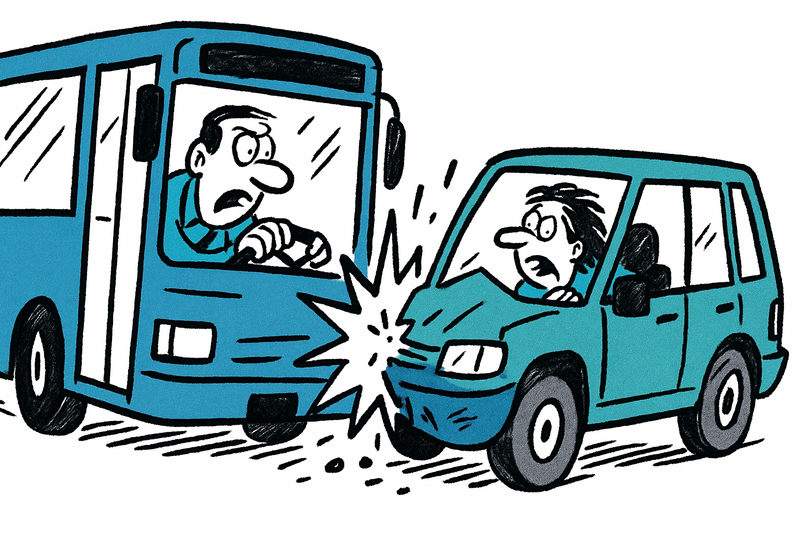
Crash in Son Gotleu: Five Injured — How Safe Are Palma's Intersections?
A city bus collided with an SUV in Son Gotleu, leaving five people injured. Beyond the course of the accident lies the question: Are increased controls enough, or does Palma need new structural solutions at dangerous intersections?
Bus and SUV collide in Son Gotleu: Five injured, many questions
Early on Tuesday morning, sirens broke the calm in Son Gotleu. At the intersection of Tomàs Rullán and Sant Ignasi, an EMT city bus and an SUV collided; for initial reporting, see Son Gotleu: Five Injured After Bus Collision – A Wake-Up Call for Palma's Streets. Four passengers from the bus and the SUV driver were injured, and the vehicles were heavily damaged. More details are in Son Gotleu: cinco heridos tras colisión entre autobús y SUV – un aviso para las calles de Palma. Fortunately, patrons on a nearby bar terrace remained unharmed — a stroke of luck that is not a given in this densely built neighborhood.
How did it happen — and why is this more than an isolated case?
Witnesses report that the SUV ignored a stop sign; see witness accounts in Choque en Son Gotleu: cinco heridos — ¿Qué tan seguras son las intersecciones de Palma?. The bus, on its route, could no longer avoid the collision and struck the car, which was then thrown into a parked vehicle. The force of the impact highlights how little room for error exists in Palma's narrow streets. The local police are investigating, SAMU 061 emergency teams were quickly on scene, Emaya cleaned the street and tow services removed the wrecks. EMT technicians inspected the bus before it was transported away, according to the EMT Palma official website.
The central question
Can intensified controls alone prevent such accidents — or does Palma urgently need structural changes and a different road design? This is not an academic question but a practical one: if a crash like this repeats, it is not only the directly involved who pay the price, but the whole neighborhood.
Aspects that rarely get enough attention
Public debate often shows only the snapshot: a stop sign ignored, a quick accident report. Less frequently discussed are:
1) Sightlines and infrastructure: Many intersections in Son Gotleu are tight, parked cars obstruct visibility, traffic lights are missing, and stop signs are sometimes positioned behind flower boxes or lampposts. A stop sign that only serves as decoration is a serious problem.
2) Route operation and bus scheduling: Bus drivers work under time pressure. When routes are tightly scheduled, there is less leeway to react to suddenly appearing traffic.
3) Social and spatial factors: Son Gotleu is a densely populated neighborhood with heavy pedestrian traffic, small shops and terraces — the risks for uninvolved bystanders are higher here than on wide ring roads.
Concrete solutions — what Palma should do now
It is not enough to demand "more intensive controls" after an accident and then let the issue fade. Practical measures that can have short-term effects:
- Keep sightlines clear: No-parking zones immediately near intersections, clear markings and removal of visibility obstructions.
- Physical traffic calming: Speed bumps, raised curb islands and narrowed lanes force lower speeds — and are often more effective than fines.
- Improve signage and lighting: Reflective materials, higher placement of stop signs, and better street lighting for the early morning hours.
- Enforcement where people live: Mobile speed checks, targeted camera monitoring at accident hotspots and visible police presence during problematic time windows.
- Public transport adjustments: More flexible scheduling, extra training for drivers on risky intersection situations and technical checks on buses so drivers can focus on driving.
- Neighborhood engagement: Local information campaigns involving residents, business owners and delivery services — road safety is a community effort.
An opportunity for Son Gotleu
An accident like this is tragic, but it can also make visible problems that have existed for years: too-narrow intersections, unclear regulations and traffic pressure in a lively district. If the city administration, EMT, Emaya and the police now work together with residents to trial concrete measures, fewer people may be put at risk in the medium term.
The sound of sirens, the scraping of Emaya's brooms, the voices in the bar — all this belongs to everyday life in Son Gotleu. It would be a small miracle if, after a morning like this, everything stayed the same. Better would be learning from the misfortune and redesigning the intersection so that the next siren only remains a memory of a dangerous day rather than a repeated reality.
Frequently asked questions
Are Palma intersections safe for drivers and pedestrians?
What usually causes traffic accidents in Mallorca city streets?
How safe is it to walk in Son Gotleu, Palma?
What should I do if I witness a car or bus crash in Palma?
Why are bus accidents in Palma more concerning in residential areas?
What makes Son Gotleu traffic intersections difficult to manage?
What road safety improvements could help Palma reduce crashes?
Is traffic policing enough to make Mallorca streets safer?
Similar News
Cafetería San Siro: A Meeting Place on Schinken Street Since 1966
In the middle of Schinken Street, Cafetería San Siro has been offering Mallorcan hospitality for more than six decades —...
From Ballermann to Prison: What the Verdict Against the Femina Operator Means for Palma
The Munich Regional Court convicted a German operator for subsidy fraud. What does the verdict mean for the Femina Club,...
Underpass Verge de Lluc: 19-year-old fights her way out of flooded car – a warning sign for Palma
A 19-year-old recently escaped swimming from her car after the Verge de Lluc underpass held up to one and a half meters ...
When the Floodgates Open Again: Why Palma's Floods Aren't a Coincidence
A sudden heavy downpour around 5 p.m. brought Palma to a standstill: flooded streets, full basements, panicked commuters...
Playa de Palma: Life-saving at Balneario 11 – Lifeguards Act Quickly
A German holidaymaker suffered cardiac arrest at Playa de Palma. Lifeguards resuscitated her on the beach; emergency ser...
More to explore
Discover more interesting content

Can Cap de Bou

Townhouse Lleo 72
