
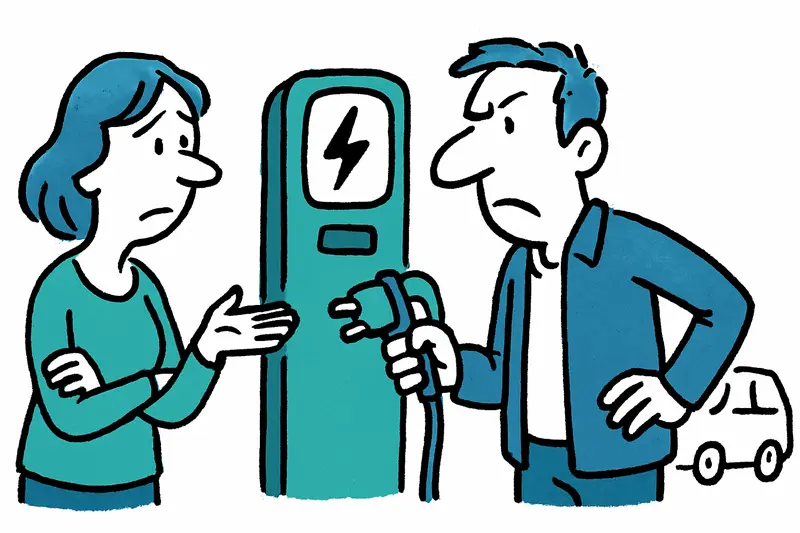
Calvià introduces fees for municipal EV charging stations — what it means
Calvià introduces fees for municipal EV charging stations — what it means
From February 2, the municipality of Calvià will charge €0.25 per kWh at municipal chargers; parking remains free for four hours, then €3 per hour. What does the new rule really mean for residents and tourists?
Calvià introduces fees for municipal EV charging stations — what it means
From February 2 charging will cost: €0.25 per kWh, four hours of parking free, then €3 per hour
Monday morning in the Costa d’en Blanes car park: seagulls screech, a delivery van maneuvers between palm trees, and next to the supermarket stands an EV charging station that will soon not only deliver electricity but also require payment. The municipality of Calvià has announced that charging at its municipal stations will be chargeable from February 2. The base rate: €0.25 per kilowatt-hour; the parking space remains free for up to four hours, after which €3 per started hour is due. Activation and payment are handled via the MELIB 2025 app.
The municipality intends to use the revenue to finance maintenance and expansion — sites in Paguera, Santa Ponça and Costa d’en Blanes are specifically planned, for context see Driving around Mallorca in an electric car: Map shows all charging stations — and how easy driving really is. At first glance: reasonable. Charging stations require upkeep, and those who charge publicly should contribute. But the announcement also raises questions that were only touched on in the brief statement.
Key question: Does the fee regulate fair access, or does it create new hurdles for commuters, residents and small businesses? The answer lies somewhere between yes and no. For tourists on short stays, usable infrastructure is important — fast charging, clearly marked spaces, simple payment. For residents who rely on a car, a comprehensive and affordable solution can be existential. €0.25 per kWh is not an extreme rate, but how it plays out in practice depends on charging power, billing intervals and whether there will be discounts for residents.
Critical analysis: First, there is a lack of transparency about costs and usage. The announcement names the kWh price and the parking rule, but not whether there will be tiered tariffs for fast vs. normal charging, whether night electricity will be cheaper, or how billing will work for partial reservations. Second, it remains unclear how the municipality will prevent "blocking" of charging points — that is, combustion vehicles or long-stationary cars occupying the charger. Third, the reliance on an app is practical but fragile: tourists without a Spanish SIM card, older users without a smartphone or people without a bank account could be excluded if there are no alternatives.
What has so far been missing from the public debate: a clear policy for low-income residents, for businesses with delivery vehicles and for people who depend on public transport. Also little discussed was the issue of charging speed — many parking spaces in Calvià are equipped with slow AC chargers; those who need fast DC chargers may travel further or occupy a charger longer if only one is available.
Everyday scene: On the road to Paguera you can see employees with thermoses in the morning; scooter noises mix with the sound of the coast. A restaurant owner who until recently used a small electric vehicle hesitates: is buying the car still worthwhile if public infrastructure is fragmented and becomes chargeable? You can feel this uncertainty in conversations at counters and at bus stops.
Concrete solutions the municipality should consider: 1) Resident tariff: households officially registered in Calvià could receive reduced rates or booking priority; similar local debates have arisen elsewhere, for example Resident parking spaces in Cala Millor and Cala Bona: What's at stake. 2) Alternatives to the app: SMS, phone-based payment or prepaid cards as a backup for tourists and tech skeptics. 3) Clear slots and enforcement: parking-disc rules, towing policies or a timeout after X minutes post-charging, combined with monitoring by municipal enforcement officers. 4) Transparent price matrix: different prices for AC/DC charging, night tariffs and a cost overview displayed at each station. 5) Expansion plan: prioritise fast chargers on through-roads and provide more charging options in residential areas, partially financed through public-private partnerships. 6) Information campaign: visible signage, multilingual information and demo stations for the MELIB app.
Conclusion: The decision to make charging chargeable is not an act of arbitrariness but an allocation measure. However, how fair and effective it will be depends on implementation. Calvià has the opportunity to create a model that not only secures revenue but also eases the mobility transition for residents and visitors. If the municipality now communicates transparently, offers practical payment methods and invests purposefully in charging infrastructure, a bureaucratic measure could become a step that truly changes things on the island. If not, it will remain a source of frustration at the charger and of conversations in the harbour about missed opportunities.
Frequently asked questions
Will municipal EV charging in Calvià soon cost money?
How much will it cost to charge an electric car in Calvià?
How do you pay for Calvià’s municipal EV chargers?
Are there enough EV charging stations in Calvià and nearby areas?
Will tourists in Mallorca be able to use Calvià’s EV chargers easily?
What happens if you leave your car parked at a Calvià charging point too long?
Why is Calvià charging for municipal EV stations now?
Where are Calvià’s new or planned EV charging sites?
Similar News
Reality check: Palma's "white" torrent — harmless salt or neglected warning sign?
White crusts on the Torrent de Sa Riera are causing a stir. Emaya describes them as salt deposits. Our reality check: wh...
When Ryanair's fleet grows: What Mallorca's travelers should know
Ryanair will soon receive 737 Max 10 jets. The larger aircraft offer potential savings — but also new risks for flight o...

Rising fuel and housing costs: Why Mallorca's overland buses are suddenly overcrowded
More and more people are leaving Palma — and boarding TIB buses: Between January and August 2026, the network recorded o...
Carriages Without Horses: Palma Plans E-Carriages – a Reality Check
Palma plans to switch to electric carriages in 2027. The prototype was shown near the cathedral. What is the technology ...

Record season, empty coffers: Who really benefits from the tourism boom?
Full hotels and more flights: the numbers sound impressive — yet many locals feel no benefit. A reality check with an ev...
More to explore
Discover more interesting content

Can Cap de Bou

Townhouse Lleo 72
