
Driving around Mallorca in an electric car: Map shows all charging stations — and how easy driving really is
Driving around Mallorca in an electric car: Map shows all charging stations — and how easy driving really is
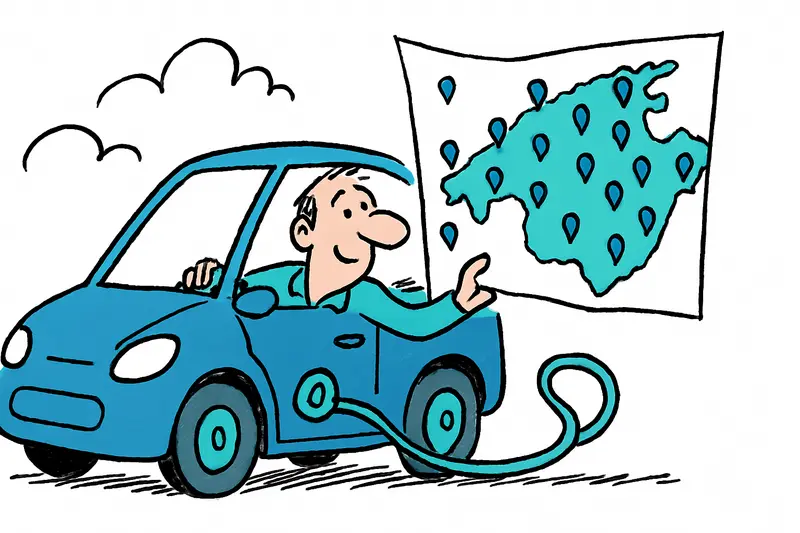
A new map from the Institut Balear de Energia consolidates more than 400 charging points across the Balearic Islands. On Mallorca the stations are practically in every village — Palma tops the list.
Driving around Mallorca in an electric car: Map shows all charging stations — and how easy driving really is
More than 400 charging points in the Balearics, many of them in Palma and in the villages
If I walk along the Passeig Mallorca on a cool December morning, I hear the sea from the direction of Parc de la Mar and already see the shimmering charging stations where commuters plug in their cars in the morning. 12°C, a few clouds in the sky — it feels like an island slowly being surrounded by an unobtrusive network of sockets and cables. The Institut Balear de Energia has now brought this infrastructure together on a map: more than 400 charging points in the Balearics, most of them on Mallorca.
The distribution in Palma is clearly visible: spots around the Parc de la Mar (16), on Via Roma (14), Marquès de la Sénia (9), Santa Pagesa (15), Calle Manacor (12), Sa Riera (8), Plaça Major (10), Comtat de Rosselló (9), Eusebi Estada (1) and the Avingudes (11). This does not feel like science fiction but like everyday infrastructure — the charger next to the bakery, the one by the photo shop, the one in the small supermarket car park.
And it is not just the main streets: in almost every village there are charging options. Andratx, Santanyí, Felanitx, Port de Sóller, Alcúdia — whether you live on Mallorca or are on holiday here, you will usually find a station nearby quickly — a fact that makes Discover Mallorca by Rental Car: Why a Car Makes the Day a practical option.
For longer trips across the island the network is even more important, because distances are short and the charging break can often be combined with a coffee or a short stroll.
Practical: many public charging points can be used with apps or charging cards; the user interfaces often come in several languages and show prices and availability. For tourists this is a big advantage — payments frequently run through international billing systems, and most chargers are accessible around the clock. Local alternatives and initiatives also complement public chargers, for example Carsharing in Palma: electric, cooperative and under €5 per hour.
The city of Palma additionally supports e-mobility with a rule that many drivers like: electric cars are exempt from fees in paid ORA zones as long as they are actually being charged. Important: anyone who unplugs and continues to occupy the space risks a ticket. The rule is simple and fair — it is intended to ensure that charging spaces rotate and remain available.
What does this mean for everyday life on the island? For commuters, for people with small businesses and for holiday planning it means: switching to an electric car is practically feasible here because charging stations are not limited to a few locations. Instead of a long search there is often a quick connection shown on the app, a short walk to the café and a charged car in the afternoon.
The Institut Balear de Energia plays a key role: it consolidates data, makes the locations of stations visible and thereby promotes projects around renewable energies and charging infrastructure, and supports projects such as Motorworld Mallorca: A new mobility experience center on the island. Such maps help planners but also ordinary drivers — they make decisions easier: where do I park? Where do I charge? How long will the spot be free?
A concrete suggestion to increase everyday usability: the map could get more flexible filters — charging power, payment options, current availability — and an option to see short local notes, for example whether a charger is accessible in the rain or whether a nearby café is open. Even better would be a small community function: users could leave short hints such as "charger next to the bakery works reliably" or "fast chargers often free after 10pm". Such tips are often more valuable than dry numbers.
In the end one simple thought remains: Mallorca is small enough that e-mobility becomes practical, and large enough that a good network makes sense. If charging stays as uncomplicated as it is now — with New Traffic Signs in Mallorca: Smaller Design, Clearer Signals, functioning apps and the understanding that people free up parking spaces after charging — more and more people on the island will choose electricity over petrol. A benefit for the air, for peace and for the wallet. And for the walk along the Passeig Mallorca: less engine noise, more conversations on the bench next to Parc de la Mar.
Frequently asked questions
Is it practical to drive an electric car around Mallorca?
Where are most electric car charging stations in Mallorca?
Can tourists easily charge an electric car in Mallorca?
Do you need to plan charging stops in advance when driving in Mallorca?
Are electric cars free in Palma’s ORA parking zones?
Are there charging stations in Mallorca villages like Andratx or Santanyí?
What is the best time to charge an electric car in Mallorca?
What should I know before using an electric car in Mallorca for a holiday?
Similar News

Release after bloody attack in Palma: Why the court's decision raises questions
An 18-year-old who allegedly inflicted a serious neck injury on a man at Plaza Gomila using a wristwatch wrapped around ...
Kidnappings in Inca: Three young men forced into car trunks and abused in the forest – a reality check
In Inca, three 18-year-old men were forced into car trunks by masked assailants at the Plaça des Bestiar, taken to a for...
Spreading Massification: The Brake That Still Has Much Work to Do
Marga Prohens announces limits on volume tourism. The measures sound harsh — but are they enough to save everyday life, ...

Through the Keyhole onto the Party Yacht: How Daniela Katzenberger Is Planning Her 40th on Mallorca
Daniela Katzenberger turns 40 and wants to celebrate it on the island — likely with a boat, cake and her mother. A relax...
By Boat Instead of the Road: Palma's Water Bus — a Reality Check
The 'Bus Nàutic' launches in two stages — but questions remain over interim operations, fares and environmental requirem...
More to explore
Discover more interesting content

Can Cap de Bou

Townhouse Lleo 72
