
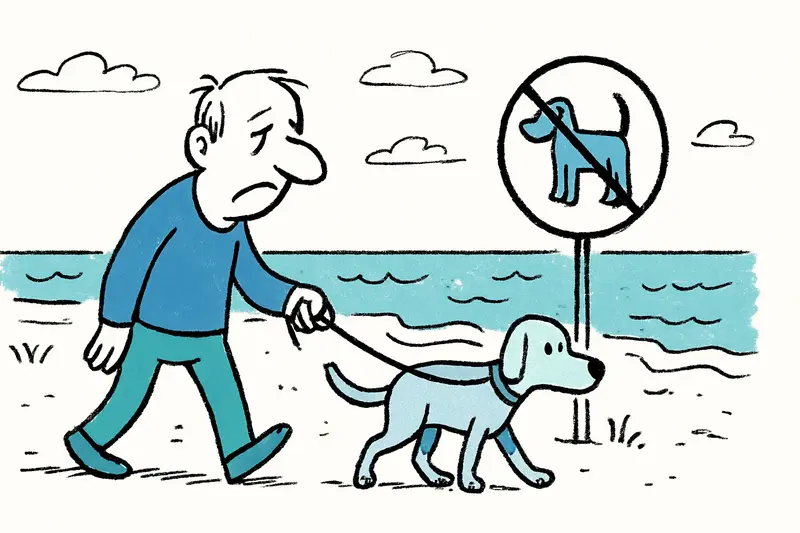
Campos bans pets at Es Trenc – what remains for dogs and owners?
Campos bans pets at Es Trenc – what remains for dogs and owners?
The municipality of Campos has excluded domestic and farm animals from beaches like Es Trenc by a general ordinance. A decision with consequences for locals, holidaymakers and the Salobrar protection area — and with open questions about enforcement and practical alternatives.
Campos bans pets at Es Trenc – what remains for dogs and owners?
Key question: Does the ban protect nature and bathers — or does it paper over a practical problem without creating alternatives?
The municipal administration of Campos recently confirmed a provision in its general public order ordinance that excludes dogs, cats, horses and other pets from beaches and bathing zones. It applies in practice from March to October; guide dogs for the blind are exempt. The legal basis is listed in the regulation under Article 38. The ordinance also sets duties for owners — obligation to pick up waste with bags, a ban on feeding on public streets, and a noise control rule for animals kept at night.
Critical analysis: On paper many points are understandable. Beaches are heavily used in season, and concerns like hygiene, allergies and disturbance are real. But the rules are uneven in many respects: they define "bathing area" very broadly — not only sandy coves but any stretch of coast where people regularly bathe. For dog owners in Campos, Ses Salines or Santanyí this effectively means that one of the last natural coastal strips, the Salobrar de Campos–Es Trenc protected area, becomes a no-go zone for people and dogs in summer. The ordinance regulates exclusion, but not compensatory measures.
What is missing from the official discourse: concrete alternatives. It does not say where dogs may safely run or swim during the closure period; there are no designated dog beaches, time-limited access windows or transition routes to exercise areas. Enforcement questions remain vague: who controls compliance, where are fines imposed, and how are seasonal visitors informed — in multiple languages? Also little addressed: the scientific basis for the measure. Are bird breeding seasons, nutrient-driven changes or concrete hygiene incidents documented? A mere administrative update carries different weight than a measure built on eco-monitoring and stakeholder dialogue.
Everyday island scene: It is early morning in Ses Covetes; the smell of sea and algae hangs in the air, fishermen are drilling holes into the wooden jetty, and an elderly man walks his dog on a leash before the sun fully hits the dunes. Those brief hours of harmony between people, animals and landscape are what many residents and regulars value. The new ban will affect these small rituals — not only at Es Trenc, but on several coastal stretches where locals have long used the area responsibly and considerately.
Concrete solutions (not just symbolism): 1) Designate specific dog zones: small, clearly delimited beach sections or parts of dune areas with seasonal time windows (for example early morning and evening) to give owners space without disturbing main bathing flows. 2) Temporary, marked dog areas on less sensitive coastal sections outside the core protected area; combined with information signs in German, English and Spanish. 3) Pilot project "dog-friendly times" with monitoring: test for six months, collect data on visitor numbers, waste disposal and disturbances. 4) Expand infrastructure: free dog-waste bag dispensers, secured trash bins, and tourist information campaigns. 5) Cooperation between the municipality, the conservation authority (because of the Salobrar status) and local animal welfare organizations: binding rules instead of blanket bans. 6) Clear enforcement rules: who controls, how cases are documented, what the fine scheme looks like — transparency builds acceptance.
Why this is not just a dog debate: For many Es Trenc is a public piece of landscape identity. A ban without alternatives shifts use to other, possibly more sensitive areas — for example small coves or the edges of salt marshes. Anyone who thinks the problem is solved by a simple access ban overlooks displacement and conflict effects. A well-managed measure would instead reduce conflicts while taking conservation interests seriously.
Pointed conclusion: Campos has the right to protect its coasts. But a sole ban feels like a makeshift move as long as the decision is not paired with practical alternatives, monitoring and clear communication. For pet owners, early-morning access, designated dog beaches or a time-limited trial concept would be fair compromises. The administration should now not only impose rules but open spaces for dialogue — otherwise there will be a lot of anger on the beach and little actual conservation gain.
Frequently asked questions
When is the best time to visit Mallorca for pleasant weather?
Can you swim in Mallorca year-round?
What should I pack for a Mallorca trip?
What family-friendly activities are there in Mallorca?
How should I choose a good beach in Mallorca?
Is it safe to hire a car in Mallorca?
How long should I stay to see Mallorca’s highlights?
Where can I find reliable weather forecasts for Mallorca?
Similar News

Sunset Society: Rooftop Night at Aethos Raig – House, All-White and Sea Views
On August 11 the Sunset Society filled the RAIG Rooftop Bar at Aethos Mallorca: house DJ, white outfits, sea views and a...

The striking restraint of guests: When will the island economy give way?
Hoteliers, taxi drivers and bus companies notice: holidaymakers are spending less. Is it due to prices, heat or simply t...

Feared roundabout at Son Rossinyol is being rebuilt — is Palma facing a year of gridlock?
The heavily used roundabout north of the Son Rossinyol business park in Palma will be significantly enlarged. Constructi...
More space to the island: Eurowings brings 'Premium BIZ Seat' to some Mallorca aircraft
Eurowings is equipping parts of its A320neo fleet with the new 'Premium BIZ Seat' from manufacturer Geven. From December...

Deceased main defendant: What does it mean for victims of the alleged fraud network in Mallorca?
The alleged mastermind of an international fraud case in Mallorca has unexpectedly died. For at least 40 victims, his de...
More to explore
Discover more interesting content

Boat Tour with BBQ along Es Trenc Beach

Private transfer from Mallorca Airport (PMI) to Pollensa
