
Cancer Fears, Masts and the Transparency Gap: What Esporles Teaches About 5G
Cancer Fears, Masts and the Transparency Gap: What Esporles Teaches About 5G
Fears are rising in Esporles: residents point to seven cancer cases near new antennas. Time for a sober check: what is known, what is missing — and how should municipalities act?
Cancer Fears, Masts and the Transparency Gap: What Esporles Teaches About 5G
A small Tramuntana village, big worries — and many unanswered questions
In Esporles some people still sit in the morning with their coffee on the plaça, listen to the carillon and suddenly discuss mobile masts instead of the weather. After the installation of a cellular antenna, neighbors report that several people within a radius of just a few dozen meters have been diagnosed with cancer. For residents who speak of about fifty families, this is not an abstract issue: it concerns houses, gardens and children playing on the pavement.
Key question: How does a municipality deal with technical infrastructure that triggers fears — and how robust are the links that are publicly claimed? This question is painfully concrete because it ties together health, law, technology and trust, as local debates over Palma steps up: More cameras, drones and the big question of privacy show.
The facts, as far as they can be reconstructed from local reports and known information: Mallorca now has numerous mobile installations; in Palma, for example, almost 400 antennas have been counted, although many are small fittings at bus stops or on traffic lights. Operators such as Telefónica report high 5G coverage rates: for the Balearic Islands a figure of around 96 percent of people in 63 municipalities was recently given.
The technical view can be stated clearly: international expert bodies on non-ionizing radiation have for years said that radio installations, when exposure limits are respected, do not pose a health risk. This is the official basis that administrations and network operators follow. Still, numbers sometimes sound dry when something seemingly new stands opposite one s own home — and that fuels mistrust.
Critical analysis: the tension arises in three areas. First, the epidemiological evidence — single clusters of illnesses in neighborhoods can occur by chance; causal chains are difficult to prove and require careful laboratories, registry data and time. Second, communication — authorities declare compliance with limits, but they rarely provide local, verifiable on-site measurements or easily accessible explanations that laypeople truly understand, as debates around Sensors on Mallorca's Beaches: Help for Self-Regulation or Creeping Surveillance? show. Third, procedural practice — citizens often feel insufficiently involved when masts are installed in sensitive locations.
What is missing in the public discourse: independent measurement series commissioned and published by the municipality; clear documentation of approval procedures; and an easy overview of who is responsible for what — operator, town hall, regional administration. There is also a lack of a low-threshold contact point for worried residents who do not want to resort immediately to protests or petitions, an issue explored in Who counts us on the beach? When sensors decide how Mallorca is distributed.
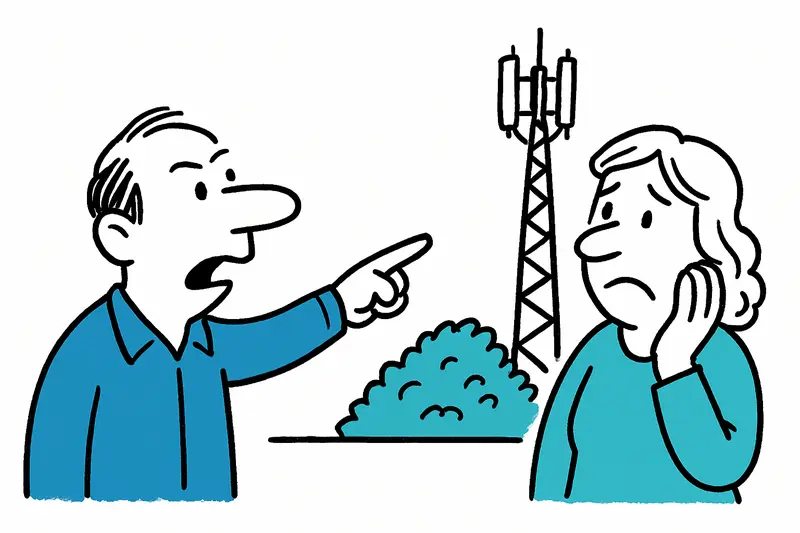
An everyday scene: on a cold January afternoon in front of the café on Carrer Major in Esporles, neighbors stand together. One points to a hedge behind which a pole with antennas has appeared recently. We are in the countryside, we did not want anything large, says an older woman. A young father pushes his stroller by and murmurs that he would sleep better at night if he had more information. Such conversations happen where authorities often do not listen.
Concrete approaches, without promising miracles:
- Transparent measurement campaigns: The town hall could commission independent EMF measurements in the affected streets and publish the results on a simple online map. Measurement protocols should be reproducible (time, device, measuring points).
- Local citizen participation: A binding hearing procedure for sensitive sites (schools, care homes, dense residential areas) and concrete alternative proposals, such as different mast locations or use of existing municipal structures.
- Expert dialogue with clear moderation: A panel of independent scientists, doctors and municipal representatives, moderated by the municipality, can present facts and structure neighborhood questions.
- Visual and noise mitigation, design solutions: Small technical adjustments and careful placement can reduce fears — even if they do not change the scientific risk assessment.
Examples from other places show that protests do not always arise from health concerns alone: approval errors or missing dialogue often lead to escalation. Sometimes an installation is later removed for formal deficiencies, not because scientific findings have changed. That should make municipalities vigilant: legally compliant procedures are the best foundation for acceptance.
Conclusion: Esporles is not an isolated case on Mallorca — the island is experiencing a rapid expansion of mobile networks, and that generates local conflicts. Facts and emotions sit close together. Municipalities thus have a twofold task: they must on the one hand enforce technical and legal standards and on the other restore trust through transparency and genuine participation. Those who ignore this risk dividing neighborhoods and later facing court challenges.
A small piece of advice at the end: open measurement data and a genuine offer to talk often have more impact than any technical lecture. And in Esporles, where the Tramuntana brings the wind, it would be progress if people at the coffee table talked about olive trees again rather than masts.
Frequently asked questions
Do 5G mobile masts in Mallorca pose a health risk?
Why are people in Esporles worried about a new antenna near their homes?
How can Mallorca residents check whether an antenna is actually within legal limits?
What should Mallorca town halls do when residents complain about a mobile mast?
How widespread is 5G coverage in Mallorca?
Why do mobile masts in small Mallorca villages cause more tension than in cities?
What kind of information do worried residents in Mallorca usually ask for about a mast?
Can a mobile mast in Mallorca be removed if the process was not handled properly?
Similar News
On the Edge: What Mallorca's Airport Loses If a Major Low-Cost Carrier Falters
The company that operates numerous connections from Palma to France and domestically is negotiating with creditors to re...
Ballermann star Frenzy wins 'Villa of Temptation' and donates prize money to Mallorca animal rescue
Ballermann singer Frenzy won the German reality show and donated the remaining prize money — around €14,080 — to an anim...
70 Trees Removed on Avenida Jaume I: What's Happening in Santa Ponça?
On October 1 the final redevelopment phase on Avenida Jaume I in Santa Ponça begins: 70 trees and old streetlights are t...

When a Boundary Is Crossed: The Case of Isi Glück and the Responsibility of Venue Operators
The singer from Mallorca reports an assault backstage in Halle. A clear guiding question, analysis of missing protective...
On the Brink: Volotea Fights for Survival — What Palma Can Expect Now
Volotea is negotiating its debts and plans to downsize its fleet. What consequences does this have for Palma, employees ...
More to explore
Discover more interesting content

Can Cap de Bou

Townhouse Lleo 72
