
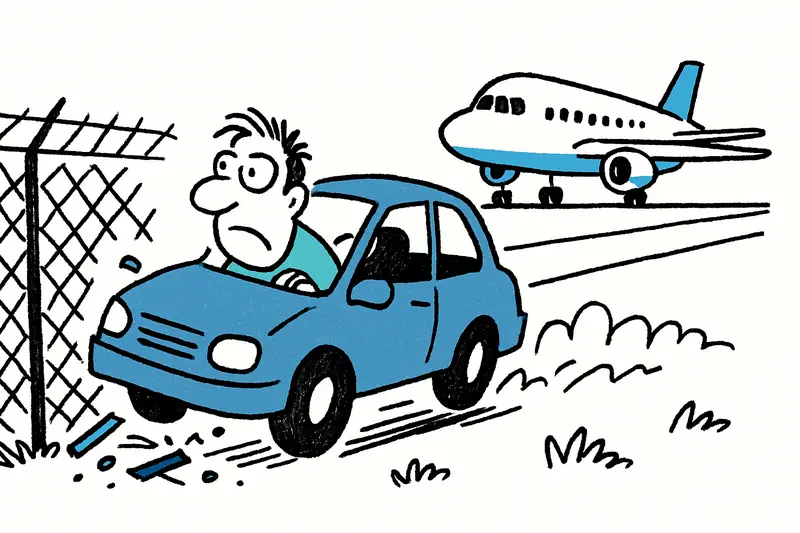
Car breaks through airport fence: How close was Mallorca to a catastrophe?
Shortly after five a.m., a car sped along the Camí Vell de Llucmajor, broke through the airport fence and came to rest just a few metres from the runway. Many questions remain: surveillance gaps, fence quality and traffic layout are now under scrutiny.
Car breaks through airport fence: How close was Mallorca to a catastrophe?
It was the early hours, the island still in dim light, seagulls screaming over the harbour and the first bus to Palma rolling along the Camí Vell de Llucmajor. Then, shortly after five, a jolt through the silence: a vehicle apparently lost control in a sharp 90-degree turn, broke through the metal fence of the airport grounds and sped across the secured area to within a few metres of the runway. Fortunately it ended with a scare — but the questions remain. The incident was first reported in Coche atraviesa la valla del aeropuerto: ¿Qué tan cerca estuvo Mallorca de una catástrofe?.
The facts, short and clear
According to investigators, the alleged driver is a 43-year-old Brazilian. After breaching the fence the car travelled around 49 metres before coming to a stop. The occupants left the vehicle on foot and disappeared, so police and the airport authority only noticed the incident hours later. There were apparently no injuries; flight operations were not immediately disrupted, as noted in Palma: Auto se detiene a un pelo de la pista de aterrizaje. Still, security forces speak of a "significant risk" — and rightly so, as local reporting also described the event in Palma: automóvil atraviesa valla y queda a solo metros de la pista de aterrizaje.
The central question: How could this happen?
How could a vehicle reach so close to the runway without being noticed immediately? That is the guiding question now echoing through the offices of the airport, the Guardia Civil and the town hall. A metal fence is supposed to mark the boundary, cameras and motion detectors should trigger an alarm, consistent with ICAO runway safety guidance. But here theory and practice only partially match. Possible gaps: suboptimal fence installation, missing or incorrectly aimed cameras, reduced nighttime monitoring capability or simply the division of responsibilities between the airport operator and the municipality.
What is often overlooked: responsibility, costs and priorities
The public debate focuses largely on the immediately visible parts — the destroyed fence, the dramatic proximity to the runway. Less examined is who is responsible for which protective measure. If a section of the road runs across municipal land, the municipality is responsible for traffic safety, not the airport. And while airports typically invest in the security of their premises, the adjacent infrastructure often falls into a blind spot. That is expensive, but urgently needed when events with high damage potential occur.
Investigated causes — and what they tell us
Initial investigations point to excessive speed in the curve as the likely cause. That fits with observations from many residents who often see vehicles travelling too fast at this spot, especially in the early morning hours when the island is still asleep. But speed alone does not explain why no one noticed the fleeing occupants or why alarm systems did not activate. Darkness, wind and low personnel presence outside regular working hours may also have played a role.
Specific vulnerabilities
The following points weigh particularly heavily and are now being checked:
- Physical barrier: The existing metal fence offers little energy absorption — a vehicle can break through it easily. Protective mesh systems or catch walls would be safer.
- Surveillance: Cameras, motion detectors and alarm protocols must be coordinated. An abandoned car that remains unnoticed for hours points to communication and jurisdictional problems.
- Traffic layout: The 90-degree curve itself is a danger point. Better signage, road narrowing, a lower speed limit or structural redesign of the curve could reduce accidents.
Concrete opportunities for improvement
The incident is a warning sign and at the same time offers opportunities to implement small, cost-efficient measures that provide substantial safety gains:
- Add sensors: Motion and vibration sensors on the fence that automatically notify the airport authority and police.
- Upgrade the fence: Higher-energy-absorbing barriers at sensitive points or the installation of a catch wall in particularly hazardous sections.
- Traffic calming: A radical solution: ease the curve or introduce a speed limit with fixed enforcement. That would not only reduce aviation risks but also improve safety for commuters.
- Rosters and communication: Better coordination between the airport security and the Guardia Civil during night and early shifts, with clear reporting chains for unusual incidents.
What is still open
Why the occupants left instead of seeking help is part of the police investigation: fear of legal consequences, missing papers, alcohol or panic — anything is possible. It is also unclear whether liability insurance will cover the damage or whether criminal investigations for endangering air traffic will follow. These processes can take weeks.
A conclusion from Mallorca's perspective
For residents of Llucmajor the feeling remains: that was lucky. For the authorities it is a wake-up call. Mallorca is loud, full of life and sometimes a bit chaotic — but precisely for that reason we must not relax when it comes to safety. A stronger fence, a few sensors and revised traffic management would not only restore a fleeting sense of security but reduce real risks. And next time the seagulls scream over the airport, we should rely less on luck and more on prevention.
Investigations are ongoing. We will continue to follow and report new findings first-hand.
Frequently asked questions
How close did the car get to the runway at Palma de Mallorca Airport?
Did the incident at Palma Airport disrupt flights?
Why is the car incident at Mallorca Airport being treated as a security concern?
What may have caused the car to crash through the fence near Palma Airport?
Who is responsible for safety around the road near Palma Airport?
What improvements could prevent a similar incident at Mallorca Airport?
What happened to the people who left the car at Palma Airport?
Was anyone injured in the airport fence incident in Mallorca?
Similar News
More than €450,000 watch seized: What remains from the raid against gangs?
The National Police report 34 arrests and the seizure of a watch worth more than €450,000. A reality check: what do the ...
When a Piece of the Sea Disappears: Portixol Pool in Limbo
Portixol in Palma faces a decision: the license for the terrace and pool on public waterfront land expires at the end of...
Magaluf: Fire on Punta Ballena — about 50 evacuated and many unanswered questions
On Monday afternoon a fire in a shop on Punta Ballena street in Magaluf prompted the evacuation of about 50 people. The ...
When the Village Street Became a Flood: What Storm Adam Reveals About Mallorca's Vulnerability
Roaring water turned Carrer de Palma in Consell into a torrent on 19 October; on the coast beachgoers helped prevent a s...
Krümel in a celebratory mood: How Peguera danced at the season closing
With accordion, glitter and an international audience: Marion "Krümel" Pfaff combined her birthday with the season-closi...
More to explore
Discover more interesting content

Can Cap de Bou

Townhouse Lleo 72
