
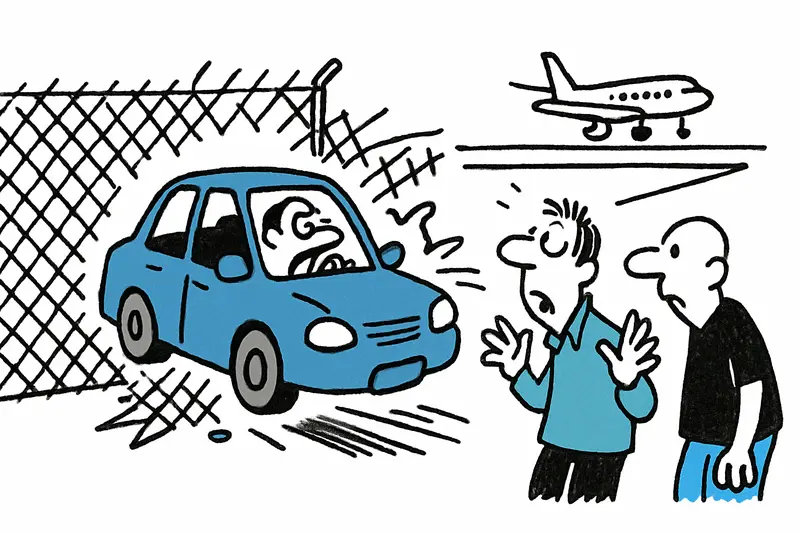
Fence at Palma Airport Breached — Car Stopped Only Meters from Runway
On the night of September 7, a car sped along the access road to Palma Airport, tore down a security fence and came to rest only a few meters behind the protective barrier near the runway. A lucky escape — and many open safety questions.
Close Call: Car Stops a Few Meters from the Runway
In the early hours of September 7, the normally quiet access road to Palma Airport witnessed a chilling incident: a car left the road, breached a section of the security fence and came to rest only a few meters behind the protective barrier near the runway. It was around 02:30 when squealing tires and bright headlights alarmed residents and night workers, as described in Car breaks through airport fence: How close was Mallorca to a catastrophe?.
Witnesses, forensic teams and first facts
A bus driver running a late route to Palma described the scene: "You only heard a crash, then the car was behind the fence. Quite eerie." The Guardia Civil reportedly found the vehicle only hours later. Several people were in the car; according to reports, some left the scene on foot after the impact. A driver was later identified, and police are investigating endangering air traffic and property damage.
The signs on the fence are clear: ripped clumps of earth, rubber marks on the asphalt and scattered car parts. A security officer briefly observed at the scene summed it up dryly: "You rarely see something like this. And when you do, we always hope nobody is sitting in an aircraft that is about to take off."
The central question: How could a car get so close to the runway?
The official short answer is "reckless driving". But that only explains the immediate event, not the structural issues behind it. How stable are the fences along the airport perimeter really? What weaknesses do access roads, parking areas or service lanes present that could be exploited for such an incident? And how quickly does the alarm chain between the guard, the airport control center and air traffic control activate?
What is often underplayed in public debate: airport perimeters are not a uniform wall. Different fences, gates for suppliers, emergency access routes and older sections create a mosaic structure — and each segment has its own weaknesses. Night lighting, sightlines and the topography of the access road play a role. A car doesn't need a rocket to create a deadly situation: with enough speed and a weak spot in the fence, a single impact is enough, a point also explored in A Hair's Breadth from the Runway: Why Palma's MA-19 Needs More Protection.
What's missing in the debate — and what would help now
Beyond the obvious, we should discuss three things: prevention, construction standards and communication. Preventive measures, both technical and organizational, would be effective: more robust fence foundations at critical points, sacrificial scissor gates instead of easily breached sections, protected light towers with motion detectors and cameras with automatic alarm forwarding to the airport control center.
When it comes to construction standards, maintenance deserves attention: How often are fences, foundations and lighting checked? A regular inspection schedule, documented repairs and a spare-parts strategy could fix simple weaknesses before they become problems. Technical solutions like catch basins or speed-reducing sections at access points could reduce a vehicle's speed before it reaches critical areas.
Finally, communication: staffing is thin at night. Clear reporting routes between the Guardia Civil, airport operations and air traffic control must be established and rehearsed. Short response times are vital here — not only after a vehicle is already behind the fence.
Social and preventive aspects
Another often overlooked point is the local context: according to emergency services, the occupants came from the Son Banya neighborhood. It would be short-sighted to simply condemn the act; underlying social and economic factors often contribute to risky night driving or flight-like behaviour. Preventive measures should therefore be thought of not only structurally but also socially: awareness campaigns, integration of neighborhood organizations and coordinated patrols could help prevent repeats without relying solely on punitive measures, a perspective also mentioned in Coche atraviesa la valla del aeropuerto: ¿Qué tan cerca estuvo Mallorca de una catástrofe?.
Demands and practical steps
Concrete proposals that could be implemented in the short and medium term: 1) immediate inspection of all fences along the runway area, 2) installation of additional lighting and motion-activated cameras at critical points, 3) setup of technical speed-reducing features at access roads (speed humps, catch basins), 4) regular alarm and response exercises between the airport and the Guardia Civil, 5) local prevention programs in problematic neighborhoods.
It is important that politicians and the airport operator do not rely on the chance that "this time it was lucky." The images of the damaged fence, the smell of burnt rubber and the distant roar of starting engines at night remind us how close the incident came.
Conclusion
The incident at Palma could have ended far worse. Investigations are ongoing and the fence damage has already been partly repaired. But the real challenge begins now: the near-miss must become a lesson — technically, organizationally and socially. Only then can we ensure that the next squeal of tires at night does not become a catastrophe.
Frequently asked questions
How could a car get so close to the runway at Palma Airport?
Is it common for Palma Airport fences to have weak spots?
What happens after a security incident near the runway at Palma Airport?
What safety improvements could help prevent another incident at Palma Airport?
Was anyone injured in the Palma Airport fence incident?
Where did the Palma Airport car incident happen?
How quickly do airport and police teams react when a fence is breached at Palma Airport?
Why is the Palma Airport fence incident being linked to local prevention work?
Similar News
Partial collapse at Palma airport – who is liable for dilapidated infrastructure?
Heavy rain caused part of a plasterboard ceiling and the roof of a former cinema to partially collapse in Son Sant Joan....
The "Cóndor" in Palma: Superyacht look, law enforcement claims — a reality check
43 metres, around 4,000 hp, built in Galicia: the customs patrol "Cóndor" is moored in Palma. Why that is impressive — a...
Tennis legend Gabriela Sabatini delights at the "Corporate Circle" in Santa Ponsa
An evening where sport and connection came together: Gabriela Sabatini led a masterclass at the Mallorca Country Club, f...

Small Places, Big Money: Why Fornalutx Is Leading — and What That Means for Mallorca
New tax data paint an ambivalent picture: a tiny mountain village tops the Balearic income list while other municipaliti...
Toxic rubber surface on playgrounds: Who protects our children in Mallorca?
Parents demand an end to pollutant-containing rubber surfaces. Local groups show cracked flooring — the city announces t...
More to explore
Discover more interesting content

Can Cap de Bou

Townhouse Lleo 72
