
Partial collapse at Palma airport – who is liable for dilapidated infrastructure?
Partial collapse at Palma airport – who is liable for dilapidated infrastructure?
Heavy rain caused part of a plasterboard ceiling and the roof of a former cinema to partially collapse in Son Sant Joan. The incident raises questions about maintenance, transparency and the protection of passengers and schools.
Partial collapse at Palma airport – who is liable for dilapidated infrastructure?
Guiding question: How safe are public buildings in Mallorca during extreme weather — and who must be held accountable?
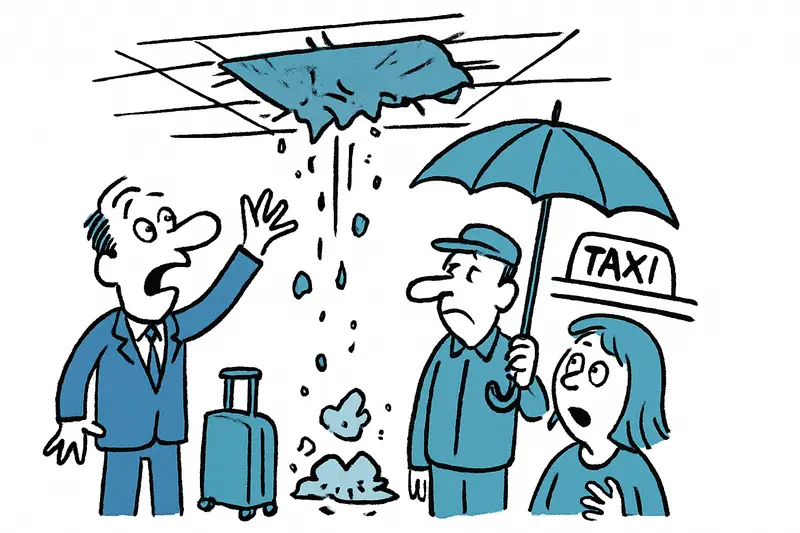
This week, heavy rain associated with the low-pressure system 'Dana Adam' exposed two visible weaknesses in Palma: in the office and storage area of the airport a section of a plasterboard ceiling collapsed (see Water in the Check‑in: Drops Again, Questions at Palma Airport), and in the El Vivero district a section of the roof of the former 'Iris' cinema gave way. According to the airport operating company, the affected area was cordoned off due to ongoing work and for safety reasons. No injuries were reported. Water played a role in both places — and with it come questions that are not only structural in nature.
A simple look on a rainy day at Son Sant Joan is enough: the halls fill with the typical smell of wet cardboard and damp insulation, announcements over loudspeakers are accompanied by the sound of dripping, we see baggage belts running more slowly, and taxi drivers stand under their umbrellas (for broader reporting on how storms act as a stress test for the airport, see Rain Chaos at Palma Airport: A Rainy Day as a Stress Test). For passengers coming from non-EU countries who pass the tax-free area, the incident is particularly unpleasant because the ceiling was affected exactly there — an area with public traffic, not just a closed storage room.
Critical analysis: three levels converge. First: materials and construction. Plasterboard ceilings are light and quick to install, but they react sensitively to penetrating water (see related construction concerns in Wall Collapse at Palma Airport: More Than an Accident — How Safe Are the Major Works Really?). Second: maintenance and inspection. Running an airport is not just about flight operations; it also includes the obligation to systematically check weather risks and weak points. Third: communication and transparency. Airport employees report that this is not the first time — information that must be taken seriously, because repetition can indicate structural deficiencies.
What is often missing in public discussion: people talk about diverted flights, cordoned-off areas or school closures, but rarely about who draws up maintenance plans, how inspection intervals are documented, and whether private contractors or the operating company can be held responsible for missed checks (see reporting on worker safety and site oversight in Another accident at Palma Airport: Worker falls on construction site — who protects the employees?). Also rarely discussed is how older buildings like the former cinema in urban neighborhoods are prioritized for renovation or demolition.
There is also a lack of clear information for those affected: passengers, parents of schoolchildren and business owners in affected neighborhoods need simple access to inspection reports and rapid information points when damage occurs after heavy rain. Without this transparency the debate remains at the level of concern and rumours.
Concrete solutions: 1) Immediate independent inspection of the affected areas at the airport and in the El Vivero neighbourhood with publication of the results; 2) short-term securing of public walkways at long-term construction sites and during forecast heavy rain, including clear diversion and information plans; 3) establish mandatory inspection intervals for interior and exterior ceilings in public buildings and make them digitally accessible; 4) replace vulnerable materials (where possible) with more water-resistant alternatives in sensitive areas such as customs and tax-free zones; 5) municipal inventory of old building fabric with prioritisation of schools and heavily frequented sites; 6) a reporting office for employees who observe structural defects — protected and anonymous.
Practical everyday tip for travellers and residents: during heavy rain keep an eye out, avoid wet spots, do not place bags directly under ceiling areas and photograph and report damage immediately. Quick documentation helps later with claims and makes problems visible.
Why this matters: a few drops of water may seem harmless, but they are not for materials not designed for prolonged moisture. Recurring incidents erode trust in operators and authorities and lead to higher costs when repairs are only carried out reactively. Above all, it is about safety — for commuters, tourists and schoolchildren.
Conclusion: the visible damage is only the tip of the iceberg. If ceilings and roofs give way during heavy rain, this is not solely a natural event, but also a test of planning, maintenance and accountability. Those who fail to act in time risk not only property damage but also the trust of the island's residents. It would be a good first sign to now disclose maintenance plans and the steps that will follow to secure infrastructure sustainably.
Frequently asked questions
How safe are public buildings in Mallorca during extreme weather, and what happens if they show signs of wear?
Who is responsible for maintenance and safety of Mallorca's public infrastructure, such as airports?
How should transparency be handled after public infrastructure incidents in Mallorca?
What happened at Palma airport during recent heavy rain, and what concerns does it raise?
What practical safety tips should travellers follow during heavy rain at Palma airport?
What improvements are suggested to prevent similar incidents in Mallorca's public buildings?
Why is timely planning and maintenance important for residents of Mallorca?
What should travellers plan for Mallorca during the rainy season in terms of weather and infrastructure?
Similar News
The "Cóndor" in Palma: Superyacht look, law enforcement claims — a reality check
43 metres, around 4,000 hp, built in Galicia: the customs patrol "Cóndor" is moored in Palma. Why that is impressive — a...
Tennis legend Gabriela Sabatini delights at the "Corporate Circle" in Santa Ponsa
An evening where sport and connection came together: Gabriela Sabatini led a masterclass at the Mallorca Country Club, f...

Small Places, Big Money: Why Fornalutx Is Leading — and What That Means for Mallorca
New tax data paint an ambivalent picture: a tiny mountain village tops the Balearic income list while other municipaliti...
Toxic rubber surface on playgrounds: Who protects our children in Mallorca?
Parents demand an end to pollutant-containing rubber surfaces. Local groups show cracked flooring — the city announces t...
Nighttime closure in the Sóller Tunnel: Who pays for the long detour?
The Sóller Tunnel, the main access to the Orange Valley, will be closed at night until November 19. Anyone driving betwe...
More to explore
Discover more interesting content

Can Cap de Bou

Townhouse Lleo 72
