
Nighttime closure in the Sóller Tunnel: Who pays for the long detour?
Nighttime closure in the Sóller Tunnel: Who pays for the long detour?
The Sóller Tunnel, the main access to the Orange Valley, will be closed at night until November 19. Anyone driving between 10 p.m. and 6 a.m. must use the winding mountain pass. A reality check: what this means for residents, businesses and emergency services – and how it could be managed better.
Nighttime closure in the Sóller Tunnel: Who pays for the long detour?
Key question: How well is Mallorca prepared for nighttime traffic interruptions – and who bears the costs of detours, delays and increased risks?
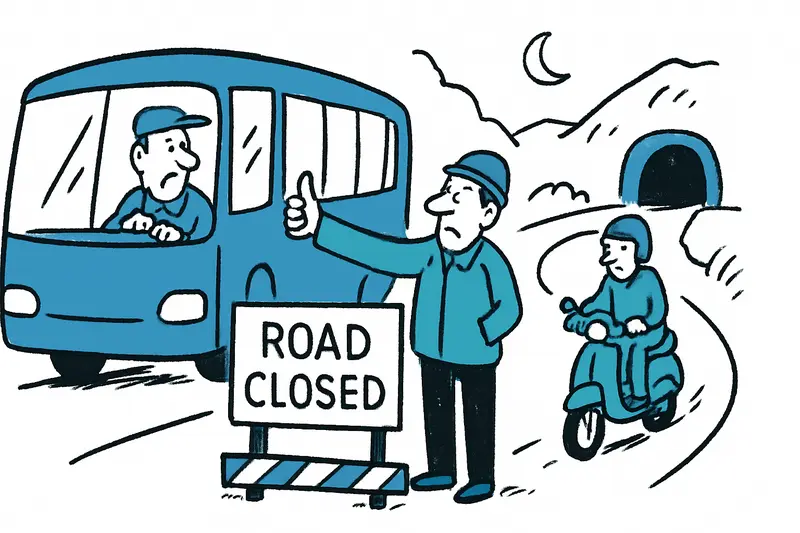
The Sóller Tunnel, that long tube connecting Palma with the Orange Valley, will be closed at night; as detailed in Nightly Closures in the Sóller Tunnel: Commuting, Detours and Smart Solutions. The connection will be shut from 10 p.m. to 6 a.m., Monday to Friday, until November 19 – a measure announced by the island council to carry out construction work. For many this may sound routine at first. In reality it means: more kilometres on narrow mountain roads, time pressure for shift workers and extra strain on emergency services.
If you now hear traffic on a mild evening that thinned out at Passeig del Born and heads toward Sóller, you have to rethink your route. The alternative is Coll de Sóller – the old mountain pass road: narrow, winding and slippery when wet. In practice this means slower driving, more overtaking maneuvers and greater stress. Residents report that even in high summer, when tourists fill the valleys, cars often parked at the roadside and motorcycles with flashing lights set the pace. Nighttime closures amplify such scenes.
There are reasons for the closure: tunnel maintenance and construction work are important for safety. The history of the structure is part of the island's story: construction began in the late 1980s, stopped in 1993, breakthrough in 1995, opening in 1997. Yet the question remains whether planning and communication are sufficient. The measure may be technically necessary, but the effects on road safety, the economy and everyday life have so far been treated too superficially in public information.
Critical analysis: The announcement explains that the tunnel will be closed at night – not much more; this lack of detail is mirrored in reporting on nighttime construction on Palma's ring road. Missing points in the public discourse are concrete: Which detour routes are cleared for emergency vehicles? Are there special regulations for scheduled buses or staff of hotels and clinics? How will truck and delivery traffic be handled? And who will compensate the additional costs for businesses in the valley whose supply chains now take longer?
There is also a safety aspect: ambulances and fire brigades must check whether the pass road is reliable in all weather conditions. Experience shows that the Tramuntana can be unpredictable on stormy autumn nights. If detour routes are not properly prepared, the risk increases in the event of accidents or medical emergencies.
What is missing from the discussion: real figures and concrete operational plans. Instead of general notices, the responsible bodies should publish maps with closure zones, marked lane widths, permitted times for delivery traffic and clear emergency plans. A simple, drivable overview would be worth its weight in gold for taxi companies, bus drivers and night-shift workers. Regular updates by SMS or notices at petrol stations and in the parking areas in front of the tunnel would also be pragmatic.
Everyday scene: It is shortly after 10 p.m., the sky over Palma is still mild. An empty scheduled bus from Palma rolls toward Sóller, the driver pulls his jacket tighter at the roadside petrol station. He knows the route, he knows the tight bend before Biniaraix. Today he has to leave an hour earlier to make his shift. On the Coll de Sóller an elderly resident who has never left the valley in decades waves at a young delivery driver taking the corner too wide. These small moments show how much people cling to routines – and how quickly these routines can be disrupted by a closure.
Concrete solutions: 1) Coordinate night lines or shuttle buses between Palma and Sóller, especially for shift workers and patients. 2) Temporary speed regulations and improved lighting on the Coll de Sóller, combined with mobile warning signs. 3) Priority rules and escorts for emergency vehicles; clear agreements between the island council and municipal fire departments. 4) Information campaign: maps, PDF plans, notices at petrol stations and hotels as well as targeted SMS notifications for registered commuters. 5) Short-term subsidies or compensation payments for small businesses demonstrably suffering economic damage from longer transport times.
These proposals are not magic bullets. They are pragmatic and do not impede the necessary work in the tunnel. What matters is that planning considers as many everyday scenarios as possible – from the taxi driver to the nurse to the construction delivery. A little respect for the island's nocturnal rhythm would be enough to reduce frustration and unnecessary risks.
Conclusion: The closure of the Sóller Tunnel is a necessary construction project, but so far it has been seen too much as a technical measure and too little as an intrusion into daily life. Whoever clearly names the costs of detours and dangers and implements simple, concrete measures will prevent jams, uncertainties and unnecessary risks. Otherwise the bill will ultimately fall on the people in the valley – and that would be sad, because they are exactly the ones we want to protect.
Frequently asked questions
How will the nighttime closure of the Sóller Tunnel affect travel between Palma and Sóller?
Are detour routes and emergency vehicle access clearly published for the Sóller Tunnel closure?
What practical steps are being considered to keep people and goods moving during the closure?
How could emergency response times be affected by the closure, especially in bad weather?
What channels will provide updates about the Sóller Tunnel closure?
What should drivers know about the Coll de Sóller detour during the closure?
Will local businesses and valley residents receive any compensation or support due to longer transport times?
Why is the Sóller Tunnel closure considered necessary, and how is Mallorca balancing safety with daily life?
Similar News

Season Review Ballermann 2026: Hit Waves, Artist Fees and the Question of Sustainability
'Mon Amour' dominated the Playa; stars like Jason Derulo and Haftbefehl performed, but minimum spend rules and XXL fees ...
Warning Level Remains: Why Mallorca Needs More Than Sirens
On Sunday the Es-Alert sounded on thousands of phones, Palma closed schools, and a tree fell on Calle Joan Crespí. The w...

Storm 'Adam' hits airports: 64 cancellations and 16 diversions in Mallorca and Ibiza
The storm system Adam noticeably disrupted air traffic in Mallorca and Ibiza: 64 flights were canceled and 16 diverted. ...
Chairs Fly on the Plaza: How Dangerous Is the Presence of Right‑Wing Groups in Palma?
An information stand by the group Núcleo Nacional escalated on the Plaza Mayor: activists threw chairs, the Policía Naci...

Sandy Wagner: The 'Macarena' Man Who Connects Ballermann with Music
Since the 1990s Sandy Wagner has been bringing atmosphere to Ballermann — live, with a guitar and a small pre-show ritua...
More to explore
Discover more interesting content

Can Cap de Bou

Townhouse Lleo 72
