
Storm 'Adam' hits airports: 64 cancellations and 16 diversions in Mallorca and Ibiza
Storm 'Adam' hits airports: 64 cancellations and 16 diversions in Mallorca and Ibiza
The storm system Adam noticeably disrupted air traffic in Mallorca and Ibiza: 64 flights were canceled and 16 diverted. A critical look at causes, gaps in crisis management and concrete improvements.
Storm 'Adam' hits airports: 64 cancellations and 16 diversions in Mallorca and Ibiza
Key question: Why did air traffic fall out of step so quickly – and what needs to change?
On Sunday the severe weather, reported under the name Adam in forecasts, caused noticeable disruption at the islands' airports. According to the operator, a total of 64 flights were canceled; 37 departures and arrivals were affected at Son Sant Joan in Palma and 27 at Ibiza. In addition, 16 flights had to be diverted to the neighboring island. At Ibiza flight operations were completely suspended for two hours, and ground crews had to carry out drainage work during two morning windows (first interruption 10:00–11:00, further work between approximately 11:15 and 12:15). These disruptions were also reported in Storm Chaos in Palma: Why a Storm Slows the Airport So Much — and What Needs to Change.
These numbers may sound like a sober statistic, but for travelers they meant sudden changes of plans and for logistics partners a domino effect. In Palma, travelers queued with wet suitcases, taxis were honking near the entrance, and traffic on the access road felt unusually congested. On Ibiza, the P1 car park was temporarily inaccessible because a canopy collapsed; one lane of the express parking remained out of service.
Critical analysis: the figures are clear, the causes are multifaceted. Heavy rain cannot be prevented, but questions arise about how well airports and responsible authorities are prepared for predicted extreme events. Two aspects stand out: infrastructure and decision-making under time pressure. Drainage systems, canopies at access points and the resilience of outdoor facilities were visibly strained. At the same time, the short, repeated operational interruptions show that procedures during intense rain tend toward reactivity rather than proactive measures. Similar reactive patterns were described in Summer thunderstorm brings Palma Airport to a halt — Nearly 100 delays and what it means for travelers.
What is often missing in public debate: clear assignment of responsibility and pragmatic steps for travelers. The discussion quickly centers on canceled flights, less often on who bears costs and detours, how fast information reaches affected passengers, and what alternatives are offered on site. EU rules on compensation can be relevant, but many affected people do not know what claims they have or how to assert them.
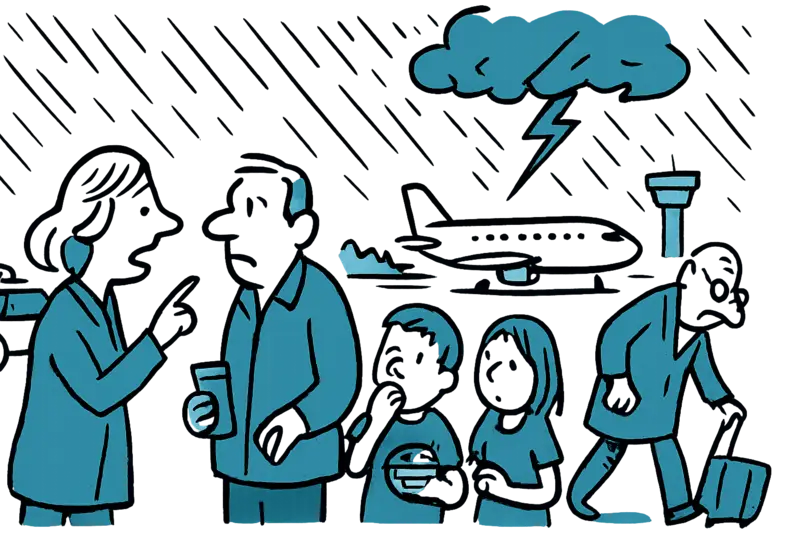
Everyday scene from Palma: rain blowing across the pavement, bus headlights reflecting on Passeig Mallorca. At the taxi rank travelers argue with an airline employee, two children eat fries from a plastic box, an elderly man struggles with a wet rollaboard. Small gestures, loud announcements over loudspeakers, and constant updates on smartphones – that was the 'controlled' chaos on an autumn Sunday.
Concrete solutions: first, preventive infrastructure measures. Regularly review and, if necessary, expand drainage concepts for runways and access roads; keep temporary barriers and waterproof covers ready for vulnerable spots; reinforce canopies and signage to prevent falling parts from blocking entrances. Second, clearer operational protocols for weather warnings: define thresholds for temporary closures so decisions are not made ad hoc and inconsistently. Third, better communication for air travelers: automatic push messages with clear information on alternatives (rebooking, refunds, shuttle buses) and central collection points for affected passengers. Fourth, cooperation between airports, airlines and local authorities to quickly coordinate ground staff and buses when car parks or access roads are closed.
Practical immediate measures that pay off in the medium term: regular emergency drills in late autumn, seasonal reinforcement of cleaning crews after heavy rain, and identifying temporary alternative areas for stranded vehicles so feeder traffic does not block emergency routes. Transparent documentation of incidents also helps: a public review of how and why certain decisions were made builds trust and provides starting points for improvement; see Power Outage and Storm: What the Incident at Palma Airport Really Reveals.
Concise conclusion: Storm Adam exposed gaps that should be closed sooner rather than after the next storm. Weather extremes will occur more often; pragmatic, well-communicated measures – from improved drainage to clear information chains – reduce chaos at terminals and save travelers time and money. Technology can do much, but it only works with clear procedures, good equipment and some advance planning.
Frequently asked questions
How can storms like Adam affect flights in Mallorca and what should travelers expect?
What exactly happened at Son Sant Joan in Palma and Ibiza during Storm Adam?
What infrastructure gaps did Storm Adam reveal at Mallorca's airports?
How did weather affect parking and access at Ibiza's airport during the storm?
What steps can airports and authorities take to handle heavy rain more effectively?
What practical steps should travelers take when flights are disrupted by storms in Mallorca?
Why is autumn storm planning important for Mallorca airports and what can be done?
Will extreme weather events become more common in Mallorca and how should travelers adapt?
Similar News

Small Places, Big Money: Why Fornalutx Is Leading — and What That Means for Mallorca
New tax data paint an ambivalent picture: a tiny mountain village tops the Balearic income list while other municipaliti...
Toxic rubber surface on playgrounds: Who protects our children in Mallorca?
Parents demand an end to pollutant-containing rubber surfaces. Local groups show cracked flooring — the city announces t...
Nighttime closure in the Sóller Tunnel: Who pays for the long detour?
The Sóller Tunnel, the main access to the Orange Valley, will be closed at night until November 19. Anyone driving betwe...

Season Review Ballermann 2026: Hit Waves, Artist Fees and the Question of Sustainability
'Mon Amour' dominated the Playa; stars like Jason Derulo and Haftbefehl performed, but minimum spend rules and XXL fees ...
Warning Level Remains: Why Mallorca Needs More Than Sirens
On Sunday the Es-Alert sounded on thousands of phones, Palma closed schools, and a tree fell on Calle Joan Crespí. The w...
More to explore
Discover more interesting content

Can Cap de Bou

Townhouse Lleo 72
