
Power Outage and Storm: What the Incident at Palma Airport Really Reveals
A thunderstorm, a tripped circuit breaker and around two hours of standstill at Palma Airport yesterday afternoon delayed or canceled nearly 100 flights. The events expose weaknesses—especially in communication and redundancy. Why this is not just a technical issue, and how travelers and the airport can be better prepared.
Power Outage and Storm: Between Chaos and Improvisation at Palma Airport
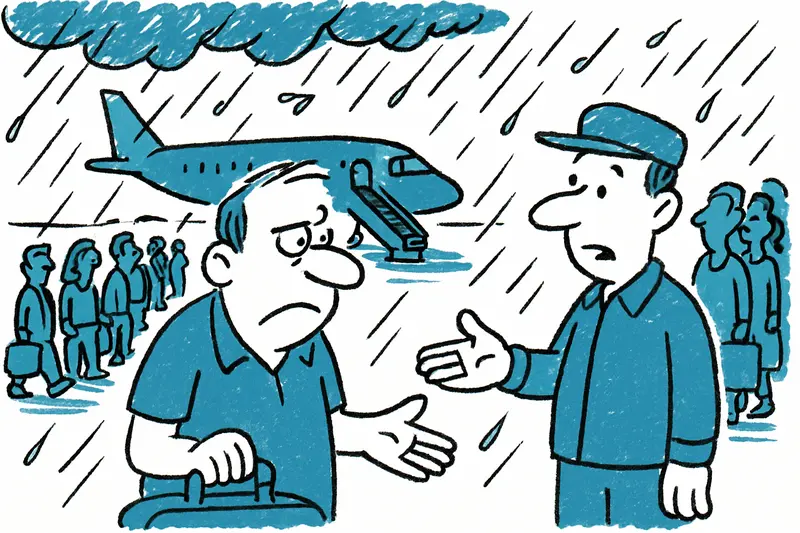
Yesterday afternoon, as rain pelted the terminal windows and wind tugged at the apron lights, it became visible in Terminal A how quickly routine can unravel. Around 4:20 p.m. power failed in several areas. For roughly two hours jet bridges were out of service, ground handling operated only in a limited capacity, and departure screens showed delayed times – in the end nearly 100 delayed flights and several cancellations.
Those who were at Gate 12 around 5:00 p.m. could observe the scene: buses rattled between plane doors and the terminal, passengers disembarked via mobile stairs, umbrellas were hastily closed. The air smelled of wet asphalt and coffee, voices rose, sometimes irritated, sometimes understanding. An elderly German couple sat on a bus for two hours before an alternative aircraft was available – a small satire of modern travel: two hours by bus instead of a lounge. Similar scenes with long queues were reported elsewhere during the storm, as described in Storm Chaos in Palma: Why a Storm Slows the Airport So Much — and What Needs to Change.
The key question: How vulnerable is an airport to weather and technical failure?
The immediate response from the airport management: safety and air traffic control were guaranteed at all times, technicians reacted quickly. The central question remains: why did a single failure affect so many systems at once? A tripped circuit breaker during a thunderstorm suggests that several critical components were not sufficiently redundantly protected.
Less visible, but just as serious, was the information management. Many passengers complained about missing or meaningless information – Gate 12 was plagued by uncertainty while staff in other areas tried to maintain calm and clarity. This highlights a problem that often goes unnoticed: it is not only the technology that must be robust, but also the communication chain between the airport, airlines and travelers.
And the less highlighted consequences
Short-haul flights within Europe were particularly affected, a point explored in Storm chaos in Palma: Why a thunderstorm disrupts the airport — and how we should plan smarter. That has consequences beyond the day: connecting flights, holiday plans, transfers – everything falls apart when a hub stalls. For the local economy this means invisible costs: extra hotel nights, disgruntled guests, increased pressure on rental car and taxi services.
Another often overlooked risk is the single-point-of-failure principle: thunderstorms hit the island regularly, so the probability of such events is not low. It’s not only about fixing individual errors, but about whether the airport has systematically minimized these routine interruptions.
Concrete proposals: What could be improved
Power and system redundancy: Multiple independent power circuits and automatic transfers can prevent a single breaker from crippling so many functions at once. Emergency generators should be sized so that jet bridges, central control systems and communication infrastructure can run in parallel.
Strengthen communication chains: A clear, redundant communication plan – SMS, app notifications, loudspeaker announcements at central points – can significantly reduce unrest. Crucially, information must be binding and timely, not just general advice.
Drills and scenarios: Regular emergency exercises with airlines, ground staff and security services under realistic conditions help streamline procedures. These exercises should also practice how to reroute and inform passengers at short notice.
Prepare travelers better: Simple measures help immediately: more flexible check-in recommendations during storm warnings, information on travel insurance and clear guidance on rebooking rights can reduce frustration.
Practical tips for the coming days
Before you leave: Check your flight status online or in the airline app. During storm warnings it is worth a double check by phone.
Getting to the airport: Allow extra time: on our island traffic jams and sudden bad weather can appear without warning. Two hours before departure can be tight for short-haul flights.
In case of an incident: Keep passports, booking numbers and some drinking water handy. Courtesy toward staff opens doors – often it is the people on site who find solutions.
Yesterday's incident was not a drama, but a wake-up call. It shows that technology and weather together remain a challenge – and that communication is often as important as backup batteries. I will keep following and report if there are new findings about the cause or planned improvements.
Frequently asked questions
What happens at Palma Airport during a storm-related power outage?
How bad can flight delays get at Mallorca Airport during severe weather?
Why is communication so important during airport disruptions in Mallorca?
How should I prepare for a flight from Mallorca when storms are forecast?
Can a storm at Palma Airport affect connecting flights and transfers?
Is Mallorca Airport prepared for repeated thunderstorms?
What should I do if my flight from Palma is delayed during bad weather?
Does bad weather in Mallorca usually mean flight cancellations or just delays?
Similar News

Who Bears the Burden? Mallorca Between Tenant Protection and Landlord Fears
Madrid's new housing decrees strengthen tenant rights — but on Mallorca concern is growing: will the law drive small lan...
On the Edge: What Mallorca's Airport Loses If a Major Low-Cost Carrier Falters
The company that operates numerous connections from Palma to France and domestically is negotiating with creditors to re...
Ballermann star Frenzy wins 'Villa of Temptation' and donates prize money to Mallorca animal rescue
Ballermann singer Frenzy won the German reality show and donated the remaining prize money — around €14,080 — to an anim...
70 Trees Removed on Avenida Jaume I: What's Happening in Santa Ponça?
On October 1 the final redevelopment phase on Avenida Jaume I in Santa Ponça begins: 70 trees and old streetlights are t...

When a Boundary Is Crossed: The Case of Isi Glück and the Responsibility of Venue Operators
The singer from Mallorca reports an assault backstage in Halle. A clear guiding question, analysis of missing protective...
More to explore
Discover more interesting content

Can Cap de Bou

Townhouse Lleo 72
