
A Hair's Breadth from the Runway: Why Palma's MA-19 Needs More Protection
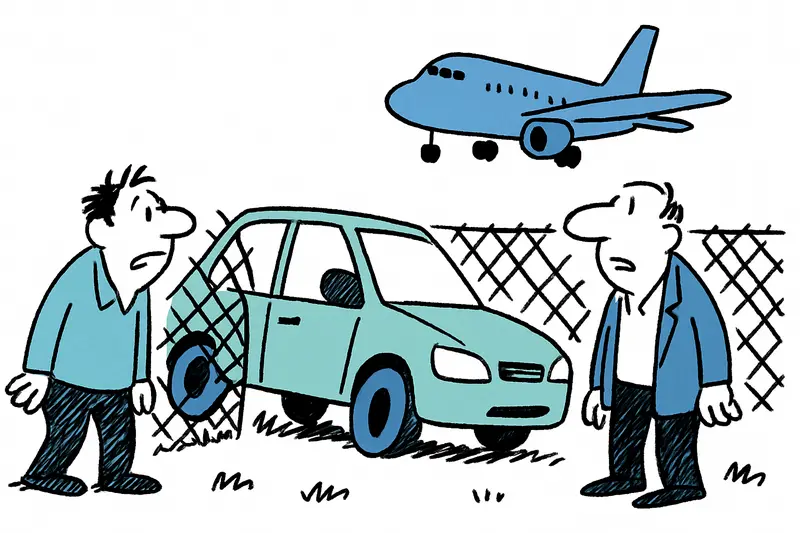
A car broke through a fence and stopped a few meters short of Palma's runway. There was no collision with an aircraft — but the risk remains. What does this mean for people along the MA-19 and which measures would actually help?
A Hair's Breadth from the Runway: A Wake-up Call for Palma's Traffic Safety
In the early morning of September 7, residents and commuters along the MA-19 witnessed something more familiar from action scenes than everyday life: a car sped over the hard shoulder, ripped down a fence and only came to a halt on the grass a few meters before the airport runway. No film crew, just the quiet hum of the nearby road, a few gulls and the distant clatter of construction machines — and the uneasy feeling of those who watched. Local reporting documented the incident in detail — see Fence at Palma Airport Breached — Car Stopped Only Meters from Runway.
The central question
How well does Palma's infrastructure actually separate road and runway — and is that enough to protect people and air traffic? This is more than a technical question. It's about design, controls and how urban planning deals with a traffic route immediately adjacent to an international runway.
What happened — brief and clear
According to the Guardia Civil, a car lost control, drove over the verge, damaged a fence and stopped on the grass in front of the runway. The driver and several passengers left the vehicle and fled on foot — initial leads point to the nearby neighborhood, but motives and possible influences such as alcohol or drugs are still under investigation. At the time of the incident, the runway in question was not in use; there were no collisions or injuries, yet the proximity was alarming.
Analytical view: Why the incident is more than an isolated case
The MA-19 runs close to the airport grounds. Road incidents elsewhere, like a truck breakdown on the Ma-20, show how Palma's roads can be quickly disrupted and highlight wider vulnerability — Ma-20 Blocked: A Truck Breakdown and the Vulnerability of Palma's Roads. Fences and barriers exist, but they do not appear designed to reliably stop a high-speed vehicle. A vehicle is unpredictable — anyone who drives here daily knows that. Many residents had already warned about reckless driving on this stretch. A fence may deter a pedestrian, but against a fully moving car it offers only limited protection.
Often overlooked is the organizational side: who is responsible for the boundary between road and airfield? Airport operator, road authority, municipality — responsibilities overlap. In a serious incident this can delay the response. The question of maintaining protective installations also matters: how quickly are fence damages detected and repaired, how good is the video surveillance? And finally: what role does prevention in the form of controls and speed reductions play? Other events, such as a drone sighting that temporarily halted flights, underscore airport vulnerability — Drone paralyzes Palma — why a small device makes our airport vulnerable.
Aspects rarely discussed
First: the psychological effect on emergency services and residents. Many report the thought "this could have ended differently" — a factor that undermines confidence in local safety. Second: the legal perspective. Property damage at the airport, unauthorized entry into secured areas and potential negligence can have long legal consequences. Third: social dimensions. If there are indications of people from marginalized neighborhoods, the debate must not slide into blanket condemnation; instead it must examine whether socioeconomic problems indirectly contribute to traffic safety risks.
Concrete opportunities and solutions
A few measures that could help in the short and medium term:
1. Physical upgrades — crash barriers instead of mere wire fences, containment berms or concrete curbs at particularly vulnerable sections can slow a speeding vehicle.
2. Surveillance and technology — additional CCTV cameras with automatic alerts to airport management and the Guardia Civil; networked sensors that report fence breaches immediately.
3. Speed and controls — targeted night and early-morning speed checks on the MA-19, mobile speed cameras and increased police presence at critical points.
4. Clear responsibilities — a coordinated emergency plan between the road authority, airport and vehicle control for quick repairs and smooth communication.
5. Neighborhood prevention — local awareness campaigns, offers for young people in adjacent districts and dialogue with community leaders to reduce flight behavior and risky driving.
What local people think
The evening after the incident: quiet voices in a bar near the access road, the clink of espadrilles on the pavement, olive trees casting long shadows. "That could have ended badly," I heard several times. Many want visible measures — not just official statements, but concrete security fences, more presence on the road, and faster repairs when damage occurs.
Conclusion
Luck was on their side that morning. But luck is not a safety concept. The incident on the MA-19 is a wake-up call: infrastructure, surveillance and prevention must go hand in hand. Only in this way can the risk be reduced that a runaway vehicle not only damages a fence but endangers lives or flight operations. Authorities are now obliged to act — and the people here will be watching closely.
Frequently asked questions
How safe is the MA-19 near Palma Airport?
What happened near Palma Airport on the MA-19?
Are fences enough to protect Palma Airport from road accidents?
Who is responsible for safety along the road next to Palma Airport?
What can be done to improve safety on the MA-19 in Mallorca?
Why does a runway incident near Palma affect airport operations so seriously?
Is the MA-19 near Palma Airport prone to traffic problems?
What should drivers know about the road area around Palma Airport?
Similar News

Sticker Attack in Port d'Andratx: When Trouble Lands on Wheels
In Port d'Andratx, cars with foreign license plates were covered with anti-tourism stickers overnight. Why is the confli...

Madò Jerònia turns 109: Campos celebrates its sprightly great-grandmother
There is a celebration in Campos: Jerònia Coll Mesquida is 109 years old and is considered the oldest resident of the Ba...

Mites on Eggs, Cadavers Next to Living Chickens: Reality Check on the Poultry Farm near Manacor
Animal welfare advocates report hygiene deficiencies, earlier Salmonella findings and repeated fines. A critical analysi...

Mallorca closes bank counters — how tourists and residents can access their money now
Since 2008 more than two-thirds of bank branches in the Balearic Islands have disappeared. People without smartphones or...
Dana 'Adam' Lets the Puddles Speak – A Reality Check After the Heavy Rain
Heavy rain in Palma and parts of Mallorca frayed nerves again. Key question: How effective are warning systems, drainage...
More to explore
Discover more interesting content

Can Cap de Bou

Townhouse Lleo 72
