
Car overturns and burns on the airport highway: What the traffic jam tells us
Car overturns and burns on the airport highway: What the traffic jam tells us
A car overturned early in the morning on the Palma–Llucmajor stretch (km 13.8) and caught fire. The driver escaped with minor injuries. The extinguishing work caused long traffic jams. Time for a reality check: How safe is our highway, how do emergency services respond — and what needs to improve?
Car overturns and burns on the airport highway: What the traffic jam tells us
Main question
Main question: Why does a single accident on the Ma-19, which fortunately only caused minor injuries, so quickly lead to long standstills — and what lessons does Mallorca draw from it?
What happened
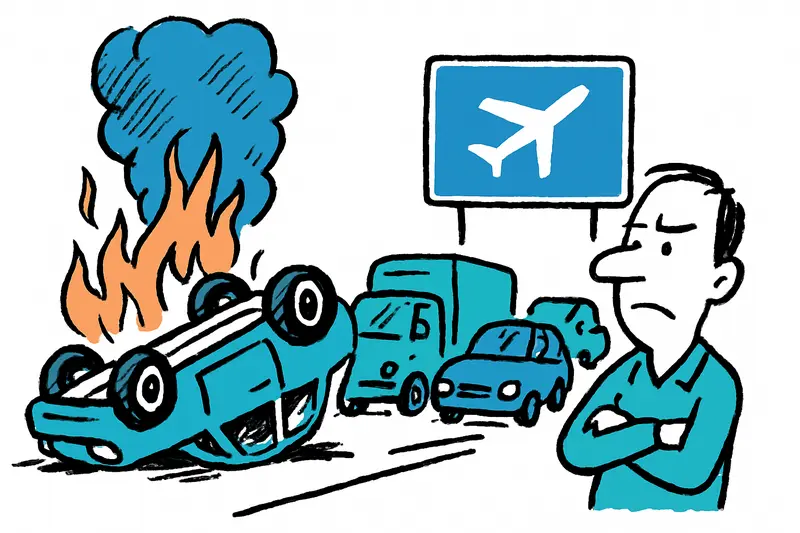
Early on Sunday morning a car left the road at kilometer 13.8 of the highway between Palma and Llucmajor, overturned and then burst into flames. The driver was able to free himself from the wreck and suffered only minor injuries. Firefighters, emergency medical services and the traffic unit of the Guardia Civil were quickly on site and extinguished the vehicle. During recovery and cleanup operations, the Guardia Civil redirected traffic, which led to significant jams on the access road to the airport, an issue not unseen when a car broke through the airport fence near the Palma runway.
Critical analysis
At first glance the incident seems like a “normal” traffic accident. Similar incidents, such as the rollover at Playa de Palma, underline how quickly a single event can escalate. On closer inspection, weaknesses become apparent: the Ma-19 is a main artery to the island's interior and to the airport. If something goes wrong at a single point — here at km 13.8 — a bottleneck is created that can block all lanes within minutes. The consequence: waiting trucks, strained commuters, delayed flights, stressed emergency plans. Such domino effects show that our infrastructure has hardly any spare capacity, and that detours quickly put pressure on other places like Avinguda de les Palmeres in Llucmajor or the N-1.
What is missing in the public debate
Conversations often focus on blame and the course of the accident — which is important — but they rarely address the structural consequences: How robust are diversion plans? How good are the information chains between the airport, police, bus companies and residents? Who takes care of parked vehicles, supply chains and the people on buses who suddenly become stranded? The topic of prevention — road edge design, guardrails, speed controls at critical sections — also appears too rarely in the discussion, and more attention is needed to guard against risky behaviours such as wrong-way driving at Coll d'en Rabassa.
Everyday life in Mallorca: A scene
I later stood at the exit toward Llucmajor next to a taxi waiting at the roadside. The hot August wind carried the smell of burned rubber and petrol across the roadway. On a café terrace on Carrer del Temple you could hear the regular rumble of buses now stuck in the jam. An older woman who was just opening her vegetable shop shook her head: “You know these jams from the holiday season, but not because of a single car.” Such images show: accidents are local, but their effects spread across the whole island.
Concrete solutions
- Intelligent traffic control: expand and better use variable signage along the Ma-19 so drivers are shown diversions early and not only when they reach the bottleneck. - Keep emergency corridors clear: legal requirements and controls so that rescue and recovery vehicles have a clear path — even when the highway is blocked. - Joint exercise scenarios between the airport, Guardia Civil and fire department: regular combined drills so that communication and responsibilities are clear when every minute counts. - Improved information chains: a central operations center that informs airlines, transit companies and major receivers simultaneously. This reduces chain reactions (delays, missed connections). - Preventive infrastructure inspections: analyze dangerous sections (e.g. curves, gradients, shoulders) with targeted measures such as additional guardrails, better drainage and lay-bys for broken-down vehicles.
Why this is not just an administrative matter
The Ma-19 connects business areas, residential neighborhoods and the airport — it is part of daily life. Commuters, taxi drivers and couriers experience these jams first-hand. Improvements cost money and planning, but they also relieve local roads like the Ma-19a or the N-1 by reacting preventively. In the short term clear traffic information and fast recovery times help; in the medium term a concept is needed to make the network more resilient.
Conclusion
An overturning, burning car at km 13.8 has once again shown us: on Mallorca one single accident is enough to disrupt traffic flow severely. Emergency services reacted quickly and prevented worse — that is good. Nevertheless, the incident should be a reason to name the weaknesses openly and take concrete steps: better traffic management, regular emergency exercises and targeted infrastructure measures. Otherwise the scene of a hot Sunday morning will repeat itself: smoke on the carriageway, the sound of stuttering traffic and the hour in which the island threatens to come to a standstill.
Frequently asked questions
Why can a single accident on the Ma-19 cause long traffic jams around Mallorca's airport?
What concrete steps could improve resilience on Mallorca's Ma-19 to prevent future jams?
How do authorities currently manage airport access when the Ma-19 is blocked?
What’s often missing in public debates after a traffic incident on Mallorca?
How do traffic jams in Mallorca feel in everyday life and affect locals and visitors?
What safety and infrastructure measures could reduce future disruption on Mallorca's road network?
How can travellers stay informed and minimize disruption during road incidents in Mallorca?
How does late-summer weather and travel demand affect road travel in Mallorca?
Similar News

More water than last year: Mallorca's reservoirs breathe easier
September rain refilled the Tramuntana's reserves: overall fill around 35 percent, Cúber at 40.42 percent, Gorg Blau at ...
Three Luxury Hotels in Banyalbufar: Lots of Money, Many Questions
A Danish investor plans three exclusive accommodations in Banyalbufar — including the historic Son Valentí. The announce...
2.1 tonnes of cocaine on sailing yacht off Spain's coast – a reality check for the coastguard
A 14-metre yacht was seized with 2.1 tonnes of cocaine. Who monitors the ports, how does the international hunt succeed ...

Heat Bonus in Mallorca: 100 Euros Extra for Outdoor Staff at MarSenses
MarSenses pays employees who worked outdoors in August an extra €100 as recognition. Lighter uniforms, reduced hours for...

Renovating in Mallorca: What You Really Can Do Without Neighbour Consent
Many think they can do whatever they want in their apartment. That's partly true — but only as long as structural elemen...
More to explore
Discover more interesting content

Can Cap de Bou

Townhouse Lleo 72
