
Celebration Meets Traffic Chaos: Why Palma's Airport Collapsed on the Night of the World Cup Final
Celebration Meets Traffic Chaos: Why Palma's Airport Collapsed on the Night of the World Cup Final
After Spain's World Cup triumph: cheers in the arrivals hall, but hours-long waits at the taxi rank and overcrowded buses show Palma was not prepared for the flood of celebrations. Who is responsible and what needs to change?
Celebration Meets Traffic Chaos: Why Palma's Airport Collapsed on the Night of the World Cup Final
Key question: Who was prepared — and who wasn't?
When the automatic doors of the baggage claim slid open, a cheer rolled through the arrivals hall like a brief thunderstorm. People waved flags, screens glowed everywhere, and outside on the forecourt a queue stretched all the way to the access road. Many passengers arriving from Germany, Belgium or other parts of Spain became part of a surge for which there was apparently no organizational countermeasure: the taxi rank was overflowing, few taxis were in sight, and the airport buses were packed to the limit. Similar capacity problems have been reported as part of broader Palma Airport delays.
The scene sounds familiar, but it was no ordinary holiday evening: Spain had won the final, and the celebratory mood turned the night into an impromptu street party. At the same time, hundreds of travelers needed to get home — with luggage, and in temperatures that still hovered near 30 degrees even after midnight. Mobile phone screens acted more as signposts than entertainment devices: many were still following the final, others were researching routes. In this mix of celebration and journey home a logistical vacuum opened up.
Critical Analysis
Several failures compounded. First: arrival forecasts for this unusual hour apparently did not go beyond standard plans. Second: the personnel and vehicle provisions — taxi fleets and additional shuttle services — were not available to the extent the crowd required. Third: communication with travelers remained episodic; many were left in the dark about when a bus would arrive or whether an alternative pickup point would be more sensible. These provisioning shortfalls echo wider concerns such as ground staff strike plans that test contingency arrangements.
One often overlooked point: major events change the behavior not only of spectators but also of service providers. Night-time taxi and bus drivers understandably had many reasons to watch the match on screens in bars — and that's human. But for a transport system serving tourism at this scale there must be clear rules so operational readiness does not fall victim to spontaneous party mood.
What Is Missing from the Public Debate
The debate quickly turns to blame and outrage ("no taxis!"), while the question of system resilience is rarely raised: Are there contractual obligations for taxi companies during large events? How quickly can bus lines be ramped up? Where are responsibilities clearly defined between the airport operator, city administration and transport providers? Even rarer is discussion about preventive infrastructure: designated staging areas, such as the Central Bus Stop at Palma Airport, emergency shuttles, digital pre-booking options for onward journeys.
Everyday Scene from Palma
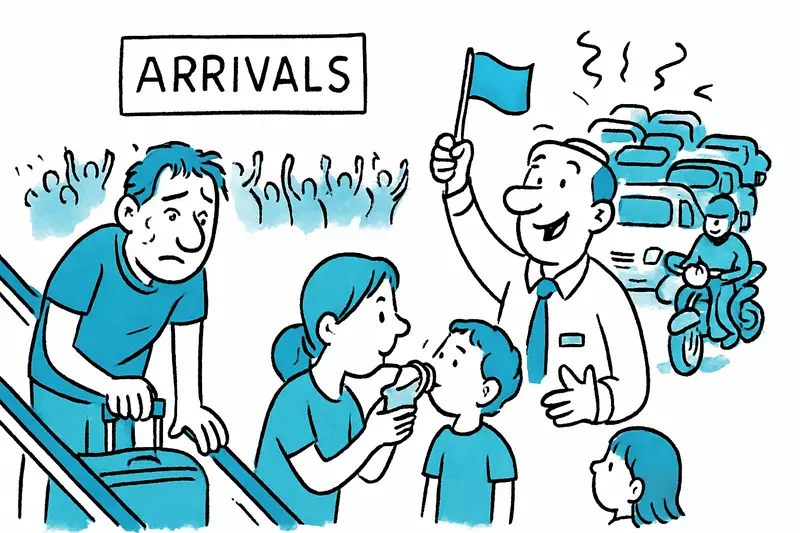
Picture the scene: a man with sweat-damp hair leans against an escalator near the duty-free area, the luggage carousel still clattering behind him. A couple with two small children share a bottle of water while outside the rhythmic honking of mopeds and cars drowns out the cheers. An airport employee in a white blouse pulls a small flag from her handbag, ties it around her shoulders, laughs, waves — and at the same time tries to calm waiting groups. This mix of revelry and uncertainty shapes the new everyday life in Mallorca when sport and tourism collide.
Concrete Solutions
There are practical measures that could help in the short and medium term: 1) mandatory standby shifts for taxi companies during foreseeable major events and corresponding controls; 2) readiness shuttles that bus operators can activate as needed; 3) clearly signed overflow pickup zones staffed by personnel to manage queues in an orderly way; 4) the airport's digital information channels providing real-time updates on waiting times and alternative connection options; 5) better coordination between airlines, the airport and city police to actively channel traffic peaks.
Another idea: officially operated, short-term bookable airport shuttles via an app could reduce private taxi demand and enable planned distributions. Legal or contractual requirements for emergency plans would anchor responsibility not just symbolically but practically — and infrastructure measures, including new elevated connecting walkways, could prevent bottlenecks at ground level.
Concise Conclusion
The night of Spain's triumph was a loud and beautiful spectacle — but it also exposed how thin the cover of everyday logistics is when emotion and mobility collide. Palma can celebrate, that's clear. But if such nights recur, clear rules and pragmatic procedures must ensure that celebrants do not have to wait for hours at the taxi rank. Otherwise rejoicing quickly turns into frustration — and the island does not deserve that.
Frequently asked questions
When is the best time to visit Mallorca for good weather and easy sightseeing?
What should I pack for a Mallorca trip to cover all seasons?
Are there family-friendly beaches on Mallorca and what should I expect?
What are must-see sights around Palma for a first visit to Mallorca?
Is Sóller worth a day trip from Palma?
Which Mallorca beaches near Alcúdia are good for a quiet family day?
What should I know about the Serra de Tramuntana mountains for hiking or scenic drives?
Are there practical travel tips for getting around Mallorca efficiently?
Similar News

When Shopping Weighs Heavier: Mallorca Demands a Tax Pause on Food and Fuel
Rising prices are putting pressure on households and agriculture. The Balearic Islands are calling for temporary tax rel...
Almost 70 Euros for Just Under Three Hours of Parking: The Trap at Son Sant Joan
A short work errand at the airport ended with a surprisingly high parking bill. Why the two-hour tariff limit raises so ...
Goodbye Megayachts: Why Palma's Port Is Now Focusing on Small Luxury Liners
Four smaller luxury liners berthed in Palma at the same time recently — around 1,600 passengers on board, plus about 2,0...
Fear in the Sa Teulera Forest: Youth Groups Harass Cruising Zone in Palma
In the wooded area of Sa Teulera, those affected report verbal attacks, property damage and intimidation. How safe is th...
Axa opens first health center in Palma: €3 million, 650 m² and more local access for La Vileta
In the heart of La Vileta, Axa has opened its first own health center in Mallorca. On around 650 square meters and with ...
More to explore
Discover more interesting content

Can Cap de Bou

Townhouse Lleo 72
