
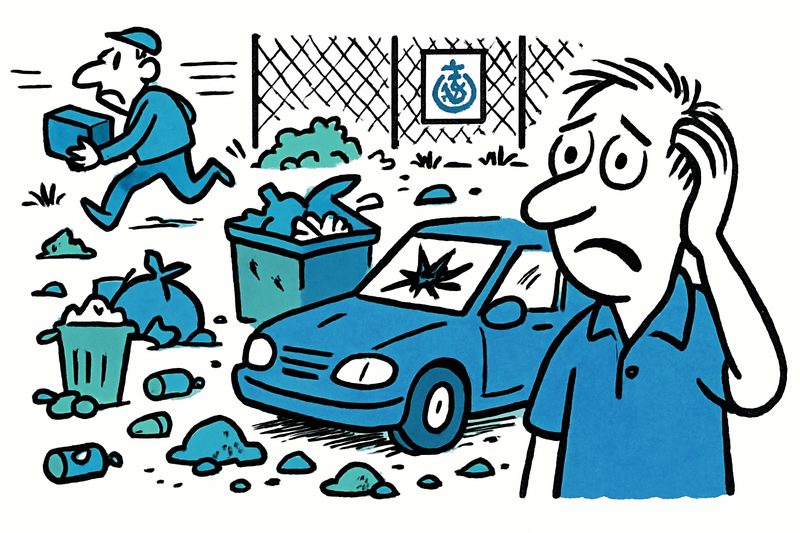
Cala Major: Parking lot turns into a litter and problem zone – who will clean up?
The only public parking lot in Cala Major is sinking in litter, attracts vandalism and increasingly feels unsafe. City officials, the landowner and the police pass responsibility around while residents, workers and holidaymakers feel the consequences every day.
When the parking lot becomes a poor showcase
In the late afternoon, when the sun sinks and the seagulls cry over the sea, Cala Major should be breathing easy. Instead, attention often falls on the only public parking lot close to the beach: scattered litter, rusty cans and broken sections of pavement, a pattern seen in Parc de la Mar neglected. The mood is tense. Residents and workers report intimidation, thefts and the feeling that the city has forgotten this place.
The central question: Why so little action?
It sounds like a typical conflict between public interest and private offers: years ago the city announced plans to reorganize the site and create a new car park. Since then, little has happened. A landowner offered almost 14,650 square meters of woodland in exchange – for a private parking facility elsewhere and additional housing projects in Cala Major. But instead of clarity there is only speculation. Is the city administration inactive, is funding lacking, or is there an unwillingness to take a political decision?
A scientific and ecological dimension receives too little attention: do such land swaps lead to a permanent reduction of woodland? And what about protection rules, groundwater conditions and the microclimate along the coast if additional housing is approved?
Litter, vehicle damage and a sense of insecurity
Everyday reports are specific: rusted drink cans that haven’t been removed for years, holes and stones that scratch vehicle underbodies, and lights that don’t work at night. A hotel employee sums it up: “I park my car here and I’m constantly afraid of vandalism in Cala Millor parking lot such as a smashed window.” Several people report witnessed thefts. Fences bearing municipal emblems feel like a weak consolation in this context.
What is rarely discussed
The public debate often misses the perspective of businesses and cleaning staff: who will take on regular maintenance in the future? A one-off cleanup before the summer season is not enough. Nor is it being asked how short-term fixes affect tourist perceptions. A littered parking lot right by the beach sends worse signals than a construction site – it reduces the quality of stay, deters families and thus lowers income for local cafés and taxis.
Concrete opportunities instead of excuses
A bit of pragmatism would help here. In the short term the following measures could calm the situation: nighttime lighting, regular cleaning rounds, additional clearly labeled waste bins, repaired or temporarily filled potholes, and temporary presence by the Policía Local. In the medium term, transparent negotiations about the landowner’s offer are needed – public access to reports, environmental impact assessment and a clear plan for balancing subsidized housing and a public car park.
Technical solutions such as smart parking systems, video surveillance at sensitive points (set up in a legally compliant way) or a parking permit scheme could increase safety. Greener options – for example a permeable surface, trees in tree pits and charging stations for electric vehicles – would upgrade the space and make it climate-resilient.
Who pays the price if nothing happens?
If the administration continues to hesitate, residents and small businesses will pay the price: declining quality of life, higher repair costs for vehicles, possible burglaries and a damaged image in the low season. Use patterns will also shift: more rental car convoys that only park and move on instead of guests who stay longer and spend money locally.
A call for transparency and swift action
What is needed now is not grand political gestures but concrete steps: a visible, quickly implementable safety and cleaning program, open negotiations about the land swap with public participation and a roadmap for sustainable redesign. Cala Major has the beach proximity, the cafés and the evening atmosphere – what is missing is the political will to shape the public space so that it becomes inviting again.
Otherwise the parking lot will remain not only a nuisance but a symbol of what can go wrong on the island: when tactical shifts and non-transparent deals trade long-term attractiveness for quick profit. And you will hear the consequences not only on the coast but also in the quiet conversations on the neighborhood steps at dusk.
Frequently asked questions
Why is the Cala Major parking lot seen as a problem area?
Is it safe to park near Cala Major beach at night?
What kind of cleanup would Cala Major’s parking lot need?
Could Cala Major get a new car park instead of the current lot?
Why are residents worried about more building in Cala Major?
How does a neglected parking lot affect businesses in Cala Major?
What short-term fixes could improve Cala Major parking lot conditions?
What are the long-term options for the Cala Major parking area?
Similar News

Palma: Car Flips Over – Seniors Rescued, Questions About Traffic Safety
On a major arterial road in Palma, a car flipped onto its roof after a heavy collision. An elderly couple was freed and ...
Calvià opts for style over rowdiness – a plan for year-round, diversified tourism
Calvià wants to shake off Ballermann images by 2030 and boost hiking, sports, culture and gastronomy tourism. Hotels, th...

Autumn Is Coming — When the Rain System Will Cool Mallorca and What We Must Learn
AEMET warns: the chance of rain increases on Thursday and Friday — temperatures will fall. An opportunity to prepare our...

Eurowings in Palma: Expansion, Approval Chaos and the Reality Test for Island Planning
Eurowings is significantly increasing its presence in Palma and is even considering technical maintenance on site. The i...

A.M.Y.: Between Finca, Cornfield and Schoolyard – a 13-Year-Old Who Gets Mallorca Humming
With sunglasses, a rock guitar and the courage to sing over nagging voices: Amy Horber, 13, lives with her family on Mal...
More to explore
Discover more interesting content

Can Cap de Bou

Townhouse Lleo 72
