
China in Mallorca – who benefits, who gets left behind?
China in Mallorca – who benefits, who gets left behind?
Ebro, GWM, MG & Co.: Chinese brands have become visible on Mallorca's roads. What does that mean for customers, workshops and the island's economy? A critical assessment with concrete proposals.
China in Mallorca – who benefits, who gets left behind?
More and more Chinese cars are rolling in. A stocktaking from Son Castelló and the streets of Palma.
Key question: Do we want cheap, large-format SUVs with Chinese technology to shape our island — and if so, how do we prepare for that in practical terms?
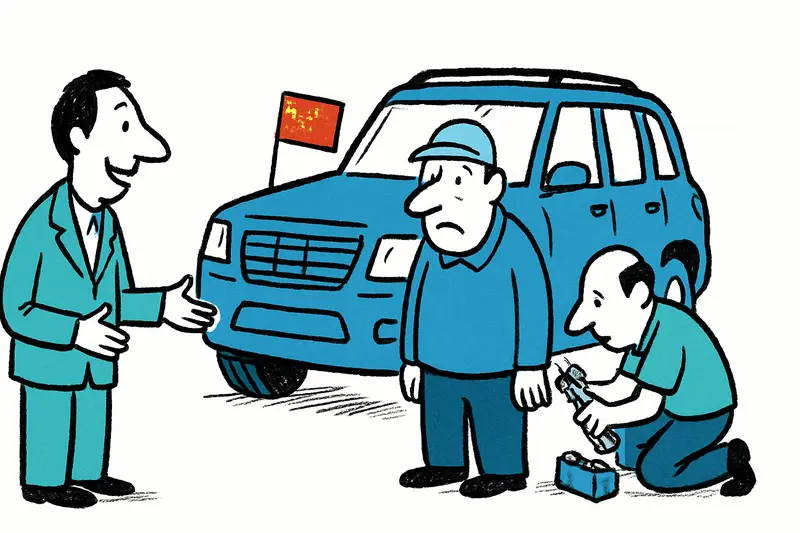
On a late Thursday afternoon, when the heat slowly rises from the asphalt and the voices of market vendors on Avinguda de Gabriel Alomar compete with the clatter of pans on Passeig Mallorca, a small crowd stood in front of a shop in the Son Castelló industrial area. Wine, cheese snacks, spicy food and Chinese music accompanied the opening of a sales point for a revived brand with a Spanish name. The vehicles: wide, tall, often bearing the inscription “Ebro” on the tailgate and displays in the dashboard showing characters from the Middle Kingdom.
What is happening here is not an episode: manufacturers that work with production or capital links to China are bringing models to Spain that are priced well below established competitors. Some entry-level SUVs are offered from around €19,990. At the same time, production with Chinese involvement has apparently been established in Barcelona again since the end of 2024; brands such as Omoda, Jaecoo or the revitalized Ebro are appearing.
The sober analysis: low entry price and substantial size are a strong combination. For many buyers in Mallorca, carrying capacity and practical usability matter more than brand myth. That explains why models with lower price tags have a chance in sales networks. At the same time, manufacturers like Great Wall Motor (GWM) are bringing a stream of new models, including compact SUVs developed specifically for the European market; first deliveries recently reached Barcelona.
What is missing from the public discourse: long-term costs, spare parts availability, workshop competence and residual value development. Purchase prices are important, but inspections, spare parts supply, software updates and the training of mechanics determine whether a vehicle remains reliable over the years — or whether later workshop bills eat up the savings at purchase. This ties into broader debates about semiconductors and standards, as discussed in Rivalry over Chips and Standards: What the Global Race Means for Mallorca.
A second point that is too little noticed is infrastructure. Some new models are offered as electric or hybrid. On Mallorca this concretely means: are the charging points in industrial areas like Son Castelló sufficient? Are local municipalities and parking garage operators prepared to retrofit charging infrastructure quickly? Who pays for the expansion when suddenly several hundred vehicles compete for the power grid within a short time?
The historical perspective also deserves mention: the name “Ebro” has roots dating back to the mid-20th century and is connected to earlier phases of domestic production. Brands come and go; what matters is which value creation — jobs, service, tax revenue — actually remains on the island (see Who Shapes Mallorca's Streets? A Reality Check on Island Demographics).
An everyday scene: under a tarp in a small workshop near Son Castelló, a mechanic is working on the front axle. Next to him stands an Ebro SUV; Mallorcan music plays on the radio. A retiree from Coll d'en Rebassa drops by to take a test drive; his first questions are about the warranty and whether his usual workshop can perform the software updates. Conversations like these are repeated in cafés and parking lots.
Concrete solutions that can be implemented pragmatically: firstly, transparent information obligations at the point of sale. Dealers should provide standardized information about warranty duration, availability of spare parts on Spanish soil and the location of authorized service points in the Balearics. Secondly, promotion of technical further training. The island administration could support workshops with grants for training so that local businesses can take over software and electronics maintenance. Thirdly, strategic expansion of charging infrastructure in industrial areas and tourist centers — involving energy providers and clear timetables, an approach that echoes proposals in When Mallorca Grows: Strategies for an Island in Transition. Fourthly, a consumer protection check for new brands that, in addition to formal approval, also examines the local service chain; this creates reliability and prevents bitter surprises.
Practically speaking: when the local car dealer has a special offer next weekend, the buyer should not only look at the price but work through a small checklist: how long is the warranty? Where is the nearest certified workshop? How long did spare part deliveries take in comparable cases? An information sheet of this kind could be published by the municipality or chamber of commerce.
Conclusion: the presence of Chinese brands on Mallorca is not a question of good or bad, it is reality. It brings choice and lower entry prices — but also challenges for service, infrastructure and consumer rights; at the same time, the island's tourism sector shows mixed trends as reported in More revenue, fewer Germans: Who really benefits from the Balearic boom?. Those who want to use the advantages must now improve the framework conditions. Otherwise the apparent savings at purchase could become expensive later. The island can benefit if authorities, dealers and workshops cooperate and agree on clear, practical rules. Then there will be more than just a new sticker on the tailgate.
Frequently asked questions
What’s the best time of year to visit Mallorca for outdoor activities?
How does Mallorca's weather vary by season and what should I expect by the coast?
What should I pack for a Mallorca trip?
Are there family-friendly beaches in Mallorca?
Is swimming safe in Mallorca year-round?
What are practical ways to get around Mallorca without a car?
What seasonal highlights or natural features should I know about Mallorca?
How can I stay hydrated and safe in Mallorca’s heat?
Similar News

Cap Vermell Grand: Second Michelin Key – a Gift for the East
The Cap Vermell Grand in Capdepera has been awarded its second Michelin key. For the region this elevates the luxury off...
Eurowings lets four aircraft carry names – a friendly idea that also reaches Mallorca
Eurowings is launching a campaign: four Airbus A320s are to carry the first names of people who help others in everyday ...

From the Reality Studio to the Pitch: Aleks Petrovic Makes Mallorca His Base
The former participant in numerous TV shows moves from Dubai to the island and launches a project with FC Germania Mallo...

When the Phone Falls Silent: Concern for Sarah Joelle in Mallorca — and What It Reveals
After days without a response, the TV personality's unreachability in Mallorca sparked concern. Shortly afterwards an al...

Ultraluxury on the Ground: Four Seasons Jet in Palma — a Reality Check for Formentor and the Island
A high-priced flight crosses Mallorca and its guests stay for days at the Formentor resort. What does the island get bes...
More to explore
Discover more interesting content

Can Cap de Bou

Townhouse Lleo 72
