
Cliff Accident at Port d'Andratx: A Near Fall and the Big Question of Road Safety
Cliff Accident at Port d'Andratx: A Near Fall and the Big Question of Road Safety
A 65-year-old resident lost control of her car near Port d'Andratx and slid down a steep embankment. The vehicle became lodged on a rock and the woman suffered only minor injuries. The incident raises fundamental questions about safety on Mallorca's coastal roads.
Cliff Accident at Port d'Andratx: A Near Fall and the Big Question of Road Safety
How much margin do drivers have on the narrow coastal roads? A drive along the sea nearly ended fatally on Monday.
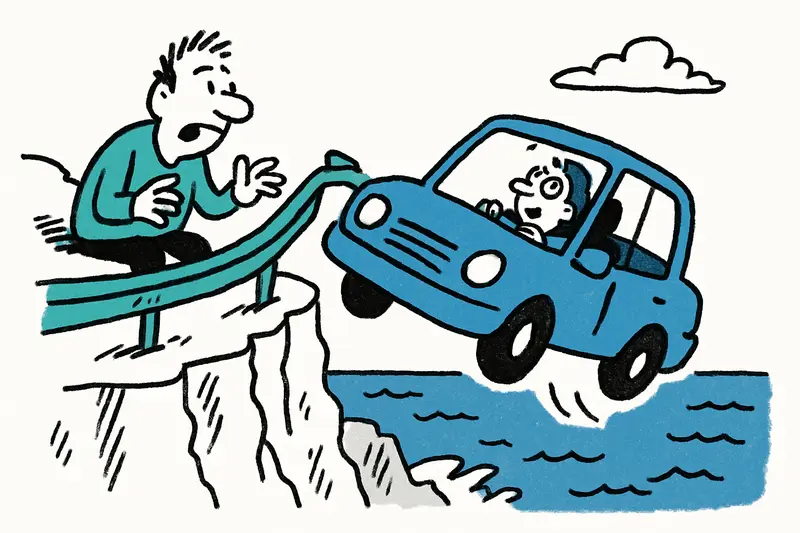
Around 12:15 p.m., a car left the roadway on the steep coastal road by the rocks of La Mola and slid several dozen meters down the embankment. The vehicle became lodged on a rock formation; otherwise it would not have been stopped before falling into the sea. The 65-year-old occupant escaped with minor injuries and was taken to hospital as a precaution. Emergency teams secured the wreck; a special crane will be needed for recovery.
Central question: Are the coastal roads around Port d'Andratx and similar stretches sufficiently protected, maintained and signposted—or are we just waiting for the next accident?
Critical Analysis
The facts are sparse but clear: a sharp left-hand bend, a vehicle losing control, and a steep drop right next to the road. These roads are not only visually spectacular, they are also complex from a safety perspective. Narrow road width, changing visibility due to rock overhangs or macchia, missing or damaged guardrails, and the mix of locals and unfamiliar drivers all create an increased hazard potential.
There is also the issue of infrastructure maintenance: corroded or absent safety barriers, traffic signs that are hard to see at dusk, and a lack of edge lighting can turn a risky stretch into a deadly one. If a vehicle is stopped only a few meters before the fall, that is luck—not sufficient precautions.
What Is Missing from the Public Debate
Many are quick to call it misfortune or human error. This framing overlooks other recent incidents such as Tragic Fall in Cala Sant Vicenç: A Wake-Up Call for Greater Coastal Safety and Sant Elm: Car slides three meters down slope – many questions, few answers. Rarely, however, is there talk of regular hazard mapping, targeted retrofitting of guardrails, or a systematic view of high-risk spots. Concrete figures on near-miss incidents that show which sections repeatedly experience near-accidents are often missing. Without this data, the discussion remains superficial.
Everyday Scene from Mallorca
Anyone who drives the stretch by the mirador in the morning knows the sound: a spray of waves, seagulls, the rattle of a scooter, tour buses at the roadside, a few fishermen with thermos flasks enjoying the view of the water. In the high season pedestrians, cyclists and cars are squeezed into a few meters. Vans park between the houses of Port d'Andratx, tourists hunt for parking spaces, and a single abrupt curve is enough to make everything tip over.
Concrete Solutions
Some measures are technically straightforward, others require political will to set priorities:
- Network-wide hazard mapping: Identify, document and prioritize: which sections have recurring problems? These maps should be public and regularly updated.
- Guardrails and restraint systems: Retrofit or modernize at critical points; it is not enough for guardrails to be merely visible if they are corroded or ineffective.
- Better markings and lighting: Reflective markings, additional warning signs before sharp bends and targeted lighting can save lives at night.
- Speed controls and traffic monitoring: Increased presence of traffic police, targeted speed checks and visible deterrence for risky driving, following Spanish traffic authority road safety guidance.
- Emergency logistics: Faster access for rescue teams, regular exercises with high-angle rescue units and prepared recovery plans including keeping special cranes available at regional locations.
- Communication with the public: A portal or app where locals can report danger spots; regular information for residents and drivers who use the route.
Conclusion
That a woman survived a fall of several dozen meters with only minor injuries is a stroke of luck. Nothing more and nothing less. Luck alone should not be the safety strategy for an entire island. People who drive along the coast want to enjoy the view—not worry whether the next rock will act as a brake. Now is the time to turn loud isolated incidents into lasting improvements and not merely respond to headlines like Three serious accidents in one night: What's wrong with Mallorca's country roads?.
Frequently asked questions
Are the coastal roads around Port d'Andratx safe to drive?
What makes Mallorca's cliffside roads more dangerous than other routes?
When is it most risky to drive along Mallorca's coastal roads?
What should I know before driving the road near La Mola in Port d'Andratx?
Is Port d'Andratx difficult to navigate by car in high season?
What safety improvements are needed on Mallorca's dangerous coastal roads?
What should drivers in Mallorca do if they meet a narrow cliff road?
Why are accidents on Mallorca's country and coastal roads still a concern?
Similar News
Who Bears the Burden? Mallorca Between Tenant Protection and Landlord Fears
Madrid's new housing decrees strengthen tenant rights — but on Mallorca concern is growing: will the law drive small lan...
On the Edge: What Mallorca's Airport Loses If a Major Low-Cost Carrier Falters
The company that operates numerous connections from Palma to France and domestically is negotiating with creditors to re...
Ballermann star Frenzy wins 'Villa of Temptation' and donates prize money to Mallorca animal rescue
Ballermann singer Frenzy won the German reality show and donated the remaining prize money — around €14,080 — to an anim...
70 Trees Removed on Avenida Jaume I: What's Happening in Santa Ponça?
On October 1 the final redevelopment phase on Avenida Jaume I in Santa Ponça begins: 70 trees and old streetlights are t...
When a Boundary Is Crossed: The Case of Isi Glück and the Responsibility of Venue Operators
The singer from Mallorca reports an assault backstage in Halle. A clear guiding question, analysis of missing protective...
More to explore
Discover more interesting content

Can Cap de Bou

Townhouse Lleo 72
