
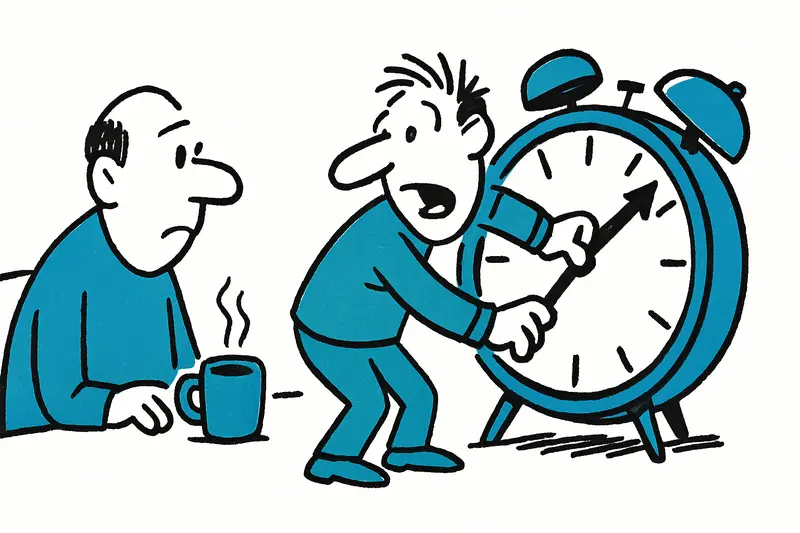
The hour that jumps back — and what Mallorca really gains
At night the clock is set back one hour. On Mallorca the discussion about the purpose and consequences of the time change is lively: from bus schedules to sunset times, from parents to shop owners — what would abolishing it mean?
The hour that jumps back — and the debate that remains
If the Plaça de Cort is still full this evening, you can feel it: the streetlights come on earlier, voices grow warmer, and the smell of coffee mixes with the cool evening air. On the night to Sunday the clocks on Mallorca will be set back by one hour again — from 03:00 to 02:00. For many that means an extra hour of sleep. For others it means manual adjustments to the stove, the grandfather clock or the good old radio alarm.
The key question: abolish or keep it?
The central question is no longer simply: “When do we change?”, but: Should the twice-yearly time change remain at all? The idea is being debated politically: Madrid wants to abolish the semiannual time change. Supporters of abolition point to supposedly small energy savings and disruptions to the human biorhythm. Critics warn of unwanted consequences for daily life and the economy — a particularly Mallorcan dilemma, because island routines, tourism and agriculture would adapt differently to any change.
What is rarely heard on Mallorca
The public debate often misses the fine web of locally rooted consequences: restaurants schedule terrace hours according to sunset, fishermen in Port de Sóller have for decades relied on tides and light, and many older shopkeepers in Santa Catalina do not like to change their opening times. The time change affects not only an urban resident's chronotype, but also a cook's shift, the start times of a cleaning company's crews and the routes of the buses on the MA-19. For historical and astronomical context see Time on Mallorca: Why Our Clocks Tick Differently.
Little attention is also paid to the burden on small businesses: manual corrections to display boards, moved-up delivery times or last-minute changed booking times for holiday apartments create administrative work — and thus costs. The health effects go deeper than the oft-cited one or two nights of poorer sleep: for shift workers, children and older people the adjustment can take weeks until the internal clock is back in sync.
Practical tips — short and concrete
Smartphones and newer cars adjust automatically. Old grandfather clocks, ovens and analog timepieces should still be checked. If you have early flights or ferries booked, double-check: some timetables are adjusted manually — in Port de Sóller, display boards have been corrected at short notice before. Tip for parents: gradually shift daycare and school times three days beforehand so children don't start the morning suddenly overtired.
Concrete approaches for the island
The debate must not end in abstract paragraphs. Three pragmatic proposals suggest themselves:
1. Regionally coordinated trial phases: The Balearics could act as pilot regions to empirically test the effects of a permanent summer or winter time — with clear metrics (energy consumption, accident statistics, work absences). The Balearic Islands are actively discussing such options in Permanent Daylight Saving Time: What It Would Really Mean for Mallorca.
2. Better communication and technical upgrades: Public transport, port operators and local administrations should deliver automatic updates and clear notices instead of manually changing signs. Funding programs could support small businesses in replacing analog devices.
3. More flexible daily schedules: Schools and employers could give parents and workers more flexibility in morning start times — a measure that makes more seasonal sense than rigid legal rules.
Why it's particularly tricky for Mallorca
The island stands between two interests: tourism beneficiaries welcome long summer evenings on terraces, while some commuters and older people would prefer brighter winter mornings. A permanent summer time could energize beach bars and the hospitality sector, but it would bring darker afternoons in December; permanent winter time would favor maritime early shifts but reduce evening revenue in the high season. The political tug-of-war is outlined in Who decides the time in Mallorca? Between bright mornings and long summer evenings.
This contradiction explains why the debate here is pragmatic: restaurateurs on Playa de Palma count customers in the evening, cyclists on the MA-19 call for better lighting, parents in El Molinar applaud an extra nap — and the aunt in Santa Catalina sits by the window and says: 'Everything used to be different.'
A conclusion that remains open
Whether the hour jumps back or not is a mix of technology, politics and habit. On Mallorca the path to the future may be less about the ideology of a Europe-wide solution and more about local experiments, better communication and practical adjustments. Until then there is the extra hour — use it for a walk along the harbor, a coffee on the Plaça or simply a short nap. The island keeps turning, with or without the clock change.
Frequently asked questions
When do the clocks change in Mallorca and do we gain or lose an hour?
How does the time change affect daily life in Mallorca?
Do smartphones and modern cars in Mallorca change the time automatically?
What should I check before an early flight or ferry from Mallorca after the clock change?
How does the time change affect restaurants and terraces in Mallorca?
Why is the time change debated so much in Mallorca?
What does the clock change mean for buses and transport in Mallorca?
How can parents in Mallorca prepare children for the time change?
Similar News
Fear in the Sa Teulera Forest: Youth Groups Harass Cruising Zone in Palma
In the wooded area of Sa Teulera, those affected report verbal attacks, property damage and intimidation. How safe is th...
Axa opens first health center in Palma: €3 million, 650 m² and more local access for La Vileta
In the heart of La Vileta, Axa has opened its first own health center in Mallorca. On around 650 square meters and with ...

30 Years of Nit de l'Art: What Palma's Art Night Really Shows — and Conceals
Nit de l'Art celebrated its thirtieth anniversary: full galleries, young visitors — and the quiet tensions between the a...

Hunt for Older Holidaymakers: Arrests after Suspected Pickpocketing in Port d'Andratx and Bellver
Five suspects were arrested after investigators accuse them of targeted pickpocketing of elderly tourists in Port d'Andr...

Knife stabbing in Magaluf: Why it must not remain an isolated incident
A 21-year-old tourist was stabbed in the chest in Magaluf and is in life-threatening condition. A reality check: what's ...
More to explore
Discover more interesting content

Can Cap de Bou

Townhouse Lleo 72
