
Collision in Palma: Why an E-scooter and a Patrol Car Ended Up on a Collision Course
Collision in Palma: Why an E-scooter and a Patrol Car Ended Up on a Collision Course
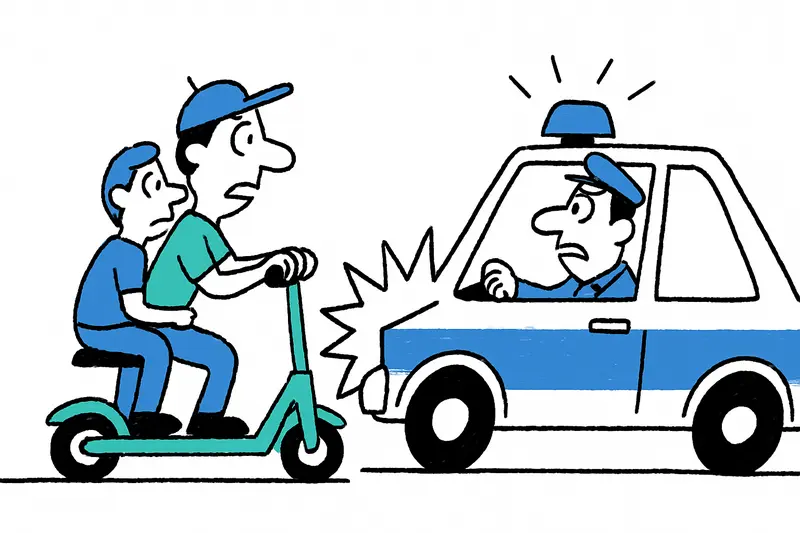
At an intersection in Palma in early September a young e-scooter rider collided with a local police patrol car. No one was injured — but the incident raises questions about behavior, enforcement and infrastructure.
Collision in Palma: Why an E-scooter and a Patrol Car Ended Up on a Collision Course
Guiding question: Who is responsible when rules, technology and nightlife collide?
On the evening of September 7, at around 11:30 p.m., an accident occurred at the junction of Camí de la Vileta and Costa de Saragossa that sounds simple in description but looks much bigger if you pause for a moment: an e-scooter drove from the pavement onto a zebra crossing, did not stop, the rider did not dismount — and a police patrol car turning to make a manoeuvre could no longer avoid the collision. The crash significantly damaged both vehicles; fortunately, no one was injured.
The local police assess the incident clearly: one person was riding the e-scooter and there was an additional passenger; the rider wore no helmet, the vehicle had no liability insurance and no high-visibility vest. Investigators hold him solely responsible. According to the records, he is a young Spanish man between 18 and 20 years old. Several charges were filed against him — from riding on the pavement to carrying a passenger.
Scenes like this are familiar in Palma: loud scooters, the ticking of distant night traffic, the flicker of streetlights above pubs and bodegas. You hear engines in the street and see pedestrians hurry across zebra crossings, often sooner than you expect. When an e-scooter enters the same path, small mistakes suddenly become dangerous.
Critical analysis: the accident is not an isolated incident but an interplay of behavior, technology and gaps in traffic supervision. The rider ignored rules on personal mobility vehicles that are especially important at zebra crossings: e-scooters must be walked across. Add to that the carrying of a passenger — not intended for most devices and a frequent factor in falls. The lack of liability insurance is more than a formality: it shows that control and registration for some vehicles remain patchy.
What is often missing from public discussion is the role of nighttime infrastructure, the responsibility of rental companies and the everyday reality of young people on the island. Many municipal checks focus on daytime; at night, when bars close and groups form, there is often little police presence. Sharing providers do not always supply transparent information about insurance and safety equipment such as Lime's safety information, and young riders do not always know the precise rules or may overestimate their control of the vehicle.
Everyday scene: on Camí de la Vileta, a few metres from the junction, there is a kiosk whose shutter had just been pulled down. Music blasts from a nearby bar. A resident gives his dog water outside his house; he sees a scooter rider suddenly race onto the zebra crossing — no helmet, two people. Such observations repeat in neighbourhoods with lively nightlife.
Concrete solutions: first, targeted night-time checks at known hotspots. Second, mandatory documentation from rental companies: insurance, age limits and a short safety briefing at handover. Third, urban planning measures: more visible zebra crossings, raised crossings and physical separations between pavement and road at critical points so vehicles cannot simply jump from sidewalk to carriageway. Fourth, an information campaign in Spanish and English aimed particularly at young people and tourists about obligations like dismounting at zebra crossings and wearing helmets. Fifth, vehicle registration checks and spot inspections of rental fleets to uncover missing liability insurance.
What else is missing? Data. A transparent statistic on night-time e-scooter accidents within European road safety statistics would help target measures precisely. Equally important are coordinated actions between the city administration, police and providers — without coordination many efforts remain piecemeal.
Conclusion: The collision at the junction was avoidable. It shows how narrow the line is between a harmless ride and serious danger — especially at night in urban neighbourhoods. Rules are not just words on paper; they need enforcement, design and a bit of common sense. Otherwise a brief moment of inattention is enough to turn a noisy night into a long file.
Frequently asked questions
When is Mallorca's best time to visit for nice weather and outdoor activities?
What should I pack for a trip to Mallorca?
Is it safe to swim on Mallorca's beaches, and what should I check before entering the water?
What are must-see experiences in Mallorca?
How does Mallorca's weather vary across the seasons?
From Palma, what are good day trips in Mallorca?
Are there family-friendly beaches and activities in Mallorca?
How should I get around Mallorca — car, bus, or train?
Similar News
Warty on the Green: When a Cyborg Is Supposed to Learn Golf in Mallorca
A silver humanoid named Warty visits Son Gual – as advertising for Water D and as a guinea pig for golf lessons. A criti...
Balearics Consider Restrictions on Second-Home Purchases – a Reality Check
The regional government is examining whether purchases of second homes by non-residents can be restricted in future — bu...

Concert and Tasting at Sa Torre de Santa Eugenia: Music, Cuisine and Mallorcan History on September 18
An evening at a historic estate: chamber music, a tasting menu paired with wines from Macià Batle, and proceeds benefiti...

Carrer Cardenal Despuig: Where Residents Feel Abandoned in the Evenings
Residents of Carrer Cardenal Despuig in Palma complain about beggars, drug use and nighttime altercations. A reality che...

When Will the Driverless Taxi Come to Majorca? A Reality Check
Madrid has approved the first tests with Level‑4 robotaxis. What does that mean for Majorca, the drivers, and the touris...
More to explore
Discover more interesting content

Boat Tour with BBQ along Es Trenc Beach

Private transfer from Mallorca Airport (PMI) to Pollensa
