
Construction chaos at Palma Airport: Where have the elevators gone?
Construction chaos at Palma Airport: Where have the elevators gone?
New wooden walls, closed glass elevators, relocated airline offices: travelers report confusion and long walks at Palma Airport. A reality check with proposed solutions.
Construction chaos at Palma Airport: Where have the elevators gone?
Why does the airport suddenly feel like a maze?
Guiding question: Is a new storefront and a few cozy seating areas enough when travelers get lost in the building, closed elevators force people with luggage and mobility impairments to take long detours, and airlines have to redistribute their check-in counters in the middle of the terminal?
Anyone walking through Palma's terminal these days first encounters wooden walls. They stand like temporary barriers, turning once-open passages into dead ends. On the route from the covered pedestrian bridge to the parking garage, the glass elevators are blocked; inside, near the gates, it's the same story. People zigzag, ask security staff, search for a hidden lift that only appears after repeated inquiries. Suitcases squeak, announcements echo in English and Spanish, and the smell of espresso from cafés sometimes becomes the only orientation point.
The situation does not only affect holidaymakers in sun hats. Business travelers, commuters and frequent flyers increasingly report that their familiar routes no longer apply. Several airline offices have moved, observed by the author to a very different end of the terminal. This lengthens journeys, complicates service and increases uncertainty, especially at peak times.
Aena operates the airport; Tomás Melgar has been leading operations since 2019. The company appears to be investing in a new look: duty-free areas, seating zones, design elements. That is legitimate. But the current construction reality shows that the user experience was not thought through: closed elevators, questions without clear answers, missing or confusing signage — a situation also noted in Palma Airport is modernizing — but the way there is noisy, confusing and exhausting for many passengers.
Critical analysis: two interests collide here. On one side is the project management of large operators planning investments, tenders and renovations. On the other side are people who arrive or depart on a given day and rely on reliable routes, elevators and information. In the balance, operational details seem to be lost: accessibility, short-term diversion plans, clear communication for arrivals and departures.
What is missing from the public debate is a clear view of those affected. There is little reliable information about how long closures will last, which routes are accessible or where passengers on a tight budget can find help. The interests of the regional administration, which sought a role in management, have been mentioned in the background — but not bindingly integrated into the construction planning. This gap feeds the idea that an airport functions primarily as a stage — rather than as infrastructure that must work every day.
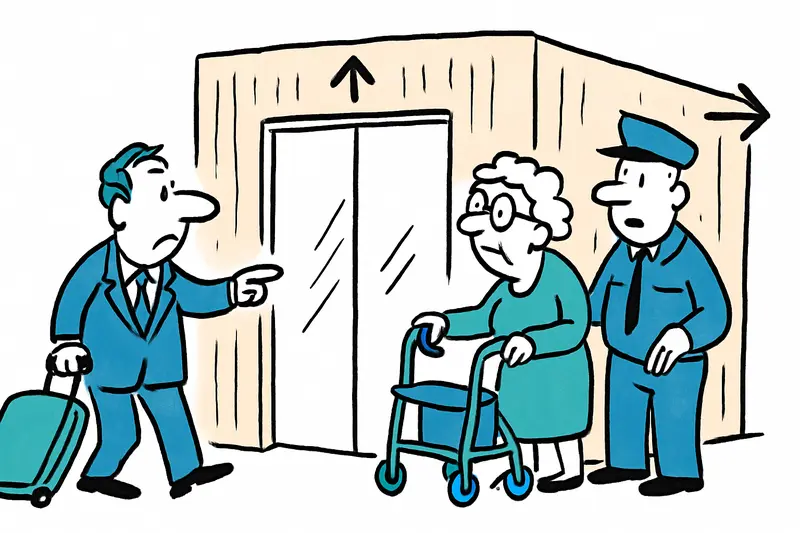
An everyday scene from Palma: A businessman in a suit and with a trolley gets out of a taxi at the pedestrian bridge, looks at the terminal map, frowns, drags his suitcase down a level because the visible lift is blocked. An elderly lady with a rollator asks security staff for the nearest accessible entrance; the staff point to a narrow, temporary path winding between wooden walls. In the background the wind at the forecourt slams car doors; there is a smell of wet stone from last night’s rain.
Concrete, actionable solutions are not missing on paper; they are missing in implementation:
1) Visible temporary routing: Large, well-placed map panels at entrances and exits, clearly marked diversion routes in multiple languages and with pictograms. No small A4 notices hiding behind pillars.
2) Accessibility as a priority: Every closure must guarantee alternative accessible routes. Mini-lifts, ramps, designated passenger escorts at set times — until the regular elevators are back in service.
3) Staff at key points: More airport personnel at the nerve centers, equipped with tablets and up-to-date plans so questions can be answered immediately.
4) Digital real-time information: A construction overview in the airport app or via SMS service showing operational restrictions, walking times and locations of temporary lifts.
5) Construction work outside peak times: Critical work on access points and elevators should take place at night or during very quiet periods. If that is not possible, then clear shift planning and more staff to assist during the day.
6) Involvement of local authorities and user representatives: If the Balearic regional government claims a role, now is the opportunity to anchor concrete commitments for accessibility and passenger information — transparent timelines, checkpoints and regular updates.
A short reality check: it is not enough to focus only on appearance; the airport must function as dependable infrastructure for everyone. Clear, enforced measures and better communication would help ensure that renovations do not compromise day-to-day usability.
Frequently asked questions
Why are the elevators at Palma Airport closed during the works?
Is Palma Airport still easy to use if you have heavy luggage or mobility issues?
How confusing is it to navigate Palma Airport during the construction work?
What should I do if I need help finding my way at Palma Airport?
What is being changed at Palma Airport besides the elevator closures?
Are there clear signs for temporary routes at Palma Airport?
Should I arrive earlier than usual at Palma Airport right now?
What would make the situation better for passengers at Palma Airport?
Similar News

Fewer Airlines, Fewer Destinations: What Palma's Winter Flight Schedule Means for Mallorca
Analysis shows: Winter at Son Sant Joan Airport will be quieter, with significantly fewer airlines and destinations. Who...
German tourist dies in Sa Calobra – a reality check for emergencies on Mallorca's beaches
A 40-year-old tourist died at the Torrent de Pareis. The emergency call, a doctor who happened to be present, a defibril...
Deadly Tractor Accident in Bunyola: What Needs to Be Done Now
In a work accident on an estate near Bunyola, a roughly 40-year-old man lost his life. His wife and a small child were o...
Head-first dive into the shallow part of Cala Fonoll: An accident and the unresolved question of responsibility
A young tourist dove into Cala Fonoll and was seriously injured. Key question: Why are clear warning signs missing at da...
Mistaken identity with fatal consequences: Brutal assault in S'Aranjassa — what's missing in the follow-up?
At S'Aranjassa a visitor to a finca was tied up, beaten and thrown out of a van. Three men have been arrested, including...
More to explore
Discover more interesting content

Can Cap de Bou

Townhouse Lleo 72
