
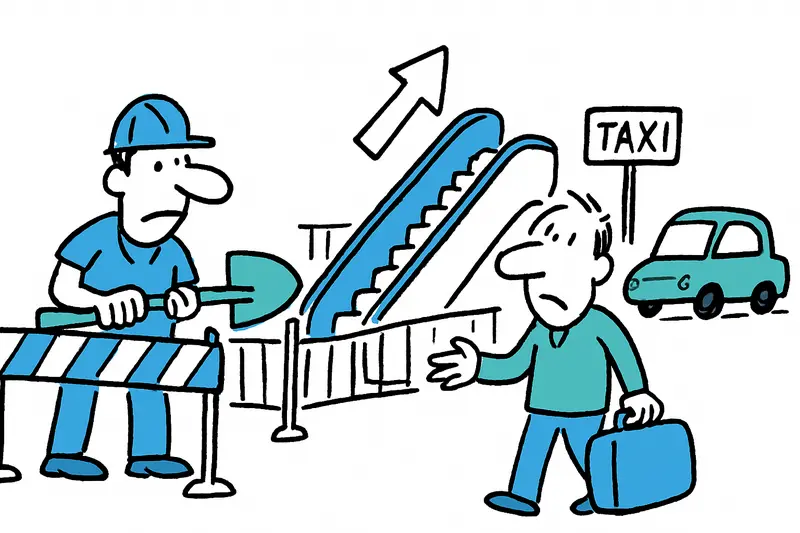
Palma Airport: The construction site that never stands still — and how we cope with it
Construction fences, detours, new escalators and 65 individual measures: Palma Airport is modernizing — but the way there is noisy, confusing and exhausting for many passengers. A look at causes, blind spots and practical solutions.
Palma Airport: The construction site that never stands still
Anyone who walks from the parking garage to the terminal at Palma de Mallorca Airport — Wikipedia these days first hears the rhythm of the construction site: jackhammers, distant announcements from the loudspeakers, the clack of rolling suitcases on provisional asphalt — and occasionally the screech of a seagull circling above the concrete. Everywhere caution tape, illuminated arrows and temporary walkways. For regular travelers it feels like a permanent makeshift; for first-time arrivals it is a small labyrinth.
The central question: Will the effort justify the confusion?
Operator Aena official website has announced big plans: by the end of next year 65 individual measures are to be implemented. It sounds like modernization, like perspective. But those who look closely ask: why are so many works running at the same time and who is thinking of the people who have to navigate the tangle every day? Module D remains closed until April report on the taxi rank relocation and Terminal D closure, new jet bridges, ventilation and lighting are being installed — all of this is necessary. But the consequences are shifted taxi ranks, relocated bus stops and a new route to the gate that nobody explains on the baggage tags.
The current structure of the main building dates from a time when less pedestrian traffic and more bus arrivals were planned. The reality today is different: more levels, more people, more stress. Past planning decisions are now coming back to haunt the airport in the form of retrofits and tightly scheduled construction phases.
What often goes unmentioned in the debate?
First: accessibility. Provisional routes, steps and confusing signs are a real problem for people with prams, older travelers and wheelchair users. Second: the local economy. Delivery vehicles, buses and taxis currently do not find a smooth flow — this affects arrivals, transfers and employees' working hours. Third: communication. A report on the wall collapse at Palma Airport in the summer did lead to more dialogue, but the daily information about routing is often patchy or inconsistent.
Practical problems in the morning
A typical scene: 8:30 a.m., families with prams and rolling suitcases standing at temporary signs trying to decipher the right direction. The wind carries dust from the construction site, the sun glares, and an elderly woman searches in vain for the elevator that, according to the plan, is right in the middle of the refurbishment. These seemingly small friction points quickly add up to delays, missed flights and extra stress.
More than just signs — concrete solutions
What would help immediately is not necessarily expensive technology, but better organization: clear, large-format signage along the access roads; permanent, covered walkways with slip-resistant surfaces; visible staff directing people, especially during peak times; and temporary ramps instead of makeshift stairs. Digitally, live maps in the airport app or free Wi‑Fi banners with navigation hints could prevent many detours.
Traffic management in front of the terminal should coordinate taxi and bus zones better; the taxi stand in front of the terminal has even been temporarily moved to the left in recent weeks report on the taxi stand relocation. A temporary lane for drop-off vehicles, clear no-parking areas and a well-communicated pickup and drop-off zone would help ease traffic — and spare drivers' nerves.
Planning instead of surprise: transparency is key
Aena talks about 65 measures — a number that leaves many questions open. A detailed timetable for the individual construction phases, regular situation reports in Spanish, Catalan and English, and a weekly updated construction plan for tour operators and taxi companies would be simple steps. Pilot phases in which only one measure is tested could help identify errors early before they multiply.
Looking ahead — with less hassle
Yes, the airport will be more modern, level and efficient when the works are completed. The challenge is to make the transition period more bearable for locals, employees and tourists. A bit more service, a little less secrecy and practical measures — covered walkways, more staff, clear communication — would make the construction site less of a daily burden and more of an accepted stage on the way to holiday.
Between caution tape and escalators lies the task: not only to rebuild, but to bring people along the way. Otherwise the construction site will be remembered longer than the result.
Frequently asked questions
Why is Palma Airport still under construction?
How difficult is it to get around Palma Airport during the works?
Is Palma Airport accessible for people with reduced mobility, prams or heavy luggage?
What should I know before taking a taxi or bus at Palma Airport?
What is happening with Terminal D at Palma Airport?
Will Palma Airport be easier to use once the construction is finished?
What can travelers do to make the construction at Palma Airport less stressful?
Why do construction works at Palma Airport affect local taxis, buses and employees?
Similar News
The End of the Cheap Ride? Why Mallorca Is Hit Harder by the Fuel-Price Shock
Gasoline and diesel average close to two euros per liter. What this means for commuters, supply chains and renters in Ma...
Relaxed liquid rules in Munich: What Mallorca travelers will notice
At Munich Airport the 100-milliliter rule will be lifted at all checkpoint lanes — thanks to new CT scanners passengers ...

For 45 Years on Mallorca — and Then This: How a Market Visit in Santa Ponsa Became a Lesson
A woman who has lived on the island for decades lost money and important documents at the Mercat Setmanal in Santa Ponsa...
10 percent surcharge on the beach: How legal and transparent is the extra charge at Playa de Muro?
A German part-time resident noticed days after a restaurant visit in Playa de Muro that the bill included a flat ten per...

Body near the Llevant Market: What this death says about our city
A man was found dead on Sunday afternoon near the Llevant Market. Police say the death appears natural. The scene raises...
More to explore
Discover more interesting content

Can Cap de Bou

Townhouse Lleo 72
