
Construction final sprint at Palma Airport: Concerns about chaos and accessibility grow shortly before season start
Construction final sprint at Palma Airport: Concerns about chaos and accessibility grow shortly before season start
Shortly before the start of the peak travel season, previously closed areas at Palma Airport are being reopened — but construction work continues. What travelers need to know now and how the island could spare passengers unnecessary stress.
Construction final sprint at Palma Airport: Concerns about chaos and accessibility grow shortly before season start
Which problems remain even though parts of the terminal are reopening?
At Palma de Mallorca airport there is more going on these days than just tourists – construction workers and tradespeople are racing against the clock. Parts of the check-in hall that had been closed since winter are scheduled to be reopened; Module D, which was idle for months, will be gradually brought back into service (see Construction at Palma Airport: Taxi Rank Relocated, Terminal D Closed – What Travelers Need to Know). On the pavement in front of the terminal you can hear taxi horns, the click of rolling suitcases and the distant hum of machines – a palette of sounds that signals: the season is approaching.
Key question: How well prepared is the airport really, when short-term closures and makeshift detours continue to shape travelers' everyday experience?
Critical analysis: The facts are simple. In winter parts of the right-hand check-in area were closed for the renovation of airline offices; processing ran for months only on the left side. In Module D climate and lighting systems and roof sections were renewed; retail areas there were redesigned. At the same time numerous elevators and escalators were temporarily dismantled and replaced by provisional stairs (see Wall Collapse at Palma Airport: More Than an Accident — How Safe Are the Major Works Really?). At first glance this looks like necessary modernisation. In practice, however, it means longer walks for many travelers, unsafe walking routes with luggage and restricted use of gates.
What is missing in the public discussion: a clear, layperson-friendly timeline and an honest assessment of the consequences for passengers with reduced mobility. Officials say some areas will be reopened while others will be closed later. A vague note "in the coming weeks" is not enough to plan a holiday. Those traveling with strollers, wheelchairs or a lot of carry-on luggage need reliable information — and well before arrival.
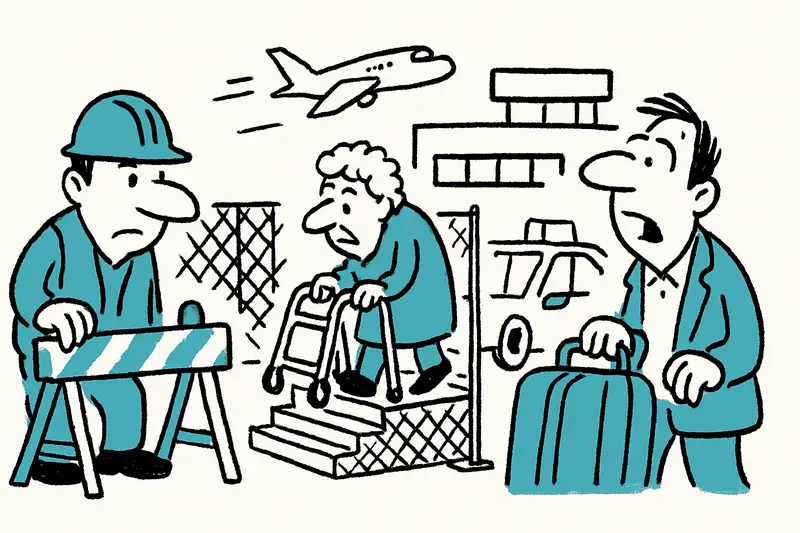
Everyday scene from Mallorca: One morning this week I saw at the taxi rank in front of Terminal 1 an elderly woman climbing down the provisional stairs with a rollator while two young couples with towered trolleys loudly cursed about connecting flights. Buses manoeuvred in the car park, an airport employee directed pedestrians around construction fences, and the smell of freshly sawn wood mixed with diesel — scenes travelers do not need at the last minute.
Concrete problem points, briefly summarised: missing, understandable timelines; temporary stairs instead of barrier-free alternatives; unclear gate assignments in Module D during recommissioning; possible bottlenecks at security and control points (see Palma: Why the security checks become a test of patience) if several construction phases coincide with peak travel times; and inadequate signage in detour areas.
Concrete, practical solutions that can be implemented immediately:
1) Transparent, daily communication: The airport should provide easily accessible daily updates on its website and at access points – with a map, marked detours and information on accessibility.
2) Priority for accessibility: If elevators are removed, temporary lift or transfer systems for wheelchairs must be available. At least one accessible entrance per affected zone is non-negotiable.
3) Phased planning according to passenger volume: Noisy or fully blocking work should be scheduled during low-traffic windows. Night or off-peak times are preferable where safety allows.
4) Extra staff at critical points: Additional personnel for wayfinding, luggage assistance and information desks significantly reduce stress and misdirection.
5) Coordination with airlines and tour operators: If gates are removed or Module D is only partially operational at times, airlines must be informed early so that boarding plans and check-in displays can be adjusted.
Concise conclusion: Renovation is right — but before the first suitcase slips down a provisional stair, a plan must be on the table that protects and informs travelers. A modern airport must not allow people with mobility impairments, families with small children or connecting passengers to become problem cases during peak season. Mallorca depends on tourism, and more visible, proactive construction management is an investment in the island's reputation.
Finally, a small, concrete request to those responsible: signs that do not only say "closed" but explain how to get from A to B most easily now — in German, Spanish and English. That would make the day easier for many holidaymakers, commuters and island residents.
Frequently asked questions
Is Palma Airport still affected by construction during the start of the Mallorca season?
Will the construction at Palma Airport cause longer walks for passengers?
How accessible is Palma Airport for wheelchair users and travellers with reduced mobility right now?
Are security checks at Palma Airport taking longer because of the construction?
What should families and travellers with luggage expect at Palma Airport during the works?
What is Module D at Palma Airport and why is it important?
How should travellers prepare for possible disruptions at Palma Airport?
What kind of signage would help most at Palma Airport during construction?
Similar News

Nipping Sea Creatures: Why Bathers in Cala Major and Elsewhere Should Be Cautious
In Cala Major, bathers have reported being nipped by small fish. What is behind it, how can problems be avoided — and wh...
Forced eviction in Santa Catalina: When a 65-year-old slept in her car and showered on the beach — a question of responsibility
The story of Pilar López from Santa Catalina represents a problem affecting many Mallorcans: How can an island with a bo...

New traffic rules from October 1: What Mallorca visitors and locals need to know
From October 1, 2026, Spain will implement far-reaching changes to traffic regulations. Important for Mallorca: greater ...

More water than last year: Mallorca's reservoirs breathe easier
September rain refilled the Tramuntana's reserves: overall fill around 35 percent, Cúber at 40.42 percent, Gorg Blau at ...

Three Luxury Hotels in Banyalbufar: Lots of Money, Many Questions
A Danish investor plans three exclusive accommodations in Banyalbufar — including the historic Son Valentí. The announce...
More to explore
Discover more interesting content

Can Cap de Bou

Townhouse Lleo 72
