
Copy in front of the fast-food joint: When a city symbol becomes an advertising sign
Copy in front of the fast-food joint: When a city symbol becomes an advertising sign
In front of a fast-food restaurant on Calle Joan Miró stands an almost identical replica of the famous "Palma" lettering. Who protects art in public space — and what can the city do when works are misused as advertising?
Copy in front of the fast-food joint: When a city symbol becomes an advertising sign
How much room does commerce have before public art in Palma?
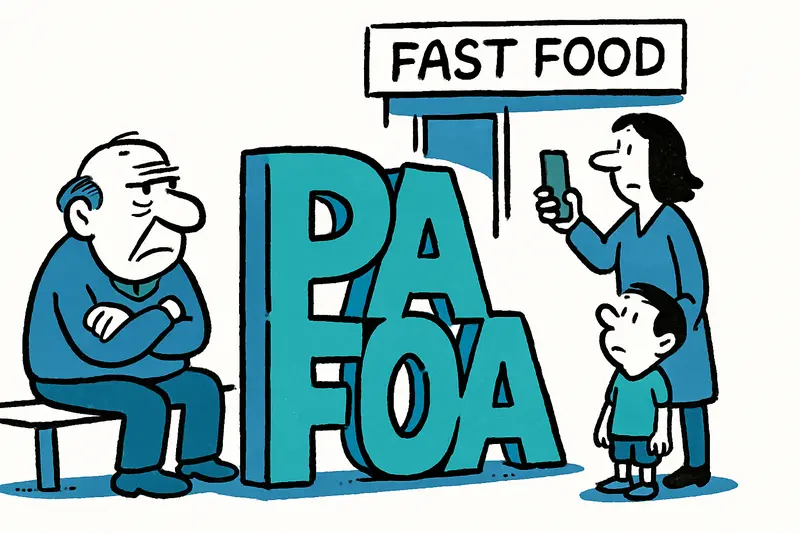
On Calle Joan Miró exhibition in Palma, not far from the hectic bus traffic and the tourists crossing the Passeig, a striking letter sculpture has recently been placed directly in front of a snack bar. At first glance it looks like the well-known "Palma" sculpture that has its fixed place opposite at La Lonja: the same typeface, the same red color, similar dimensions. Only the material differs — instead of Corten steel, wood was used.
The scene feels odd: people stop, pull out their phones, order fries while looking at a work that resembles a city landmark and now serves as an eyecatcher for a restaurant. The sizzling from the fryer drifts out of the shop; an old man on the bench shakes his head in resignation. Such everyday snapshots show how quickly public art can become a backdrop for consumption.
Key question
Who decides how public art is used — and what rights does an artist have when their work is reproduced without permission for advertising purposes?
Critical analysis
Legally, the situation is basically clear: works are protected by copyright, which can also cover forms and typographies. In Spain these protection rights last for decades. In practice, however, the law and enforcement often diverge. A scale-accurate replica of a city artwork placed in front of a business is not only an aesthetic problem; it raises questions about the respect for creative work, the responsibilities of entrepreneurs, and the role of the city administration.
Business owners see striking shapes as a way to attract attention — and that is economically understandable in a street where pedestrian flows fluctuate. But attention must not automatically become a license to copy. The replica of a well-known artwork in front of an establishment turns a work with public presence into a commercial accessory. That robs the original of its uniqueness, and the author may be left without recognition or compensation.
What is missing in the public discourse
Surprisingly little is discussed about how municipalities systematically deal with such cases, as recent coverage Palma Cleans Up — Who Pays, What Remains? shows. Lawyers and copyright regulations are only part of the debate. There are no clear local rules for the placement of replicas, no transparent procedures for artists' complaints, and no simple mechanisms that would require city-center operators to ask for permission before installing a copy. Consumers are also rarely aware that they are posing in front of a replica that may be legally problematic.
Concrete solutions
The situation requires practical steps, not just words. A few proposals that could work locally:
• Municipal mediation: City hall should create a point of contact to mediate conflicts between artists and businesses before they end up in court.
• Identification and information system: A simple labeling requirement for commercially used replicas — for example a small plaque with the author's name and a note about permission — would create transparency.
• Licensing models for reproductions: Fair, easily accessible licensing agreements could allow businesses to work legally with local motifs — in return for reasonable compensation or collaborations, such as a special edition that benefits the artist.
• Awareness campaigns, such as Posters, Provocation, Polarization: How Mallorca's Streets Become a Campaign Ground, could distribute information so that shop owners and tourists know when a replica is problematic.
• Promotion of original commissioned art: Instead of copying, establishments could collaborate with regional artists to develop their own new signs for their façades. This strengthens the local creative scene and avoids legal risks.
Everyday scene as a reminder
In the afternoon in front of the snack bar: a mother tells her son that "Palma" is actually an artwork, not a brand logo; the boy asks why it is made of wood. That is exactly the moment that shows how important visibility and education are. Art does not arise in a vacuum — it lives in exchange with the public. If that exchange is channeled one-sidedly by commerce, the city loses cultural depth.
Conclusion
The replica in front of the snack bar is more than a legal nicety. It is a small, loud wake-up call: Palma needs rules and respect for the works that shape its cityscape. Politics, administration, creatives and businesses must find ways to balance use, protection and recognition. Otherwise iconic art risks becoming a miscellaneous sales prop — and that would be a loss for everyone who lives and works here.
Frequently asked questions
Is it legal to copy a public artwork in Palma for use in front of a business?
What should Mallorca businesses know before using a city symbol in their shopfront?
Why does a replica of a Palma landmark cause controversy?
Who can artists in Mallorca contact if their work is copied by a business?
Are there rules in Palma for placing replicas of artworks in public-facing commercial spaces?
How can Palma protect local art without stopping businesses from being creative?
Should I take a photo in front of a copied sculpture in Palma?
Why does public art matter so much in Palma’s city centre?
Similar News
Palma, Palma de Mallorca, Palma‑Mallorca: What is it really about?
The debate over the city's name is more than grammar: it concerns identity, law and branding policy. A sober reality che...
Warning to Bathers: Nipping Fish in Cala Major and Other Coves — a Reality Check
In Cala Major and several beaches around Mallorca, bathers report painful “nips”. Who are the animals, why are they gett...
Rental Car Theft in El Arenal: What This Incident Reveals About Our Gaps
A teenager steals a running rental car in El Arenal, flees on foot, climbs over walls and is caught by the Guardia Civil...
Red Rope in Palma's Library: What Helps Against Selfie Tourism — and What's Missing
Palma's city library cordoned off an area with a red rope to keep selfie tourism away from reading and working activitie...
Fort San Carlos: Museum, Harbor Dispute — and a Conflict That Demands Answers
The military museum at Fort San Carlos sits right on Palma's harbor, with unexpectedly quiet rooms filled with cannons a...
More to explore
Discover more interesting content

Can Cap de Bou

Townhouse Lleo 72
