
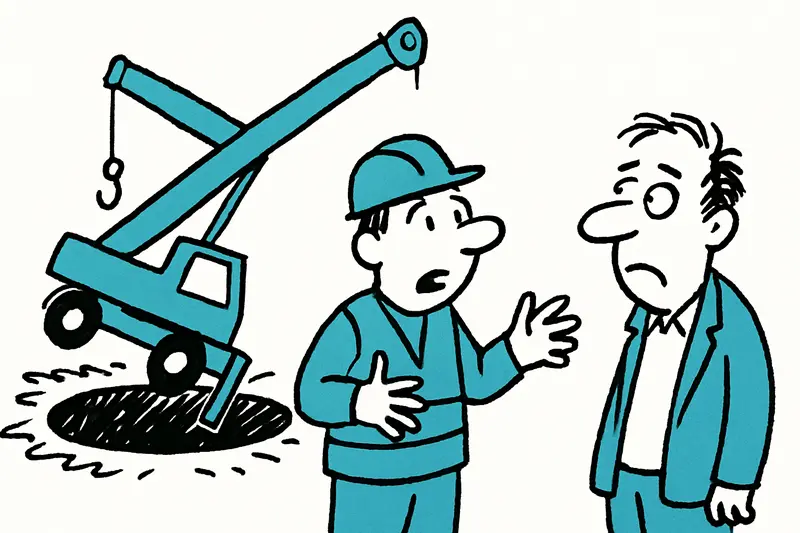
Dangerous Blind Spot: Why a Crane in Palma Fell into a Hidden Cistern
Dangerous Blind Spot: Why a Crane in Palma Fell into a Hidden Cistern
A crane truck collapsed into an unknown underground cistern at a school in Palma. Who is responsible — and how can we prevent such an incident next time?
Dangerous Blind Spot: Why a Crane in Palma Fell into a Hidden Cistern
Key question
How could a multi-ton crane truck fall into an unknown underground cistern during tree work at a school in Palma — and who must ensure that this does not happen again?
Summary of the incident
During work to remove pine trees a crane truck tipped at a school in Palma and broke through a previously unknown cistern in the ground. The fire department responded, pumped out the water and prepared the site for recovery. A salvage company will recover the heavily damaged vehicle using a second crane.
Critical analysis
Underground cisterns are not uncommon on Mallorca: old rainwater tanks, forgotten wells or private retention basins are often found in older neighborhoods and on school grounds with large trees. That a company apparently was not informed about the existence of a cistern indicates fragmentary risk management: before major lifting or dumping operations there should be a simple but mandatory check of subsurface conditions. Instead, the practice here seems to be: look, assess, act — and hope that nothing unexpected happens.
What is missing from the public discourse
There is a lot of talk about spectacular images — the crane half in the hole, emergency crews with hoses — but hardly any discussion about how such cavities are documented. Missing or outdated maps, unclear ownership of schoolyards, the lack of an obligation to inquire with the municipality before using heavy equipment: we hear little about these, even after larger construction incidents such as Wall Collapse at Palma Airport: More Than an Accident — How Safe Are the Major Works Really?. Also rarely discussed are the legal responsibilities between clients, companies and property owners, as well as the need for legal minimum standards for preliminary investigations.
Everyday scene from Palma
The day after the accident the smell of wet pine needles still drifts across the schoolyard. Parents drop off their children, pause, point at the barriers; a bus stops, older men watch the cordon from the café. That is the consolation of the island: life goes on, conversations about excavators and insurance mix with the sound of children’s laughter and the rattle of the tram in the distance. It is precisely the proximity of everyday life and heavy machinery that makes the matter so explosive.
Concrete solutions
1) Mandatory registration of underground installations: A public digital map maintained by the municipality with known cisterns, wells and channels should be created — accessible to authorities, construction companies and major clients. 2) Pre-deployment checklist: For work with heavy equipment at or near buildings and large trees, a binding on-site inspection (including visual probing and, if suspected, a simple ground-penetrating radar survey) should be required. 3) Clear information obligations: Schools, municipal bodies and private owners must provide information about existing installations before contracting work; false statements or omissions should be sanctioned. 4) Insurance requirements and liability coverage agreements: Companies using cranes or similar machines should provide proof of technical risk assessments and liability policies before being allowed to work. 5) Training and reporting channels: Contractor training on local risks and a rapid reporting channel to the fire brigade/police in case of unclear subsurface conditions.
Why this is not just a technical problem
It is about chains of responsibility and prevention in a densely used urban space. A hole that swallows a crane could just as easily endanger people or playing children if left undiscovered, as other local incidents have shown — for example the midday collapse that injured a cook in the city centre reported in Ceiling Collapse at Plaza de l'Olivar: Questions About Safety and Responsibility. The fire department’s response was correct and professional — that is the immediate protective measure. The lasting solution must, however, be structural: better data, binding procedures, clear responsibilities.
Pointed conclusion
The image of the half-submerged crane is striking; even more striking would be a list of measures that prevent such cases in the future. The question remains: will the city administration take responsibility for a systematic survey, or will it remain limited to ad hoc actions after incidents? For the people here in Palma that means: we should not only applaud when someone rescues something again — we should demand that less needs to be rescued in the first place, and that lessons from events such as Car Plunges into Ciutadella Harbor Basin: Who Could Have Prevented It? are applied.
Frequently asked questions
Why are hidden cisterns a risk during construction work in Mallorca?
What should be checked before using a crane in Mallorca?
How do emergency crews respond when a vehicle falls into a cistern in Mallorca?
Who is responsible for warning contractors about underground risks in Mallorca?
What should schools in Mallorca do before tree work or heavy maintenance?
Are old cisterns still common in Mallorca neighborhoods?
What can prevent crane accidents caused by hidden underground structures in Mallorca?
Why do incidents like this matter for everyday life in Palma?
Similar News
Rental Car Theft in El Arenal: What This Incident Reveals About Our Gaps
A teenager steals a running rental car in El Arenal, flees on foot, climbs over walls and is caught by the Guardia Civil...
Red Rope in Palma's Library: What Helps Against Selfie Tourism — and What's Missing
Palma's city library cordoned off an area with a red rope to keep selfie tourism away from reading and working activitie...
Fort San Carlos: Museum, Harbor Dispute — and a Conflict That Demands Answers
The military museum at Fort San Carlos sits right on Palma's harbor, with unexpectedly quiet rooms filled with cannons a...
Old Town Under Pressure: When a Doorway Becomes a Sleeping and Shower Place
For months a woman has been living with a parasol, a clothes rack and personal belongings next to the social welfare off...
When Shopping Weighs Heavier: Mallorca Demands a Tax Pause on Food and Fuel
Rising prices are putting pressure on households and agriculture. The Balearic Islands are calling for temporary tax rel...
More to explore
Discover more interesting content

Can Cap de Bou

Townhouse Lleo 72
