
Ceiling Collapse at Plaza de l'Olivar: Questions About Safety and Responsibility
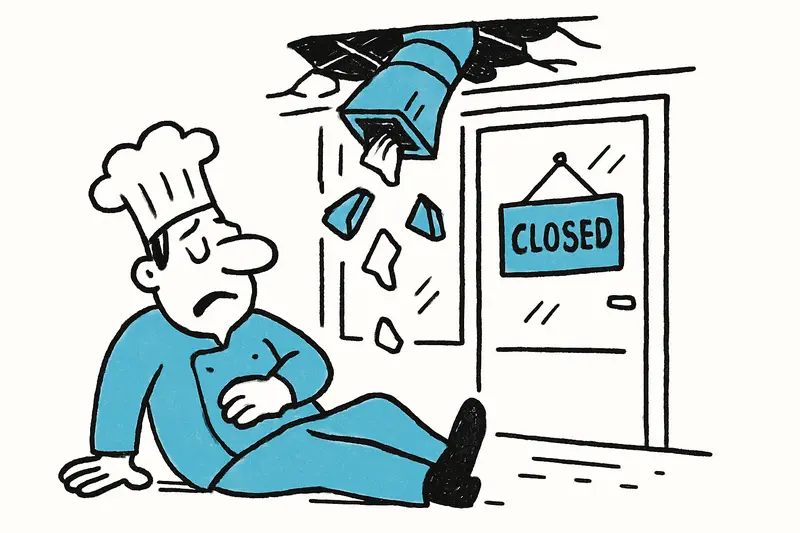
Midday in Palma: a section of the ceiling of a restaurant at Plaza de l'Olivar gave way and a cook was injured. The scene raises fundamental questions about safety in historic buildings and the oversight of kitchen installations.
Market square suddenly silent: Collapse at Plaza de l'Olivar
Yesterday, shortly after the busy midday activity on Plaza de l'Olivar, the soundscape changed abruptly: the usual market chatter, the clinking of coffee cups and distant honking — and then a dull crack, followed by panic and the clatter of falling parts. A section of the ceiling in a restaurant gave way. A cook was injured and taken to hospital; according to emergency services his condition is stable, but the incident raises questions that concern Mallorca as a whole.
The establishment remains closed temporarily. Emergency personnel cordoned off the area, onlookers gathered along the edges of the barrier, and the market routine was redirected. Fire brigade, police and ambulance services worked calmly and efficiently. Yet in the shadow of the emergency vehicles the expected mix of sympathy and concern emerged: How could something like this happen in the middle of the old town?
Why did the ceiling give way?
Initial observations point to problems with the ventilation and extraction system. From the street, hanging parts of the extraction installation were visible before the material gave way. Whether it was material fatigue, improper fastening, an unsuitable retrofit in an old building or a combination of these factors is now the task of technical experts.
The central problem is not only a physical one. Many restaurants in Palma's old town have modernized their kitchens over the years — with powerful motors, heavy hoods and ducts — often in buildings originally designed for very different uses and loads. If such installations are retrofitted without structural checks, a latent risk emerges.
What is often missing from the public debate
The quick response of the emergency services was important, but answers are missing on structural questions: Who is responsible for regular inspections of fittings in rented properties — the operator, the landlord, or the municipality? How often does the city inspect commercial kitchens in historic buildings? And to what extent are small businesses financially able to carry out costly upgrades? Questions of responsibility have been the focus of recent reporting, for example Playa de Palma Trial: Who Bears Responsibility After the Rooftop Terrace Collapse?.
Equally important is the question of the qualification of the companies that install such ventilation systems. Improper installation may seem cheaper at first, but in the long run it can endanger lives and damage buildings. This is a point that restaurateurs, landlords and local policymakers urgently need to discuss.
Concrete steps needed now
In the short term, clear, pragmatic measures are required: a complete structural assessment of the affected building, an inventory of comparable facilities in the neighborhood and transparent communication of the results. Authorities should also consider whether short-term financial or administrative support can be provided for necessary safety measures — for example for small businesses that must retrofit.
In the medium term, binding regulations would be helpful: mandatory load calculations for conversions and retrofits, certified installation companies for kitchen extraction systems and a digital register of such installations accessible to the fire brigade and building inspectors. Training for operators on safety checks and emergency plans would increase the resilience of the sector.
Neighboring incident in Inca: coincidence or pattern?
On the same night the island reported another incident: the roof of a residential building in Inca collapsed, fortunately without injuries. Such spatial connections suggest that we may not be seeing isolated cases but possibly a wave of aging building stock and insufficient controls — a silent hazard appearing in various locations, as seen in Collapse at Palma's City Wall: What Needs to Happen Now and in reports of cordoned-off venues in other areas of the island, such as Acute Danger in Cala Major: Six Shops Cordoned Off — Who Bears Responsibility?.
What residents and visitors should do now
Continue to avoid the cordoned-off area around Plaza de l'Olivar and report visible damage to the local building authority. If you live or work in an older building, it is worth having the main installations checked — fans, extraction systems, suspended ceilings. Precaution is inconvenient, but far less costly than an accident.
The immediate story will be written by experts and authorities in the coming days. The quiet admonition remains: Palma is lively, noisy and often improvised — and precisely for that reason we must not lose sight of the question of responsibility and safety.
I will continue to follow the story and will report as soon as reliable results from the investigations are available.
Frequently asked questions
Is Plaza de l'Olivar in Palma safe to visit after the ceiling collapse?
What caused the ceiling to collapse in the Palma restaurant?
Who is responsible for safety checks in a rented restaurant space in Mallorca?
How often are commercial kitchens in Palma inspected for structural safety?
What should restaurant owners in Mallorca do if they have a heavy extraction system in an old building?
Could the Plaza de l'Olivar collapse affect other old buildings in Palma?
What should residents and business owners in Mallorca do if they notice visible building damage?
What can visitors to Palma's old town do to stay safe around historic buildings?
Similar News

Arrest warrant at check-in: Why two travelers at Cologne/Bonn Airport suddenly had to pay
At Cologne/Bonn Airport, federal police in mid-September found two German passengers subject to enforcement measures. Bo...
Balearic Islands as a New Route: A Reality Check on Rising Boat Migration
For the first time the Balearic Islands are ahead of the Canary Islands in boat arrivals. What do the numbers really say...
Residents First at Palma's Stops? A Reality Check on Negueruela's Bus Idea
The proposal to prioritize residents with TIB or Tarjeta Única cards when boarding strikes a nerve. But what would a pri...
Why traffic jams in Mallorca stress us more than elsewhere
A study shows: 40 percent of Balearic residents name traffic jams as a major source of stress. We ask: why is that — and...
Residents first: Why Palma's city buses should give priority to residents
A proposal is causing debate: residents in Palma should be given boarding priority. Why the idea grows out of everyday l...
More to explore
Discover more interesting content

Can Cap de Bou

Townhouse Lleo 72
