
Acute Danger in Cala Major: Six Shops Cordoned Off — Who Bears Responsibility?
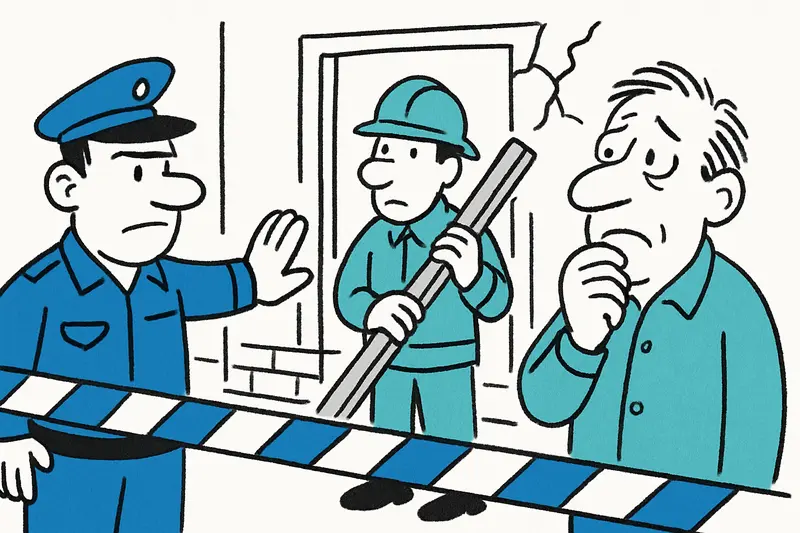
In Cala Major the fire department had to secure six shops and a function hall on Avinguda de Joan Miró. The action raises fundamental questions about maintenance, responsibility and the protection of small businesses.
Suddenly Cordoned Off: Avinguda de Joan Miró Between Everyday Life and Alarm
On Tuesday morning, shortly after 9 a.m., the usually busy Avinguda de Joan Miró in Cala Major was transformed into a cordoned-off area: police, firefighters and building authority staff sealed off a two-storey building. Six shops on the ground floor and the large function hall on the upper floor were closed as a precaution in Cala Major after a shop owner discovered deep cracks in his ceiling. The rustle of barrier tape in the wind, the distant screech of a seagull and the beeping of radios gave the early-morning drama an almost surreal sound.
Central Question: How Did It Get This Far?
That's the question now being asked in the cafés and on the balconies of Cala Major: should this condition have been detected earlier? The city points to the owners' obligation to carry out regular technical inspections. But here the grey areas begin: many coastal buildings are old, mixed-use (shops below, flats above) and often privately owned by multiple parties. Who pays for the reports, who organises repairs, who takes responsibility when ownership structures are complicated?
What the Data Doesn't Show: Between Tourism Pressure and Tight Budgets
Several factors exacerbate the problem. Ongoing tourism pressure increases the use of commercial premises — more foot traffic, longer opening hours, more frequent renovation requests. Small business owners usually do not have the means for expensive structural surveys; many owners prefer to invest in short-term modernisations rather than invisible fabric maintenance. At the same time, municipal building departments are often understaffed; priorities lie with major projects requiring permits, not routine inspections of small buildings.
Consequences for Those Affected: Immediate and Concrete
For the six affected shop owners and the association that uses the function hall, the closure means lost income, cancelled bookings and organisational chaos. A café across the street immediately offered free coffee — that's what neighbourhood looks like — but that only helps in the short term. If assessors find extensive damage, renovations can take weeks or months. Who bears the operating costs during that time? Insurances do not always cover it, and state aid for such cases is often bureaucratically slow.
What Is Often Missing from the Debate
Public debate often revolves around assigning blame — owners versus the city. Less attention is paid to structural solutions: transparency about building conditions, support for micro-enterprises with inspection costs, and preventive training for homeowners to recognise early warning signs. The issue of short-term rentals and how they change usage patterns of buildings also rarely features prominently in such cases, although it is relevant.
Concrete Steps That Could Help Now
Pragmatic measures are needed on the ground: first, an accelerated assessor procedure with clear deadlines (what must be done now); second, a municipal emergency fund that compensates affected small businesses in the short term; third, an obligation for regular, standardised inspections of older mixed-use buildings — financially subsidised if necessary. Fast approvals for temporary protective measures (shoring, façade reinforcement) should also be possible so that shops do not have to remain empty for months.
A Look Ahead: Opportunities in the Crisis
The cordoning-off on Avinguda de Joan Miró is unpleasant, but it can also be a wake-up call. If the city, owners and business people work together now, a model could be developed that combines prevention, transparency and rapid assistance. That would be good not only for Cala Major, but for all neighbourhoods in Palma that live with old building stock and intensive tourism.
Until the reports are available, the rules are: keep your distance, follow the instructions of the emergency services — and support the affected people with practical solidarity. Small gestures like the offered cappuccino are more than symbolism; they show that community matters in such moments. And if comprehensive renovations are needed in the end: better five months of construction noise than a slow loss of safety.
Frequently asked questions
Why was part of Avinguda de Joan Miró in Cala Major cordoned off?
What should I do if I notice cracks in my Mallorca property?
Who is responsible for structural maintenance in mixed-use buildings in Mallorca?
How long can a shop closure last after a building safety inspection in Mallorca?
Do insurers usually cover losses when a business is closed for building repairs in Mallorca?
Are older buildings in Cala Major more likely to need technical inspections?
What help is available for small businesses affected by building closures in Palma?
How can Mallorca communities prevent building safety problems before they become urgent?
Similar News
Caro Robens: 15 kilograms lighter — and again in the crossfire of online comments
Bodybuilder Caro Robens, who lives in Mallorca, has lost 15 kilograms. Her success on Instagram was met with applause — ...
Meager Industry in Mallorca: How the Island Can Be More Than Just Tourism
The industrial sector in Mallorca is shrinking, productivity is falling and firms remain tiny. The key question: can the...
Pre-Nit de l'Art: Galerie Mensing invites to a special evening with Tom Boston
Before the big art night, Galerie Mensing opens its doors: pop art, champagne, a DJ and a hand-signed print by Tom Bosto...
Sea view and more seats: Cappuccino Grand Café reopens in Port d'Andratx
After a long renovation, the Cappuccino Grand Café on the Port d'Andratx harbor promenade has quietly reopened. Larger t...

Enric Mas wins the Vuelta – a triumph that resonates in Mallorca
Mallorcan Enric Mas has won the 82nd Vuelta — the first Spanish overall victory since 2014. Cyclists and neighbors on Ma...
More to explore
Discover more interesting content

Can Cap de Bou

Townhouse Lleo 72
