
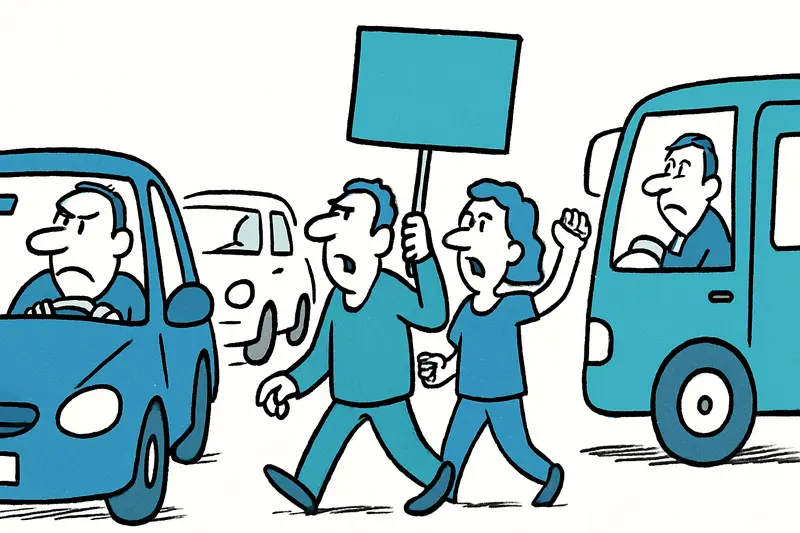
Detours in Palma: Self‑employed demonstration disrupts city center traffic – what to do?
This morning (11:00) a demonstration march by self‑employed workers starts at Sa Feixina Park heading to City Hall. Until about 2:00 p.m., bus detours and closures are expected on Paseo Mallorca and Plaza Mayor.
Detours in Palma: Self‑employed demonstration disrupts city center traffic – what to do?
Key question: How can the right to protest be reconciled with a functioning city traffic system?
Anyone who planned a visit to Palma this morning was likely surprised by the density of emergency vehicles and roadblocks when turning into the center. At 11:00 a demonstration march of self‑employed workers formed at Sa Feixina Park and is moving through the city center toward City Hall, as reported in Desvíos en Palma: Manifestación de los autónomos altera el tráfico del centro – ¿qué hacer?. The aim is clear: to draw attention to calls for better conditions. The consequence for traffic is equally clear: municipal bus lines operated by EMT will be broadly diverted until around 2:00 p.m.; among those affected are lines 3, 4, 25 and 35. In addition, exits from parking garages at Paseo Mallorca and Plaza Mayor remain partially closed.
The scene in the city is typically Mallorcan and at the same time a bit tenser than usual. Mopeds roar along Passeig des Born, a street vendor selling almonds clears his throat, passengers at stops check their apps and exchange short comments. A bus driver I meet on the way back to the depot shrugs: "We receive diversion updates as they come, but people are annoyed." These small, everyday snapshots show: protests have faces and content, but their side effect is also lost hours for commuters, students and shopkeepers.
Critical analysis: freedom to demonstrate versus traffic planning. Both matter. Authorities apparently secured the route with a large deployment of personnel; nevertheless many ask: why is traffic being blocked so extensively? The measures taken today — diversions, closures of parking garage exits (see Cierres de calles en Palma: Policía cierra vías centrales debido a la protesta vespertina) — are effective in the short term but bring a number of problems: unpredictable delays for commuters, restricted access for delivery traffic and emergency services, and extra burden on residents in alternative streets. In addition, information does not always reach users quickly enough. A push notification in the EMT app, larger signs on arterial roads or coordinated announcements at the airport would help prevent many confusions.
What is missing from public debate: the perspective is often split — solidarity with the protest or frustration about closures. Rarely discussed is how recurring large demonstrations affect infrastructure in the medium and long term. There is a lack of open discussion about how frequent road closures influence the supply chains of small shops, public transport punctuality and access to doctors and care facilities. Also seldom addressed: barrier‑free alternative routes for people with reduced mobility and how tourists, who rely on fixed schedules, are informed in time.
Concrete proposals that would help today: first, better advance communication. If authorities and organizers share fixed routes and times early via EMT, parking operators and airport notices, timetables and delivery windows can be adjusted. Second, establish clear temporary diversion routes for buses with secured replacement stops, including highly visible signage. Third, temporary shuttle services from large parking areas outside the city center to the center to ease pressure on inner‑city parking garages. Fourth, a permanent coordination office on days with announced demonstrations to connect police, transport operators, emergency services and organizers — this would prevent the same access points from repeatedly being affected.
At the local level, simple measures would make a big difference: an EMT staff member in a clearly visible vest at key junctions, additional boards showing expected delays at busy stops and a brief information sheet in Spanish and English for tourist centers. Such small measures are inexpensive but increase acceptance among those affected and reduce chaos on side streets like Carrer de Sant Miquel or at Plaza Major.
Conclusion: Demonstrations are part of public life — in Palma as anywhere else. The question remains how to ensure their visibility without paralyzing the city for hours. Today’s detours and closures show once again that better cooperation between organizers, police and city services is possible and necessary. If we open a dialogue about route planning, communication and replacement services, protests can take place while the city remains accessible. A good first step would be for the next actions to be not only loud but also well organized — to the benefit of everyone.
Frequently asked questions
How much traffic disruption should I expect in Palma during a city-center protest?
Which EMT bus lines are usually affected by demonstrations in Palma?
Can I still drive into Palma city center when there is a demonstration?
What should I do if I need to park in Palma during a protest?
How long do protest-related traffic changes usually last in Palma?
Is Palma still easy to get around if I am not using a car?
What should tourists in Palma do if they need to reach the city center during a protest?
Where did the protest in Palma start and where was it heading?
Similar News

Maribel: Five Decades of Service – Housekeeper from Peguera Celebrated with a Special Honor
Over 50 years in the hotel business: María Isabel “Maribel” Molinos was honored in Palma at the Nit del Turisme by Unive...

Orange Alert over Parts of Mallorca: Are We Prepared?
Dark clouds and an announced wet spell have triggered an Orange alert in parts of Mallorca. A reality check: what's miss...

Sundair & Co.: Sale speculation and what it could mean for Mallorca
Rumors about a possible sale of the airlines Sundair and Fly Air 41, which belong to Schauinsland-Reisen — and whether b...
Anne Wünsche in Mallorca: A job offer with a catch — who fits the role of personal assistant?
Influencer Anne Wünsche has left Berlin and is urgently looking for a full-time personal assistant in Mallorca. Why the ...
Daily from New York: Palma Between Boom and Strain
United will increase the Newark–Palma route to daily flights in 2027 using Boeing aircraft (231 seats). What does the in...
More to explore
Discover more interesting content

Can Cap de Bou

Townhouse Lleo 72
