
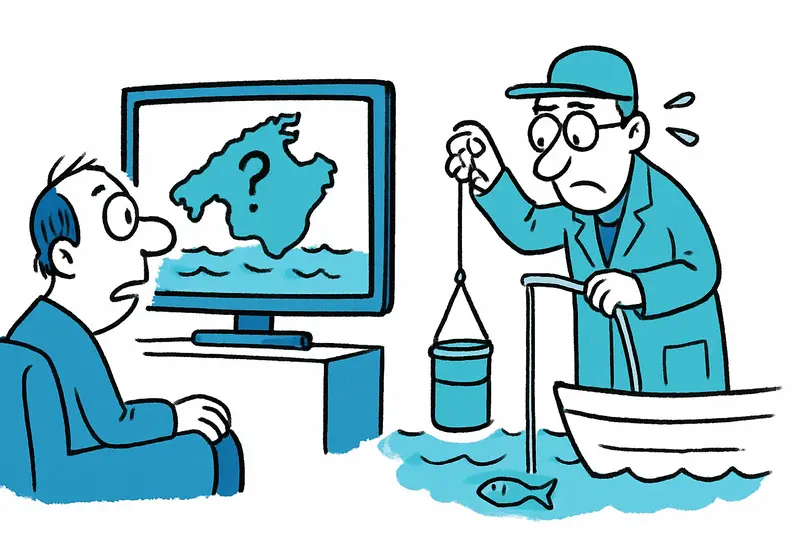
TV documentary on the Mediterranean: How threatened is Mallorca really?
TV documentary on the Mediterranean: How threatened is Mallorca really?
A new television documentary follows marine research off Mallorca and shows: sea temperatures are rising, and farmers are feeling the effects. A sober stocktaking — and what is missing here.
TV documentary on the Mediterranean: How threatened is Mallorca really?
Key question: Is research — and our everyday life — sufficient to protect the island?
At Palma's harbor, when the first delivery truck rumbles along Passeig Mallorca and seagulls have stolen the fishermen's breakfast, the sea still feels taken for granted. That image, however, is starting to wobble: the water around the island has recently reached unusually high temperatures, and researchers aboard a German research vessel are investigating how deep the changes go, including unusual warming at depth highlighted in When the Sea Cooks from Below: Why 500 Meters Depth Should Alarm Mallorca. At the center is the question: Do we understand enough to initiate effective countermeasures, as discussed in How the Sea off Mallorca Is Heating Up Faster Than We Think — and What We Can Do About It?
The expedition of the vessel Meteor has focused on the thin film at the sea surface. A doctoral candidate from the team takes samples of the top millimeters, measures temperature and salinity, and follows up with biological and chemical analyses. Such measurements are not lab exotica; they show directly how habitats are changing — for example, seagrass meadows that thrive best at moderate temperatures. The implications for Posidonia and fishing communities are detailed in Sea off Mallorca: When the Underwater Meadow Disappears.
That has tangible consequences on the island: wildfires, dry spells and intense rainfall events occur more often. On a small organic farm in the Tramuntana, farmer Xesc Sans reports that the almond harvest is declining; high temperatures and drought are taking their toll on the trees. He is therefore planting more carob trees because they cope better with heat and little water. Such changes in agriculture already indicate that adaptation in practice is necessary.
Critical analysis: research data are important, but they often remain too isolated. Measurements of the sea surface provide precise signals — heated water layers, altered salinity profiles — yet this information does not always reach the people who need it most: small farmers, fishers, port authorities and tourism businesses. Mallorca currently lacks a routine, publicly accessible dashboard that brings together marine data, wildfire warnings and water storage levels in real time.
Another blind spot in the public discourse is the connection between tourism and local water use. Beach bars, large holiday complexes and golf courses consume enormous amounts of water seasonally; the topic is discussed, but rarely linked to findings from marine research. If the sea warms, it affects evaporation and rainfall patterns — this has direct consequences for water reserves, agriculture and fire risk.
Everyday scene: on a late September afternoon in Portixol you see yacht owners securing their boats while children build sandcastles on the beach. You hear boats dropping anchor and occasionally the creak of a hull over seagrass meadows. These meadows, the seagrass called Posidonia, are not just pretty decoration; they bind carbon, protect beaches and are nurseries for fish. If they suffer, it is a practical loss — less catch for small fishers, rougher coasts in winter.
What is missing in the debate: clear rules for anchoring over seagrass, financial support for farmers who want to switch to drought-resistant crops, and a coordinated water strategy for communities that combines groundwater storage, desalination and reuse. In addition, there is a lack of local early-warning systems that translate research findings into direct recommendations for action — for example, restrictions on certain tourist activities during extreme events or targeted reforestation programs in fire zones.
Concrete approaches that could work here: 1) building an open data platform for marine and climate data accessible to authorities, farmers and businesses; 2) targeted funding programs that support the transition to drought-resistant agriculture and long-term investments in irrigation efficiency; 3) protection and restoration zones for seagrass meadows, combined with clear anchoring rules and controlled boat routes; 4) municipal water management plans that limit seasonal withdrawals and promote retention projects; 5) practical early-warning systems for fires and floods that use regional research results.
These proposals are not a panacea, but they are feasible and locally adaptable. What is missing is political consequence and the willingness to limit short-term revenues in favor of long-term stability — this applies equally to tourism, property development and agriculture.
Conclusion: The documentary on television provides images and science that help us see the problem. What is decisive, however, is that the island moves to the next level: turning data and impressions into binding rules. Those who watch the sun rise over the bay of Palma from Passeig in the morning do not only wish for postcard idylls but for practical answers — water storage, marine protected zones, different trees in our gardens. If that happens, Mallorca will remain not only a place of longing but a place that is livable even in hotter times.
Frequently asked questions
What is the best time to visit Mallorca for good weather and outdoor activities?
Is Mallorca suitable for swimming year-round?
Do I need a rental car to explore Mallorca or are trains and buses enough?
What should I pack for a Mallorca trip?
Are there good beaches in Mallorca for families?
What are some must-see places in Mallorca for a first visit?
How is the food scene in Mallorca, and where can I find fresh seafood?
Are there safety tips for outdoor activities in Mallorca?
Similar News
Autumn approaches on the island: Still sun, but a rain band will soon bring relief
The last warm days on Mallorca are still here – around 30°C by day, just under 20°C at night. According to AEMET, a rain...
After Ceuta: Intelligence Activities in Mallorca – A Reality Check
The CNI, National Police and Guardia Civil have intensified their surveillance in Mallorca. What does this mean for isla...
An evening that resonates: Hans Theessink in the Claustre of Llucmajor
With a guitar, dry humour and a voice that carries stories: Hans Theessink turned the Claustre de Sant Bonaventura in Ll...
Reality Check: Will Mallorca Become the Weather Laboratory of the Mediterranean?
A new TV documentary has the Mediterranean off Mallorca in its sights. What research shows — and what we on the coast st...

Cardiac arrest in the Tramuntana: Why a rescue often depends on chance
A 47-year-old cyclist suffered a cardiovascular arrest near Lluc. What went well, what is missing in the mountains — and...
More to explore
Discover more interesting content

Boat Tour with BBQ along Es Trenc Beach

Private transfer from Mallorca Airport (PMI) to Pollensa
