
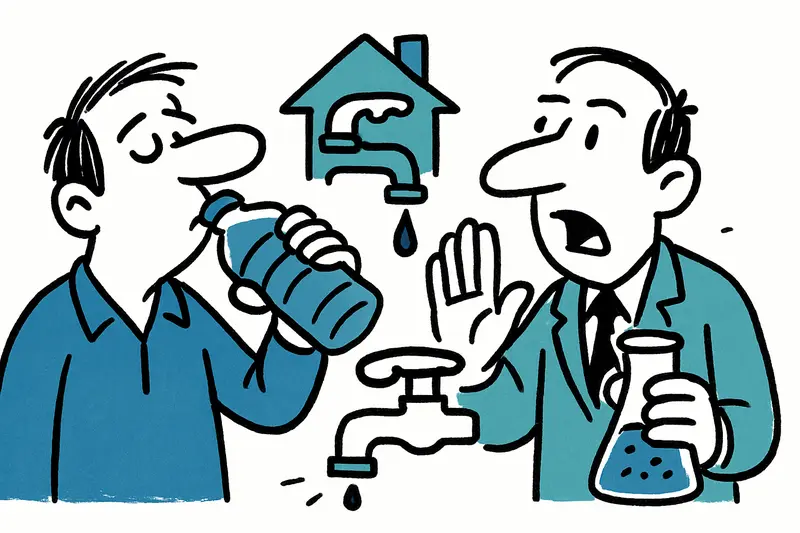
Drinking water alarm in Sa Pobla: Why did residents only learn about the nitrate danger months later?
Drinking water alarm in Sa Pobla: Why did residents only learn about the nitrate danger months later?
Sa Pobla apparently knew since October 2024 about exceedances of the nitrate limit but only informed residents in May 2025. A reality check: who failed — and how can we prevent this in the future?
Drinking water alarm in Sa Pobla: Why did residents only learn about the nitrate danger months later?
Key question: Why was the population kept in the dark for months even though measurements exceeded the legal limit?
On a late morning at the Plaça Major in Sa Pobla: traders are still stacking damp crates with early potatoes, a tractor rattles by, and somewhere a well pump is running. Most people casually reach for a bottle of water, buy bread, and chat briefly about the weather. Nobody suspects that the tap water in many households delivered nitrate levels above the EU limit for months — and that the municipality withheld this information for a long time.
The facts as they stand: the Conselleria de Salut has opened sanction proceedings because the municipality is said to have been aware of high nitrate concentrations since October 2024, which exceeded the limit of 50 milligrams per liter. The public was only warned in early May 2025. Inspections found values over 50 mg/L; under EU law this means the water is not suitable for direct consumption — particularly dangerous for infants and pregnant women. At the same time, entries in the national information system are missing for several months, and older measurement data is incomplete.
Critical analysis: several shortcomings interact here. First: the delay between internal findings and public warning. Similar water emergencies have prompted municipalities to restrict supplies elsewhere on Mallorca, as reported in Water alarm in Mallorca: Seven municipalities turn off the tap — is saving alone enough?. Second: poor documentation. Those who do not measure properly and do not keep complete records create room for mistrust and omissions that can endanger people. Third: the question of identifying the causes — in a region with intensive agriculture nitrate contamination is often to be expected. Whether the main source here is fertilizer, irrigation runoff, or leaky pipes has not yet been fully disclosed publicly.
What has been missing so far in public debate: health follow-up measures. Were affected families, parents of infants, nursing homes and schools systematically identified and advised? Were there free household tests or distribution of alternative drinking water during critical months? And: how reliable are the long-term measurement series — can the population trust that reported values have been stably safe again since December?
Everyday observation from the community: in Sa Pobla you see the connection between agriculture and the water cycle every day. The roads to the fields are full of tractors; the market is supplied by heavily fertilized production. That explains the situation — but it does not make it acceptable. A farmer I met recently on the edge of a field said that there is a lot of talk about sustainability, but those who pay for the work often lack practical support for less polluting fertilization strategies. Such voices often go unheard in the debate.
Concrete solutions, no empty talk: 1) Immediate, mandatory transparency: every limit exceedance must be publicly communicated within 24 hours — via notices, an SMS service and the town hall website. 2) Independent, regular spot checks by external laboratories, not only by municipal technicians. 3) A publicly accessible dashboard with time series of measurements that highlights missing months. 4) Priority testing and alternative water supply for risk groups (infants, pregnant women, nursing homes, kindergartens). 5) Source-control across the area: advisory programs for farmers on fertilizer planning, controlled buffer zones along drinking water catchment areas and financial incentives for nitrate-binding crop rotations. 6) Clear procedures for sanctions and liability so that inaction has consequences.
Technology and organization should go hand in hand. The national information system for drinking water must receive standardized interfaces that allow automatic uploads — so months are no longer lost simply because data was not entered. The need for transparent alerts has been emphasized during the alert level for Es Pla. In addition, local administrations need emergency plans that do not gather dust in drawers but are practiced once a year.
Pointed conclusion: the fact that Sa Pobla is a center of potato cultivation explains the nitrate contamination — it does not justify that people were kept uninformed for months. Transparency is not a luxury; it is protection. Those who want citizens' trust must not rely on hindsight; they must act measurably, visibly and quickly. The municipality has the chance to rebuild trust: through open data, independent controls and concrete protective measures for the most vulnerable. Anything else would be a risky continuation of the silence.
Frequently asked questions
Why was the tap water in Sa Pobla considered unsafe?
What does a nitrate warning in Mallorca’s drinking water mean?
How long can a municipality in Mallorca wait before warning residents about unsafe water?
Is nitrate in drinking water dangerous for babies and pregnant women in Mallorca?
What should residents in Sa Pobla do if their tap water has a nitrate alert?
Could agriculture be behind nitrate pollution in Sa Pobla?
How are drinking-water problems usually handled in Mallorca towns?
Why is transparency important when Mallorca has a water quality problem?
Similar News

Fewer Airlines, Fewer Destinations: What Palma's Winter Flight Schedule Means for Mallorca
Analysis shows: Winter at Son Sant Joan Airport will be quieter, with significantly fewer airlines and destinations. Who...
German tourist dies in Sa Calobra – a reality check for emergencies on Mallorca's beaches
A 40-year-old tourist died at the Torrent de Pareis. The emergency call, a doctor who happened to be present, a defibril...

Deadly Tractor Accident in Bunyola: What Needs to Be Done Now
In a work accident on an estate near Bunyola, a roughly 40-year-old man lost his life. His wife and a small child were o...
Head-first dive into the shallow part of Cala Fonoll: An accident and the unresolved question of responsibility
A young tourist dove into Cala Fonoll and was seriously injured. Key question: Why are clear warning signs missing at da...
Mistaken identity with fatal consequences: Brutal assault in S'Aranjassa — what's missing in the follow-up?
At S'Aranjassa a visitor to a finca was tied up, beaten and thrown out of a van. Three men have been arrested, including...
More to explore
Discover more interesting content

Can Cap de Bou

Townhouse Lleo 72
