
El Arenal loses Mercadona — who will be left behind?
The Mercadona in the S'Arenal Park shopping centre closes in mid-November. Older residents, people with limited mobility and seasonal visitors may face a gap in access to essentials. What now?
El Arenal loses Mercadona — who will be left behind?
Key question: Who benefits from the closure — and who pays the price locally?
At the end of next week a familiar shopping door in El Arenal will be closed: the Mercadona in the S'Arenal Park shopping centre will shut its branch on Saturday, November 14, as reported in Mercadona withdraws from Arenal Park – what Llucmajor must now consider. For passers-by, taxi drivers and beach stall operators this is at first just another piece of everyday news. For some residents, however, it can mean the end of a simple daily routine.
The local neighbourhood association, which shared its concerns on Facebook, points to a group that will be particularly affected here: older people and those with limited mobility. The shopping centre is not located in the middle of the residential area but on a route that is aimed primarily at beachgoers and customers from the urban area. When the district's largest supermarket disappears, the trip to buy groceries becomes longer for many — and in winter, when bus timetables are thinned out, also considerably more cumbersome (see Holiday shopping in Mallorca: Where you can still shop in the coming days).
A critical view shows: the closure is not an isolated event. Earlier, a large Mercadona branch in Cala Major already had to make way. The pattern suggests structural reasons: branch networks are optimised centrally, retail space in tourist districts is reassessed and locations with fluctuating demand are closed. This affects places that live seasonally — El Arenal is not a summer hotspot in November, but people live there all year round.
What has been missing in public debate so far is the perspective of those who rely on short journeys every day. Debates often focus on jobs, visitor numbers or the return on commercial spaces. Rarely is it calculated in concrete terms: how many seniors use the branch twice a week? How many households do not own a car? How will walking and bus usage change if the next large supermarket is located outside the town centre?
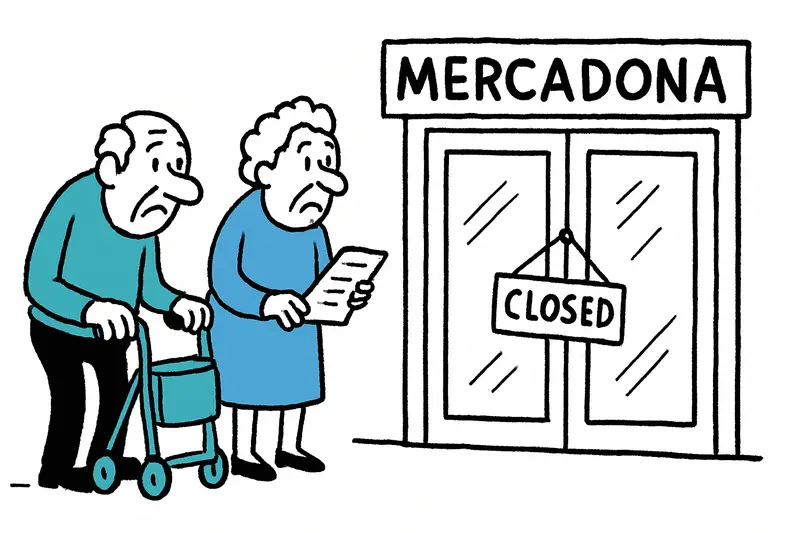
An everyday scenario: an elderly couple from one of the low apartment blocks along the promenade stands in front of closed doors in the morning, shopping list in hand. Until now they needed ten minutes to reach the Mercadona in S'Arenal Park — with a walker or a small trolley. Now they would have to change two bus lines or call an expensive taxi. The shopping-centre's marble floor still echoes with the rattle of trolleys; at the exit the sun sometimes strikes lower and hotter than on the way home.
The sober analysis puts clear facts on the table: a closure reduces supply and raises costs for certain groups. The city administration and the chamber of commerce have room for action here that is often not used. Farmers and small traders in the area also feel the shift — supply chains change, pedestrian flows divert to other shopping streets.
What is missing: concrete transitional solutions. Public authorities could broker short-term measures instead of watching helplessly. The following measures would be pragmatic and quick to implement:
Concrete proposals:
1. Joint interim solution: the municipality mediates a pop-up supplier or extends leases on vacant retail spaces until a permanent tenant is found.
2. Mobility support for people with limited mobility: a municipal shuttle service two days a week to a larger supermarket or agreed special rides at a social fare.
3. Cooperation with delivery services: agreements between the municipality and delivery platforms to secure fixed delivery windows with reduced fees for older households.
4. Strengthening neighbourhood models: support for shopping cooperatives, neighbourhood shuttle groups or organised shared orders — this reduces individual trips and keeps money in the community.
5. Incentives for new providers: short-term rent reductions or tax breaks for food retailers that settle in critical districts.
These proposals are not theoretical: in smaller island municipalities flexible delivery windows, neighbourhood initiatives and temporary markets have already filled gaps. What is needed now, in the coming weeks, is someone with a sense of responsibility to coordinate the options and not leave those affected alone.
The conclusion is stark: the closure of the Mercadona in S'Arenal Park is more than a corporate economic decision. In El Arenal it hits those who count every euro and every step. If administration, retailers and the neighbourhood do not work together, a supply gap will remain — and the island will once again show how much everyday security depends on the market. A simple "Closed" sign in front of a supermarket door must not mean the end of local provision.
Those who act now can ease the hardship: with pragmatic, locally coordinated solutions that do not sound like a lot of paperwork but like clear timetables, agreed delivery windows and an eye for the people who live here — not just for those who come and go.
Frequently asked questions
What happens to groceries for seniors in El Arenal after the Mercadona at S'Arenal Park closes?
Why is the S’Arenal Park Mercadona closing, and what pattern does that reflect across Mallorca?
What practical measures could help residents during the transition after the Mercadona closure in El Arenal?
How can local authorities and traders collaborate to avoid a supply gap in El Arenal?
What are the broader implications of a supermarket closure for Mallorca’s coastal towns?
What should travelers know about shopping and transport in Mallorca during the off-season?
How might the closure affect mobility for people without cars in El Arenal?
Are there examples from other Mallorca towns where interim markets or delivery windows helped during closures?
Similar News

Was it murder or a tragic accident? The unanswered questions after the discovery of a body in El Arenal
A foreign man was found covered in blood in an apartment in El Arenal on Sunday evening. The Guardia Civil has launched ...

From the Limelight to the Reception: Robert Hazzan and the Short Foray into Cala d'Or's Hotel Business
A media-savvy entrepreneur took over a hotel in Cala d'Or for the summer—without industry experience. Why that raises mo...
Reality Check: Fast Food in Majorca — Why the Fryer Wins and What We Could Do
A health survey shows: fast food is eaten more often in the Balearic Islands. Key question: Why do pizza and burgers rep...

Who counts us? Mobile phone data, cruise tourists and the question of transparency
The tourism agency wants to use anonymized mobile phone data to find out where cruise passengers flow on Mallorca. A sob...
How serious are the threats from "Blocus Mallorca"? A reality check from Palma
A call, a provocative poster, the mention of "terror" — and a city securing its shop windows. What is behind the escalat...
More to explore
Discover more interesting content

Can Cap de Bou

Townhouse Lleo 72
