
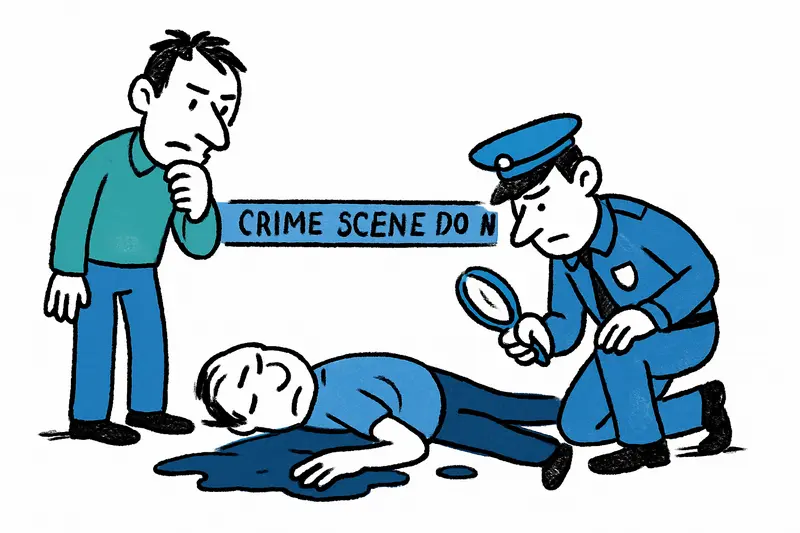
Was it murder or a tragic accident? The unanswered questions after the discovery of a body in El Arenal
A foreign man was found covered in blood in an apartment in El Arenal on Sunday evening. The Guardia Civil has launched an investigation. The autopsy in Palma should provide clarity. What remains unclear so far — and how could such cases be better prevented in the future?
Was it murder or a tragic accident? The unanswered questions after the discovery of a body in El Arenal
A man was found dead on Sunday evening in an apartment on Antoni María Alcover. The Guardia Civil is investigating.
Late on Sunday evening, around 10:40 p.m., several patrol cars from the Llucmajor local police and the Guardia Civil, together with forensic teams, responded to an apartment on Antoni María Alcover street in El Arenal. A relative had alerted the emergency services after not having heard from the man for several hours. Inside, the man was found lying on the floor, surrounded by blood, but there were initially no externally visible injuries. The body was transferred to the Institut de Medicina Legal in Palma; an autopsy is expected to provide clarity.
Key question: Was it murder — or is there another explanation for the blood? This question has shaped the discussion in the neighborhood and among investigators since that evening.
The facts are scarce, which is not unusual in the first hours of an investigation into a death. Blocked streets, flashing blue lights and neighbours peering out from bars: anyone in El Arenal will recognize the scene. The situation looks different in the early evening than it does during the day: the last buses rush by, the smell of fried fish drifts from a tapas bar, a cleaning crew sweeps the pavement — and suddenly a crime scene with barrier tape in the middle of it all. Such contrasts make the case even more puzzling. Similar unresolved deaths have been reported nearby, for example Mystery at the finca near Llucmajor.
A critical assessment requires examining all possible explanations. A pool of blood without outward injuries can point to internal bleeding, for example from a ruptured vessel, a stroke with subsequent injury to the head or mouth, a severe medical crisis, or consequences of drug misuse. It is also possible that injuries were initially overlooked because they were hidden or only became apparent later. The autopsy, including toxicological screening and detailed forensic examination, is decisive here.
What is missing in public discourse so far is information about the daily lives of people who live in or are temporarily housed in the party districts. These are often foreign guests or seasonal workers who are poorly integrated, face language barriers, and whose health or social status is not regularly checked. There is also often a lack of transparency about short-term rentals and who is responsible as a contact person for elderly or isolated residents in an emergency. Related concerns were raised after the Suspected Contract Killing in s'Arenal incident.
Another blind spot is the speed of information flow between emergency services, police and forensic medicine. When residents or relatives later learn that someone has died, it often remains unclear what steps were taken and why autopsy results take time. This uncertainty fuels rumours — in the neighborhood as well as on social networks. Cases such as Body in Es Carnatge: Investigations After Discovery on the Shore illustrate public confusion.
From everyday experience, practical measures can be proposed: the municipality could set up an anonymous hotline for reporting concerns about isolated residents, and tourist information offices should point out emergency contacts. Landlords and property managers could be obliged to maintain an emergency contact list and to hand out simple first-aid information. Health services could run targeted information campaigns in popular party areas: more prevention materials on overdoses, alcohol poisoning and first aid in multiple languages.
On the police side, standardized and prompt communication about the type of examinations and clear statements about what results can be expected would help reduce speculation. Forensic medicine need not publish every detail, but it should at least make the timeline of investigations transparent.
Conclusion: It is still unclear whether the discovery in El Arenal points to a crime or a medical tragedy. The autopsy in Palma will provide key findings. For the island, however, another lasting question remains: how do we better protect people who live in or are housed in tourist districts from being lost in the shadow of the party nights? A bit more neighbourhood organisation, better information channels and low-threshold ways to call for help could in future help resolve such cases more quickly and perhaps even prevent them. Discussions about decaying spaces and responsibility link to stories like Corpse found in Alcúdia disco ruin: Who is responsible for decaying places?.
Frequently asked questions
What actually happens when a death is discovered in a Mallorca party district like El Arenal?
How do investigators determine whether a death is a crime or a medical incident in Mallorca?
Why can autopsy results take time after a death reported in Palma?
How can the public stay informed during a death investigation in Mallorca?
What practical steps could Mallorca take to protect isolated residents in tourist areas?
What role do landlords play in safety and emergency planning in Mallorca?
What should visitors know to stay safe while enjoying Mallorca's party areas?
Which authorities coordinate in Mallorca when a death is suspected to be more than a medical incident?
Similar News
El Arenal loses Mercadona — who will be left behind?
The Mercadona in the S'Arenal Park shopping centre closes in mid-November. Older residents, people with limited mobility...

From the Limelight to the Reception: Robert Hazzan and the Short Foray into Cala d'Or's Hotel Business
A media-savvy entrepreneur took over a hotel in Cala d'Or for the summer—without industry experience. Why that raises mo...
Reality Check: Fast Food in Majorca — Why the Fryer Wins and What We Could Do
A health survey shows: fast food is eaten more often in the Balearic Islands. Key question: Why do pizza and burgers rep...

Who counts us? Mobile phone data, cruise tourists and the question of transparency
The tourism agency wants to use anonymized mobile phone data to find out where cruise passengers flow on Mallorca. A sob...
How serious are the threats from "Blocus Mallorca"? A reality check from Palma
A call, a provocative poster, the mention of "terror" — and a city securing its shop windows. What is behind the escalat...
More to explore
Discover more interesting content

Can Cap de Bou

Townhouse Lleo 72
