
Emergency Departments in Mallorca at the Limit: How Long Will Patients' Patience Last?
Emergency Departments in Mallorca at the Limit: How Long Will Patients' Patience Last?
Waiting times up to eight hours, IB‑Salut reports an average of 3.5 hours: emergency departments, above all Son Espases, are overloaded. A reality check on causes, gaps in the discourse and concrete solutions.
Emergency Departments in Mallorca at the Limit: How Long Will Patients' Patience Last?
Clear Guiding Question
How much waiting time is still acceptable before public healthcare in Mallorca begins to crumble?
Critical Analysis
In recent days the island's emergency departments have been visibly overloaded. Patients report that at Son Espases they have to spend up to eight hours with a waiting number and on chairs. The Balearic health authority IB‑Salut confirms a significantly higher burden, but offers a different perspective: on average the waiting time is about three and a half hours. Both statements fit together when one considers that averages do not capture peaks. A single patient who waits eight hours counts just as much as one who is seen after one hour — the average says nothing about extreme suffering or individual cases.
The cause, as far as it can be reconstructed from local information, is many respiratory infections that have flooded emergency departments since the start of the season. Such infection waves are regular, but in combination with staff shortages and limited bed capacity bottlenecks emerge. IB‑Salut has reacted: additional beds were provided at central hospitals and temporary staff were hired, as reported in At the Limit in Son Espases: Operations on Standby — How the System Can Breathe Again. That alleviates the situation but does not compensate for structural understaffing.
What Is Missing in the Public Debate
The public debate focuses largely on numbers: waiting times, additional beds, temporary positions. That is important but incomplete. Serious discussions are missing about causes on several levels: How are outpatient care and general practitioners positioned to keep cases out of emergency departments, especially when appointments are hard to book as shown in Hospital hotline crippled: Why appointment scheduling on the Balearic Islands is failing? How does triage work during peak loads — who decides which cases are prioritized? And: what role do preventive services (e.g. mobile vaccination or infection clinics) play in the months when respiratory infections increase?
Moreover, the perspective of staff often remains invisible. Nurses and doctors report daily increased stress, overtime and moral strain because they cannot treat patients within the usual time. This leads to a demoralized workforce, constant time pressure and a higher risk of errors — a topic rarely discussed in depth in public debate.
An Everyday Scene from Palma
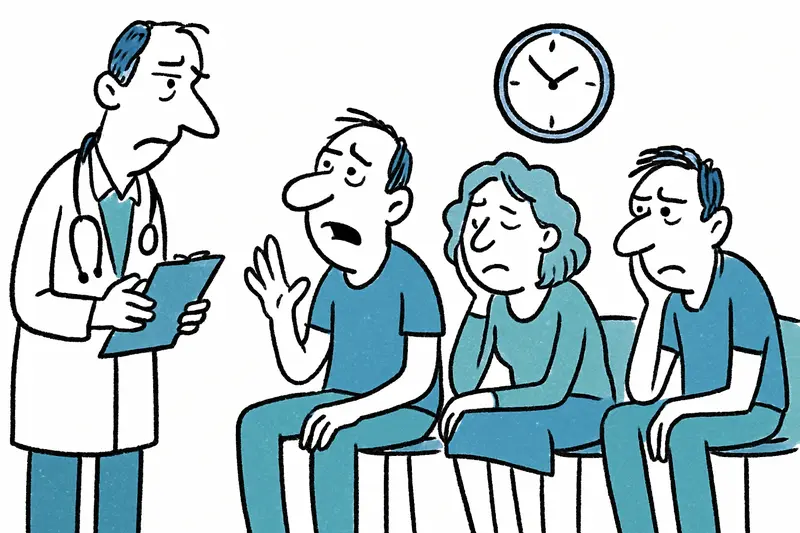
I was on site yesterday afternoon: in front of the entrance to Son Espases families with children were standing, an elderly woman held a thermos of coffee in her hand, young parents moved in slow motion between nappies and worry. The information board blinked sluggishly, people sat on plastic chairs, some phoned nervously, others closed their eyes. An ambulance drove away in front of the building, a paramedic stacked blankets in the trunk, echoing broader issues with patient transport discussed in Ambulances in Mallorca: Temporary measures in December — a question of driving licenses. Such images stick — and they express the discrepancy between statistics and lived experience.
Concrete Approaches to Solutions
Some measures could show short‑term and medium‑ to long‑term effects:
1) Strengthened primary care outside emergency departments: Low‑threshold contact points with extended opening hours and a focus on infectious diseases could pick up simple cases. Collaborations between GPs and hospitals should be expanded and made more visible.
2) Flexible staffing pools: Instead of relying solely on temporary hires, a regionally organized pool of professionals that can be deployed quickly in peak times would be sensible. That requires planning, incentives and fair working conditions.
3) Transparent triage and communication: A clear, publicly accessible triage system helps manage expectations. Anyone arriving in Palma should know how priorities are set and why some cases are seen faster.
4) Prevention and education: Especially with respiratory infections, information campaigns, vaccination offers and simple hygiene measures can reduce emergency visits. Schools, pharmacies and local media are important partners.
5) Data‑driven management: Real‑time data on occupancy, staffing and case numbers could help steer resources more proactively. A digital dashboard for control centers and clinics would not be a luxury.
Why This Matters
Waiting times are not only a question of patience. They are an indicator of the resilience of our healthcare system. When people with acute complaints wait for hours, the risk of complications increases, the burden on relatives grows, and trust in care declines. For an island that relies on dependable basic care in winter, this is a serious warning sign.
Concise Conclusion
The current images from Son Espases and other emergency departments show: adding beds or recruiting temporary staff is not enough. Mallorca needs a networked response — strengthen outpatient primary care, plan staffing regionally, improve communication and act preventively. Those who now only apply short‑term fixes will face the same situation with the next infection wave.
The guiding question remains: do we want to keep merely easing symptoms — or change the care structure so that emergency departments are relieved and people receive timely help again?
Frequently asked questions
Why are emergency departments in Mallorca so crowded right now?
How long do patients wait in Mallorca emergency departments?
Is it still worth going to Son Espases in Palma if the emergency room is full?
What causes long emergency room waits in Mallorca during winter?
What can hospitals in Mallorca do to reduce emergency department pressure?
What should I do in Mallorca if I need medical help but it is not an emergency?
Are long waits in Mallorca emergency rooms a risk for patients?
What does the situation at Mallorca hospitals say about the health system?
Similar News
Palma Gets a Welcoming Park: Tirador Goes Greener — and a Café Is Coming
A new green project in Es Fortí/Camí de Jesús will transform the old Voltadora into a city park with an experience fores...
Why the End of "Los Últimos Mohicanos" Is More Than the Closing of a Bar
With squealing tires and one last glass, an icon on the Palma–Manacor expressway closes. Why the demise of this German b...
Protest camp on Plaza España: Who asks for solutions to the right to housing?
Around 30 activists set up a tent camp on Palma's Plaza España to push for stronger tenant rights. Our analysis asks: Ar...
In the Name of a Gang: Alleged Extortion in El Molinar and What It Reveals About the Protection of Sex Workers
A man is accused of posing as a member of the Hells Angels and extorting two women at accommodation in El Molinar. The s...

When Chile Meets the Mediterranean: A New Flavor at Can Bordoy
At Can Bordoy in Palma's old town, Chilean chef Jhonatan Maldonado combines Patagonian seafood with Mediterranean island...
More to explore
Discover more interesting content

Can Cap de Bou

Townhouse Lleo 72
