
Endangered Balearic Lizards: Why Mallorca Is Only Part of the Story
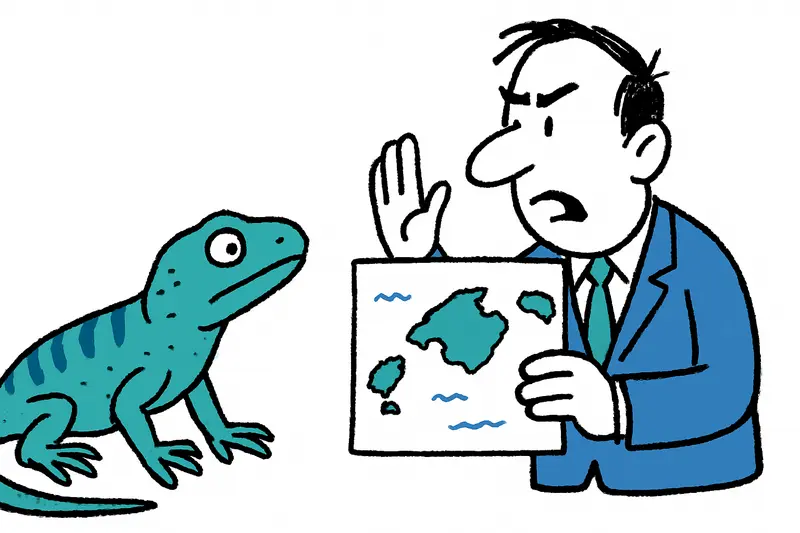
When discussing endangered lizards in the Balearic Islands, it is worth taking a closer look at the map: endemic species live mainly on other islands and small rocky islets. Mallorca can also help protect them.
A lizard on the garden wall is not automatically a rare island species
A shadow darts across the warm wall, then disappears behind a flowerpot. This is part of everyday life on Mallorca’s terraces. Most often, it is a gecko catching insects among the cracks and plants. But this familiar scene is only the starting point for the story of the Balearic lizards—and sometimes it leads in the wrong direction.
The names sound as though the subject has a direct connection to Mallorca’s gardens: Balearic lizard, Ibiza wall lizard. In reality, their ranges differ. The Ibiza wall lizard lives on Ibiza, Formentera and the surrounding islets. Today, the Balearic lizard is found mainly on smaller islands and rocky islets; it has disappeared from the main islands. This does not make these species any less part of the Balearic Islands’ natural heritage. But it does mean that describing them all broadly as “Mallorca’s lizards” blurs an important geographical distinction.
How introduced snakes change things
On islands, a new predator can have a particularly serious impact. Native animals have evolved over a long time in a limited habitat; additional predators can quickly put small populations under pressure. On the Pityusic Islands, introduced snakes are considered a serious threat to the local lizard populations. These animals cannot cross the sea under their own power. But they can arrive on an island unnoticed among goods, plants or other transported materials.
That is why the issue is not confined to the countryside. It also concerns the routes used to move plants and materials between the mainland and the islands, and how quickly a new species is detected. A snake in a garden is not automatically evidence of an invasive species. Even so, trying to catch or kill it yourself is not a good idea: it could put people at risk, harm native animals and make identification more difficult. Keeping your distance and notifying the relevant authority is the more sensible step.
What can get lost in the debate
Conservation status and warnings matter, but they do not solve the practical problem by themselves. On a small island, it matters whether populations are monitored regularly, whether new snakes are detected early and whether conservation measures receive funding over several years. The origin and inspection of transported goods belong in the same discussion. If an animal is not noticed until after it has spread, the work becomes much more difficult.
It is just as important to distinguish between species and their habitats. A measure that makes sense on an inhabited main island will not necessarily work on an uninhabited rocky islet. One population may depend on a refuge, while another needs newly introduced predators to be controlled. Talking only about “the lizards of the Balearic Islands” creates a neat catch-all category—but not a useful conservation plan.
And what about Mallorca? The island is not merely a bystander just because the two species mentioned are found mainly elsewhere. Plants are delivered here, gardens are tended and wildlife is observed. Keeping a watchful eye out can help people report unusual sightings early. At the same time, no one should assume that every small lizard by the house is an endangered endemic species. That very confusion can create false expectations and, in the worst case, lead to unnecessary intervention.
What actually helps in everyday life
When buying plants or larger trees and shrubs, you can check that their origin is traceable and that they have been transported carefully. Do not carelessly take soil, root balls or packaging into natural habitats. If you see an unusual snake, do not touch or pursue it. If possible, take a photo from a safe distance and report the location to the relevant environmental or wildlife authority. It is not a heroic act, just useful information.
A garden does not have to be sterile, either. Using fewer insecticides, providing some cover and planting native species can make it more welcoming to wildlife. This will not save an isolated lizard population on an island near Ibiza. But it can help avoid putting additional pressure on wildlife in general—and make your own terrace less like a brightly lit, bare stone slab in the process.
Conservation starts before the next sighting
So the useful question is not only whether a species ranks near the top of a list. It is also: Who monitors the affected islands? How are transport routes checked? And how quickly can experts respond? This requires reliable monitoring, clear reporting channels and long-term work on the ground. The public also needs clear information that accurately distinguishes between species and islands.
On Mallorca, people will continue to see geckos on walls, perhaps right beside the terrace door. They are a small part of everyday nature, not automatically a conservation emergency. Some of the endangered island lizards live far away. That is precisely why it is important to look closely: conservation works better when a dramatic headline becomes a precise map—and concern becomes a reliable report, before the next stowaway arrives.
Frequently asked questions
What small lizards are commonly seen on Mallorca terraces?
Are endangered Balearic lizards found on Mallorca?
Where does the Ibiza wall lizard live?
What should I do if I see a snake in my Mallorca garden?
How can snakes reach small islands in the Balearics?
How can I make my Mallorca garden more welcoming to wildlife?
What should I check before buying plants for my Mallorca garden?
Why does the exact island matter when protecting Balearic lizards?
Similar News
Mallorca in Late Autumn: When the Northwesterly Wind Turns the Day Upside Down
Thursday will be cool, gusty and occasionally wet on Mallorca. After a windy day, the weather is expected to settle down...

A Red Smile with Staying Power: TUI Brand Turns 25
Since 2001, the TUI logo has linked the different divisions of the travel group. On Mallorca, it now represents a brand ...
Tanker Sinks off Ibiza: Alert Level 2 Is a Precaution, Not an All-Clear
A cargo ship has sunk about 25 nautical miles off Ibiza. Spain is reinforcing its response teams over the risk of diesel...

Palma’s Shared-Room Prices Are Rising: When Even a Room Becomes a Housing Issue
A room in Palma costs an average of €586 a month. The figures show more than rising rents: supply is struggling to keep ...

Tanker Sinks off Ibiza: What Matters Now Is Reliable Clarity
The sinking of a tanker off Ibiza raises questions that reach far beyond the site of the accident. What matters now is v...
More to explore
Discover more interesting content

Can Cap de Bou

Townhouse Lleo 72
