
Everything for the Perfect Picture: Palma Between the Post Office and the Promenade
Everything for the Perfect Picture: Palma Between the Post Office and the Promenade
Selfie tourism is changing Palma: squares like Passeig d’es Born or the cathedral become backdrops. Who benefits — and who bears the consequences? A critical look with concrete, everyday solutions from city life.
Everything for the Perfect Picture: Palma Between the Post Office and the Paseo Marítimo
Those chasing the snapshot put the city at risk — an assessment and recommendations for action
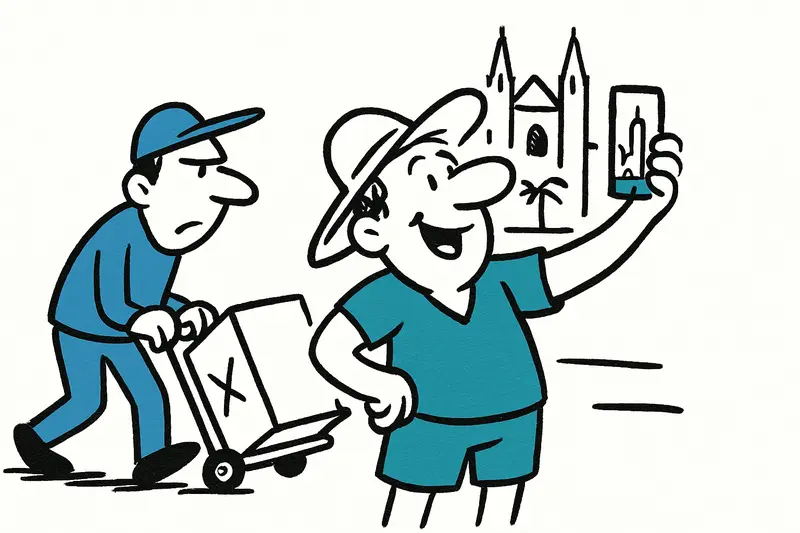
If you walk through Palma in the morning you know the scene: in the heat of June the ice clinks in the café on Passeig d’es Born, the cathedral bells toll on the hour, and between tourists, delivery apps and delivery scooters people line up in front of a brightly decorated ice-cream counter to take that one photo. This is no longer a private hobby; it has become part of an economic cycle that turns squares into stage sets.
Key question: Is Palma becoming a pure photo backdrop — and what remains of the city for those who live here? This question is not a stylistic gripe for cultural pessimists but a practical issue with consequences for traffic, commerce, peace and the public image of the island capital.
Selfie tourism is not a phenomenon confined to the harbor or the cathedral. Places like San Miguel, Plaza de la Reina, S’Hort del Rei, La Lonja, Plaza del Mercat and Santa Catalina keep appearing in social media feeds. They function as geo-tagged brands: one image, one hashtag, and the next visitor appears. For cafés and small shops that brings visibility; for residents it means tangible disadvantages: blocked steps, noisy groups, litter in previously quiet spots.
Critical analysis: Behind the trend lies a simple economy. Platforms reward visibility, service providers adapt their offerings, and destinations benefit in the short term from visitor numbers. But in the long run external effects arise that no one fully accounts for: wear on public spaces, increasing stress for residents, displacement of everyday scenes by staged moments. There is a lack of reliable data that balances the revenues and costs of this form of tourism locally — where does promotion end and urban wear-and-tear begin?
In public debate typically only the perspective of photo-seekers or business owners is visible. What is missing: the viewpoint of the people who live and work here. The voices of delivery drivers, kindergarten staff, seniors who depend on quiet are hardly heard. Equally rare are concrete figures about short visits versus longer stays, about street damage, public order disturbances or concrete revenues of local shops from classic sales compared to pure social-media-driven promotion.
A concrete everyday example: on a Tuesday noon two groups stand on the steps in front of the cathedral and block the glass front of a small bookshop. A delivery person needs five extra minutes to reach the ramp, the shop owner misses a sales conversation — not dramatic, but symptomatic. Such micro-obstructions add up; they are unspectacular, but bought and sold every day in the form of likes.
What can be done? There are several concrete solutions that work without heavy ideology:
1) Distributed attractiveness: City tourism promotion should intentionally advertise lesser-known neighborhoods and city-approved photo spots so visitor flows can spread out. Small, professional maps for "photo walks" could help.
2) Rules for commercial shoots: Paid photo sessions or elaborate shoots could require simple permits — this creates revenue and provides clear time windows in which residents are not disturbed.
3) Time windows and minimum distances: Popular steps and squares can be subject to time restrictions for large groups, tripods or professional equipment. This leaves room for everyday life between staged moments.
4) Quality over quantity: Promote experiences that engage visitors for longer — for example small workshops in markets or guided walks with local participants — instead of pure photo spots. This distributes income more fairly.
5) Transparent data and participation: Surveys on visitor numbers, lengths of stay and local revenue should be made publicly available. Resident participation in such analyses increases acceptance of measures.
For example, in the square in front of La Lonja one could designate a marked zone for short individual photos, alongside a sign with alternative locations and a short explanation: why consideration matters. Such small interventions seem banal but show respect for urban everyday life.
What else is missing? A discussion about responsibilities: tourism authorities, platform operators, tour operators, but also local businesses and consumers share responsibility. Platforms could show clearer notices about considerate behavior, organizers could hand out UNWTO Global Code of Ethics for Tourism, and shop owners could offer fixed photo times instead of spontaneous stagings.
Conclusion: Palma is more than a sequence of images. The city has a soul made of everyday life — delivery vans on Calle Sant Miquel, children on their way to school in Santa Catalina, the chatter at Mercat de l'Olivar — which is under pressure from the omnipresence of selfie tourism. Small, pragmatic rules, better data and a little consideration could prevent Palma from becoming a static backdrop. If we want to avoid that outcome, we must answer the question: For whom is the city — for the quick click or for shared life?
Frequently asked questions
Is Palma becoming too crowded with selfie tourism?
Which parts of Palma are most affected by photo tourism?
What can visitors do in Palma to be more considerate when taking photos?
Are there rules for commercial photo shoots in Palma?
How can Palma reduce crowding around popular squares and steps?
Why is La Lonja such a popular photo spot in Palma?
What does photo tourism mean for local shops in Palma?
What kind of experiences in Palma are better than just chasing photo spots?
Similar News
Nine-year-old rescued after cliff fall at Cala Murada — How safe are Mallorca's coastal paths?
A boy fell roughly five meters down the rocks near Cala Murada. The dusk rescue was elaborate; a helper also had to be r...

How safe are tourists in the luxury marinas? After arrests: a reality check
The Guardia Civil arrested two men in Calvià who are suspected of stealing luxury watches in Port d'Andratx and Puerto P...
Palma Chases Wealthy US Tourists — The Key Question: Who Should the City Actually Serve?
The city is investing more than €200,000 to attract high-paying visitors in several US cities. A good idea — but what is...

Enough swimming: Why Port de Pollenca is louder than the sea
More than 200 people formed a human chain in Port de Pollenca — not only as a protest but as a wake-up call. Guiding que...
Mysterious disappearance in Alcúdia: Where is 24-year-old Lisa B.?
Since August 3 there has been no trace of 24-year-old German Lisa B. The family has traveled to Mallorca and urgently re...
More to explore
Discover more interesting content

Boat Tour with BBQ along Es Trenc Beach

Private transfer from Mallorca Airport (PMI) to Pollensa
