
Fatal Accident on the Ma-19 at Es Molinar — How Safe Are the Access Roads to the Airport?
Fatal Accident on the Ma-19 at Es Molinar — How Safe Are the Access Roads to the Airport?
In an early-morning accident on the Ma-19 near Es Molinar, a 61-year-old motorcyclist lost his life. What does this incident reveal about the safety of the bridges and access routes around the airport?
Fatal Accident on the Ma-19 at Es Molinar — How Safe Are the Access Roads to the Airport?
Key question: What weaknesses in traffic management and in the protection of motorcyclists does the accident on the Ma-19 reveal, and which concrete short- and medium-term measures can save lives?
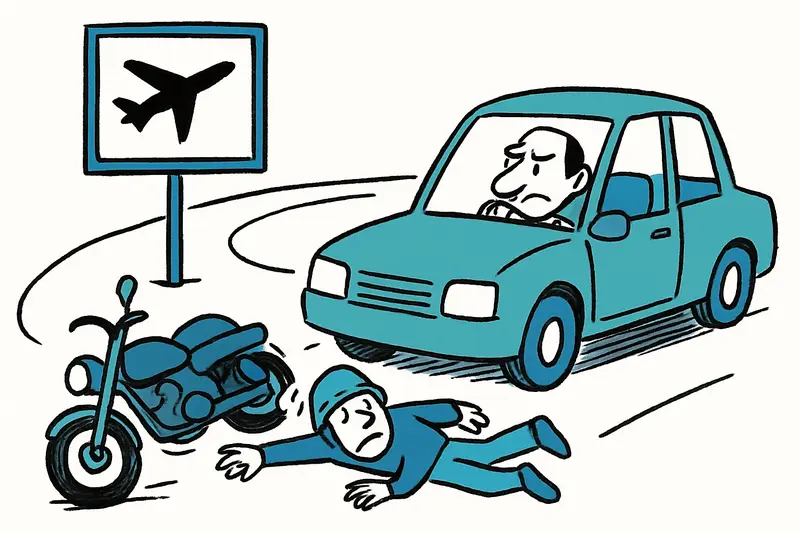
Early in the morning, shortly after seven, the usually busy access road to the airport was once again a place where everything happened too late. According to published information, a 61-year-old motorcyclist left the inner lane at the Es Molinar roundabout and collided with a car in the outer lane. Because of the force of the impact he fell down onto the airport highway below. Help arrived too late for the man. Recovery operations led to lane closures and long traffic jams on the Ma-19, an episode described in Chaotic day on the Ma-19: How safe is the airport motorway really?.
Critical analysis: The accident illustrates a typical risk in stacked traffic structures: vehicles on different levels and lanes are in close spatial relation, sight lines are restricted, and reaction time is short. Motorcyclists are particularly vulnerable in such collisions. Important questions remain open because reports so far are sparse: Were the markings and signage at the exit clear? Were there visibility obstructions or lane narrowings? How are the guardrails under the bridge designed, and could they have prevented the fall?
Public discourse tends to quickly look for blame after such events — at the rider, the vehicle, or the weather, as happened in MA-19 at Night: Why Was a Pedestrian on the Airport Access Road?. What is often missing is a sober look at the infrastructure: How well are transitions between the roundabout and the highway separated by physical barriers? Are road markings and surfaces at critical junctions regularly checked? And what about data collection — reliable accident statistics for this exact location are often absent from the broader debate.
What is overlooked in the discussion: The daily routine of many commuters on the Ma-19. People from Palma, airport employees, bus drivers and delivery drivers share this lifeline in the morning hours. In these moments you see cyclists at the road edge, taxis cutting in abruptly, and delivery vans scraping past each other. These small, recurring hazards form the backdrop for serious accidents but are rarely addressed directly, as seen in Pile-up at Es Molinar: Small mistake, big traffic jams — and what needs to be done.
An everyday scene: At the Es Molinar roundabout it often smells of fresh pastries from a nearby bakery in the early hours, the first buses stop at the bus stop, and delivery vans pause briefly before taking the airport access road. On a normal workday the Ma-19 hums like a well-timed clockwork — on days like today that hum stops abruptly and turns into a question: How can the clockwork be repaired before it breaks again?
Concrete proposals for solutions:
1) Short term: Increase visibility and orientation — conspicuous road markings, additional reflectors on lane edges, clearer signage before the roundabout, and temporary reduction of the speed limit during morning peak hours. These measures can be implemented quickly and are relatively low-cost.
2) Medium term: Improve physical separation — additional protective barriers at the edges of the bridge, reinforced guardrails that could prevent vehicles from sliding down onto the road below, and inspections of drainage and pavement to reduce aquaplaning or skidding risks.
3) Data and control: Installation of cameras and automatic incident recording at critical junctions, coupled with targeted traffic monitoring during peak times, a measure recommended after incidents such as Fatality on the MA-19 near Palma: How did a pedestrian get onto the highway?. Reliable data help prioritize problem areas and plan focused safety campaigns for drivers and motorcyclists.
4) Awareness: Prevention work in cooperation with motorcycle clubs, driving schools and companies around the airport. Practical workshops and reminder campaigns — for example about maintaining safe distances when changing lanes at roundabouts — can change everyday driving behavior.
A concise conclusion: The tragic death of a person on the Ma-19 is more than a single news item; it is an indicator of structural risks at bridges and access points. Technical improvements, better signage and controlled traffic management would not only increase the feeling of safety but would concretely save lives. Politicians must not stop at lip service. It is time for visible measures where people rush in the morning and small mistakes can have fatal consequences.
Our thoughts are with the relatives of the deceased. And to everyone who will use the Ma-19 tomorrow: one extra moment of careful observation can make a difference.
Frequently asked questions
How safe is the Ma-19 access road to Mallorca Airport?
Why are motorcyclists especially vulnerable on Mallorca’s Ma-19?
What makes the Es Molinar roundabout on Mallorca’s Ma-19 a traffic risk?
What safety improvements could help reduce accidents on Mallorca’s Ma-19?
When is traffic on the Ma-19 in Mallorca usually heaviest?
What should drivers watch out for when using Mallorca Airport access roads?
What can Mallorca drivers do to stay safer on busy roundabouts?
Are there reliable accident statistics for the Ma-19 near Es Molinar in Mallorca?
Similar News

More water than last year: Mallorca's reservoirs breathe easier
September rain refilled the Tramuntana's reserves: overall fill around 35 percent, Cúber at 40.42 percent, Gorg Blau at ...

Three Luxury Hotels in Banyalbufar: Lots of Money, Many Questions
A Danish investor plans three exclusive accommodations in Banyalbufar — including the historic Son Valentí. The announce...
2.1 tonnes of cocaine on sailing yacht off Spain's coast – a reality check for the coastguard
A 14-metre yacht was seized with 2.1 tonnes of cocaine. Who monitors the ports, how does the international hunt succeed ...

Heat Bonus in Mallorca: 100 Euros Extra for Outdoor Staff at MarSenses
MarSenses pays employees who worked outdoors in August an extra €100 as recognition. Lighter uniforms, reduced hours for...

Renovating in Mallorca: What You Really Can Do Without Neighbour Consent
Many think they can do whatever they want in their apartment. That's partly true — but only as long as structural elemen...
More to explore
Discover more interesting content

Can Cap de Bou

Townhouse Lleo 72
